
THE SHOOTING WAS JUSTIFIED IN FLORIDA. WHAT IF IT HAPPENED IN MINNESOTA?
- Originally published:
- September 11, 2026
By Jeffrey S. Straub · 9 min read · Minnesota
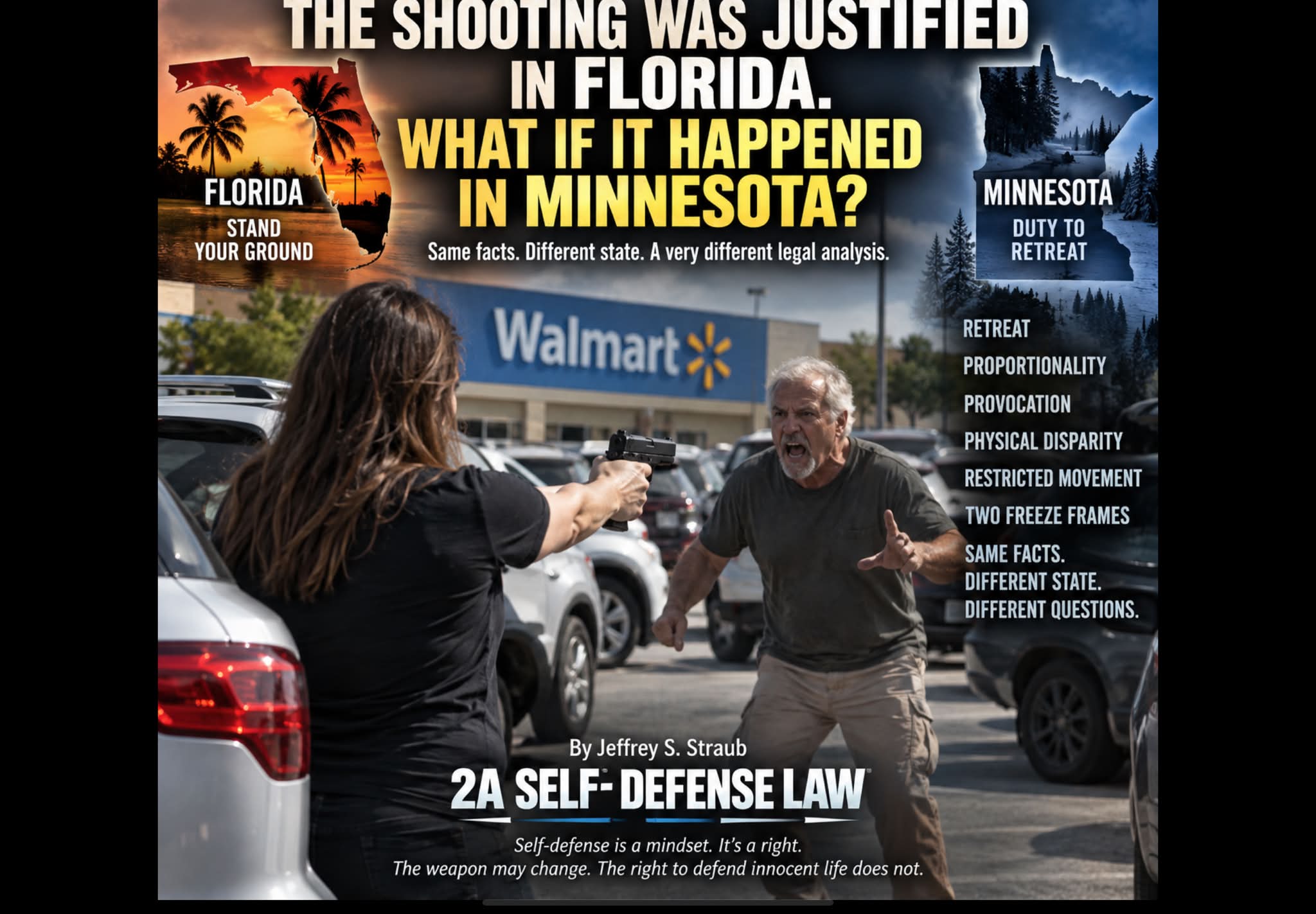
THE SHOOTING WAS JUSTIFIED IN FLORIDA. WHAT IF IT HAPPENED IN MINNESOTA?
By Jeffrey S. Straub
2A Self-Defense Law
Self-defense is a mindset. It’s a right. The weapon may change. The right to defend innocent life does not.
On June 30, 2026, Melissa Payne and 62-year-old Bart DiGuglielmo became involved in a dispute over a parking space at a Walmart in North Lauderdale, Florida. It began with something apparently important enough to eventually leave one person dead: two adults wanting the same rectangle of asphalt. DiGuglielmo eventually left his vehicle and went into Walmart. Payne took the disputed parking space. That could have ended it, but some people simply cannot tolerate feeling offended, challenged or disrespected and walk away. Sometimes restoring wounded pride becomes more important than ending a meaningless confrontation.
According to the Broward County State Attorney’s investigation, witnesses heard DiGuglielmo threaten to damage Payne’s property. He eventually moved his vehicle elsewhere but later approached Payne again. Witnesses described him as visibly angry and shaking. Payne exited her vehicle holding a cellphone in one hand and a handgun in the other. She warned DiGuglielmo not to approach and told him she would shoot if he continued. He initially backed away and then began approaching again.
Payne backed away. DiGuglielmo followed. She continued retreating around parked vehicles, and he continued pursuing her. Eventually he approached Payne’s vehicle with keys in his hand and gestured as though he might damage it. He then turned back toward Payne and approached her again. Payne fired once, striking DiGuglielmo in the abdomen. He later died.
Florida prosecutors ultimately declined to prosecute Payne. Importantly, they did not simply declare that Payne was right. Their memorandum specifically acknowledged that the video did not necessarily demonstrate that. Instead, prosecutors concluded that under Florida law they could not overcome her claim of self-defense immunity by clear and convincing evidence. Florida also imposed no general duty on Payne to retreat, although Payne actually did retreat. That becomes particularly important when we pick up this entire Walmart parking lot, move it roughly 1,500 miles north and drop it in Minnesota.
Minnesota is not Florida. Under Minnesota Statute §609.065, deadly force can be justified when necessary to resist or prevent an offense that the defender reasonably believes exposes herself or another person to death or great bodily harm. Outside the home, Minnesota generally imposes a duty to retreat when the defender can do so in complete safety. In Florida, Payne’s retreat wasn’t legally required, but it was powerful evidence supporting the reasonableness of her actions. In Minnesota, those same backward steps could demonstrate both that her fear was reasonable and that she was attempting to satisfy an actual legal duty.
Then Minnesota gives us State v. Blevins. In 2024, the Minnesota Supreme Court addressed the duty to retreat in connection with assault-fear involving a dangerous weapon. Blevins involved a machete, but its importance for defensive-firearm training is difficult to miss. Before making what we commonly call a defensive display of a firearm, Minnesota may require a person to retreat if that display constitutes assault-fear with a dangerous weapon and retreat can be accomplished in complete safety. The gun doesn’t have to be fired before Minnesota’s retreat doctrine potentially becomes relevant.
That brings us to our first freeze frame. DiGuglielmo is approaching and Payne has exited her vehicle with the handgun. At some point she points it directly at him and warns him not to continue. Nobody has been shot yet. This is also where we need to be careful with the phrase “defensive display.” Calling something defensive doesn’t magically make it lawful. Payne’s pointing of the handgun must itself be justified. Florida’s decision not to prosecute the eventual shooting does not establish that every use or threatened use of force preceding that shooting was independently justified.
Now keep that exact freeze frame and first leave it in Florida. Payne is lawfully present in a public parking lot in a Stand Your Ground state. Florida does not impose a general duty to retreat merely because she might have been able to remain inside her vehicle, drive away or move elsewhere. Assuming the other legal requirements for defensive force are satisfied, her failure to retreat does not by itself defeat her self-defense claim. That does not automatically make pointing the handgun reasonable or proportional, but Florida does not add a separate requirement that she first retreat simply because retreat might have been available.
Now take the identical freeze frame and move it to Minnesota. Same woman, same man, same approaching behavior, same handgun and same vehicle sitting immediately behind her. Suddenly facts that were not independently disqualifying under Florida’s retreat law can become legally significant. Payne voluntarily left what appears to have been a place of relative safety and entered the confrontation while armed. Minnesota can now ask whether she could instead have remained inside the vehicle, driven away or otherwise retreated in complete safety before pointing the handgun. Blevins potentially makes that question relevant before the trigger is ever pulled.
Minnesota also has to consider innocence and proportionality at this first freeze frame. Did Payne’s decision to leave the vehicle and enter the confrontation make her a willing participant in continuing or escalating it? Was pointing a handgun directly at DiGuglielmo a reasonable and proportional response to the threat that existed at that moment? Could she have avoided the entire confrontation in complete safety by remaining where she was? Those are legitimate Minnesota questions, and they demonstrate exactly why moving the same encounter across a state line can change its legal character.
Proportionality deserves particular attention because having a legal right to possess a handgun does not transform every obnoxious person approaching you into a deadly-force threat. DiGuglielmo apparently had no visible conventional weapon. He was also 62 years old. Payne was a woman. None of those facts decides the case by itself. Relative size, strength, age, sex, physical condition, numbers, weapons, mobility, distance and positioning can all affect what a person reasonably perceives. A male aggressor may present a significant physical disparity to a woman, while his age or physical condition could reduce that disparity. Without knowing more about these particular people, declaring the answer based solely upon “man versus woman” or “armed versus unarmed” would be analysis by bumper sticker.
Now let the video continue, because self-defense encounters have the annoying habit of refusing to remain frozen at the moment most convenient for either side’s argument. Payne backs away and DiGuglielmo follows. She creates distance and he eliminates it. She warns him and he continues. He knows she possesses a firearm, and apparently even that doesn’t convince him that perhaps the battle for Walmart parking supremacy has reached its natural conclusion. Payne continues retreating around vehicles while DiGuglielmo continues pursuing her.
Those vehicles matter. Payne doesn’t necessarily have to be literally trapped before restricted movement becomes relevant. A parking lot filled with cars is not an empty football field. Moving between vehicles can restrict lateral movement, visibility and escape routes while someone is closing distance. Whether Payne could retreat in complete safety therefore cannot be answered simply by pointing to additional pavement somewhere behind her and announcing that technically she could have kept walking.
Provocation also matters. If DiGuglielmo’s conduct and reported statements, including his apparent challenge for Payne to shoot him, legally amount to aggression or provocation, that affects the innocence element of self-defense. An aggressor can potentially regain the right to self-defense through a genuine good-faith withdrawal accompanied by the required communication, but that isn’t what our factual sequence shows. Payne is the person retreating while DiGuglielmo continues pursuing her. Whatever theoretical legal escape hatch withdrawal provides an aggressor, one generally has to actually use it.
Eventually DiGuglielmo approaches Payne’s vehicle, gestures with his keys, turns back toward Payne and approaches her again. This gives us our second freeze frame, and the legal picture has materially changed. Payne still must actually and honestly believe she faces imminent death or great bodily harm. That belief must still be objectively reasonable, and the force she uses must be necessary and proportional. Minnesota’s retreat requirement remains important, but now Payne has actually been retreating while DiGuglielmo has continued following her.
This is where proportionality also changes with the circumstances. We aren’t evaluating an angry 62-year-old man merely standing across a parking lot anymore. We are evaluating what Payne reasonably perceived after warnings failed, the display of the firearm failed to end the confrontation, retreat failed to end it, movement around vehicles restricted her options, and DiGuglielmo continued pursuing and ultimately approached again. An apparently unarmed person doesn’t automatically present a threat of death or great bodily harm, but “unarmed” does not mean physically incapable of causing great bodily harm. The totality of the circumstances matters.
Minnesota’s duty to retreat doesn’t mean a defender must continue retreating indefinitely while an aggressor follows wherever she goes. The relevant question is whether retreat can be accomplished in complete safety. If every attempt to create distance is answered by the aggressor closing that distance again, the circumstances can eventually reach a point where retreat no longer provides a safe means of avoiding the danger.
This is where Blevins creates an uncomfortable possibility. Payne’s earlier pointing of the handgun could potentially create a Minnesota legal problem if that conduct constituted assault-fear and she could have retreated in complete safety before doing it. Yet her later actual use of deadly force could potentially become justified after she retreats and DiGuglielmo refuses to allow that retreat to terminate the confrontation.
Think about the incentive that potentially creates. A lawful defensive display can sometimes stop an encounter without anyone being physically harmed. The aggressor recognizes what is happening, decides his wounded pride might survive after all and leaves. Nobody gets shot, nobody dies, and nobody gets introduced to the fascinating hourly rates charged by criminal-defense attorneys.
Yet Blevins potentially requires retreat before that defensive display under circumstances where retreat can be accomplished in complete safety. The defender retreats, the aggressor follows, the defender retreats again, and the aggressor continues closing distance. Eventually retreat may no longer be safely available and the perceived threat may become sufficiently imminent and severe that the law permits something far more consequential than displaying the firearm: actually firing it.
Would Melissa Payne have been justified if this exact incident occurred in Minnesota? There isn’t an intellectually responsible automatic yes or no. Her decision to leave the vehicle and point the handgun could create serious questions involving innocence, proportionality, retreat and Blevins. The final shooting presents a different and potentially much stronger self-defense claim because of everything that occurs afterward, particularly her repeated retreat and DiGuglielmo’s continued pursuit.
That is why the two freeze frames matter. At the first, Payne hasn’t fired, and Minnesota could potentially require retreat before her defensive display while also asking whether pointing the handgun was proportional to the threat. At the second, she has repeatedly retreated, DiGuglielmo has continued pursuing her, her movement has become increasingly restricted, and the entire proportionality and necessity analysis has changed. A justified shooting does not necessarily mean every defensive action preceding it was independently justified, and a questionable decision earlier in an encounter does not necessarily answer whether deadly force became necessary later.
That leaves an uncomfortable question for Minnesota self-defense law: Have we created a rule under which an early defensive display intended to prevent violence can carry greater legal jeopardy than actually firing the weapon later, after retreat has failed and the danger has become sufficiently imminent? Good self-defense law should do more than determine who goes to prison after somebody dies. It should also encourage lawful decisions that, whenever reasonably possible, keep anybody from dying in the first place.
Sponsored by 2A Self-Defense Law
Self-defense is a mindset. It’s a right. The weapon may change. The right to defend innocent life does not.
InnocenceProportionalityReasonablenessMinnesota Case Analysis and Use-of-Force Law
Related articles
Minnesota Case Analysis and Use-of-Force Law
Minnesota's Castle Doctrine: The Statute Says Felony, but the Courts Ask a Harder Question
Minnesota law permits deadly force to prevent certain felonies in the home, but that does not make every felony a license to kill. Learn how the courts interpret necessity, reasonableness, retreat, and the rights of co-residents.
October 20, 2026 · 9 min read
Minnesota Case Analysis and Use-of-Force Law
EZEKA v. STATE: A THREAT IS NOT YET AN IMMINENT THREAT
September 30, 2026 · 3 min read
Minnesota Case Analysis and Use-of-Force Law
STATE v. BAKER: RE-ENGAGEMENT AND THE INNOCENT STANDARD
September 29, 2026 · 7 min read