
Minnesota's Castle Doctrine: The Statute Says Felony, but the Courts Ask a Harder Question
Understanding the two legal justifications, the three-part test, and the limits of defending your home
- Originally published:
- October 20, 2026
- Last modified:
- October 20, 2026
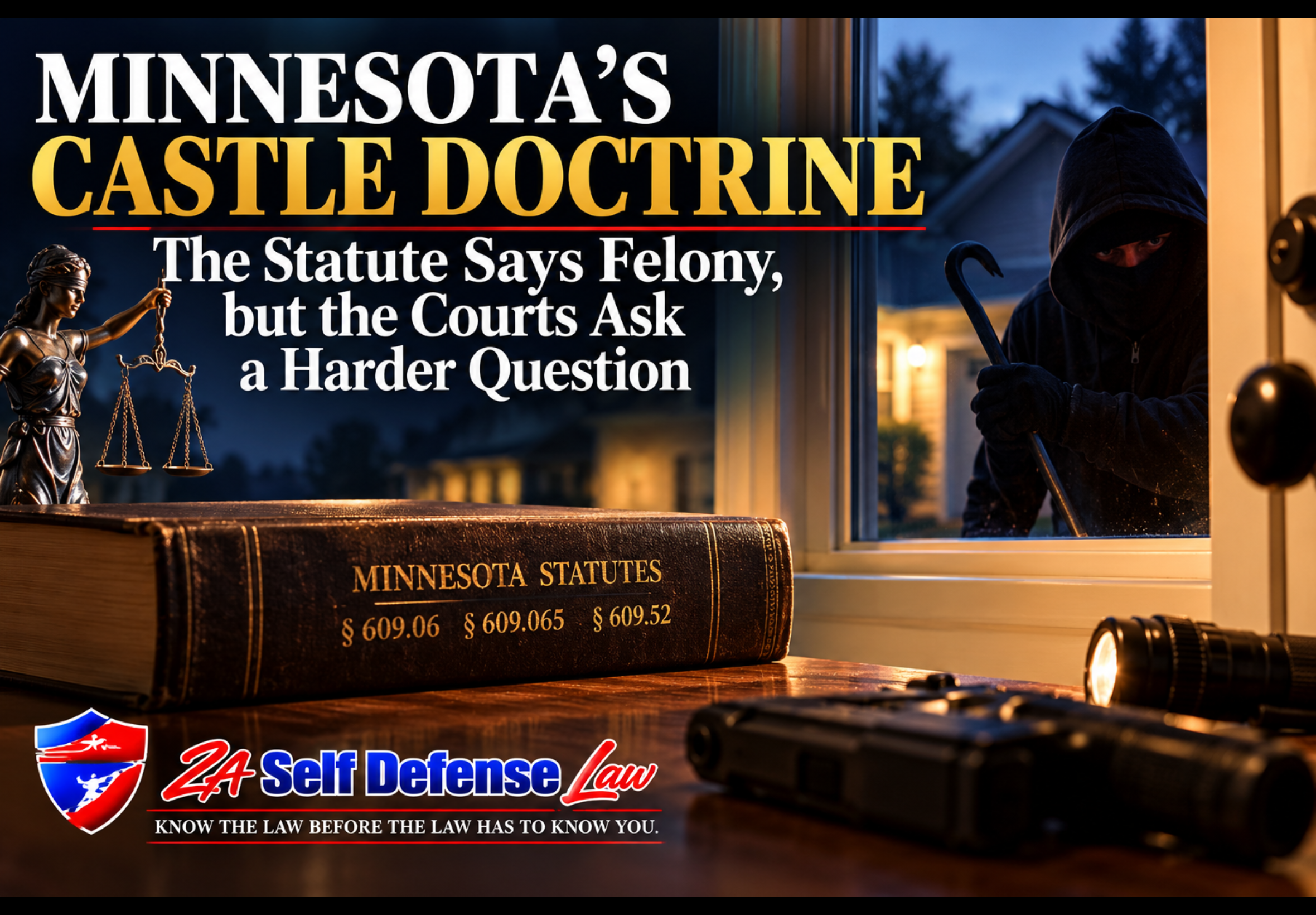
Most gun owners have heard of the Castle Doctrine. The familiar expression suggests that a person's home is their castle, a place where the law recognizes special protections against unlawful intrusion. But ask ten people what Castle Doctrine means, and you may receive ten different answers. Some believe anyone unlawfully entering their home can legally be shot. Others believe they must fear death or great bodily harm before using deadly force, regardless of what felony is being committed. Neither explanation fully captures Minnesota law.
One of the greatest obstacles to learning is the illusion that we already understand something. That principle has guided my approach to teaching self-defense law because the greatest danger is sometimes the student or instructor who knows just enough to be confidently wrong. Minnesota's Castle Doctrine illustrates why understanding the law requires more than memorizing a statute.
The Importance of One Word: OR
Minnesota Statutes § 609.065 provides two alternative justifications for the intentional taking of life. The critical word separating them is OR, not AND.
Under the first provision, deadly force may be justified when necessary to resist or prevent an offense the defender reasonably believes exposes themselves or another person to death or great bodily harm. This familiar self-defense standard can apply inside or outside the home, subject to the applicable legal requirements.
OR, under the second provision, deadly force may be justified when necessary to prevent the commission of a felony in the defender's place of abode. This is Minnesota's independent defense-of-dwelling justification. Unlike the first provision, it does not require a separate reasonable fear of death or great bodily harm.
In State v. Pendleton (1997), the Minnesota Supreme Court confirmed that distinction. Requiring fear of death or great bodily harm under both provisions would effectively erase the independent protection the legislature created.
But the statute does not say every felony justifies deadly force. Sections 609.06 and 609.065 must be read together. Section 609.06 identifies circumstances authorizing reasonable force, including resisting offenses against persons and unlawful interference with property. Section 609.065 establishes additional requirements before force may extend to taking human life.
The legislature wrote felony, not violent felony. Yet identifying a felony is only the beginning of the legal analysis.
The Three-Part Test: How Each Question Builds on the Previous One
In Pendleton and State v. Carothers (1999), the Minnesota Supreme Court explained the framework for evaluating deadly force used to prevent a felony in the dwelling.
First, was the defender acting in the belief that deadly force was necessary to prevent a felony in the dwelling? The defender must be attempting to prevent criminal conduct, not punish someone for conduct already completed.
Second, was the defender's judgment about the gravity of the situation reasonable? This involves more than correctly identifying a felony. The circumstances, the seriousness of the anticipated danger, and the defender's assessment must withstand objective examination.
Third, was using deadly force itself reasonable in light of the danger anticipated? Even when a defender reasonably recognizes a felony and assesses the circumstances, deadly force must independently be justified.
These questions involve subjective belief and objective reasonableness, concepts familiar to students of my Five Pillars of Self-Defense. Subjectively, what did the defender genuinely believe? Objectively, would a reasonable person facing those circumstances have reached a comparable assessment?
Here is how the three questions build on one another. The first examines the defender's purpose in preventing a felony. The second examines whether the defender reasonably assessed the situation and its gravity. The third examines whether deadly force was a reasonable response. A yes to the first does not guarantee a yes to the second, and a yes to the second does not guarantee a yes to the third.
A defender might correctly identify a felony but exaggerate the danger. Another might reasonably perceive serious danger but use force beyond what the circumstances justify. Each requirement must be evaluated because the preceding answer cannot establish the next.
There is also a distinction between producing evidence and proving a defense. A defendant must present sufficient evidence to warrant the applicable justification instruction. Once the defense is properly raised, the prosecution bears the burden of disproving justification beyond a reasonable doubt. The defendant's initial burden of producing evidence is not the ultimate burden of persuasion.
Pendleton and Carothers: Independent Justification, No Duty to Retreat
In Pendleton, the defendant shot and wounded another man during a confrontation inside his home. The jury instructions effectively required fear of death or great bodily harm under both self-defense and defense-of-dwelling theories. The Supreme Court reversed because the instructions improperly combined two independent statutory justifications.
In Carothers, the defendant fatally shot another man during a confrontation involving an alleged burglary. The jury had been instructed that he was required to retreat before using deadly force. The Supreme Court rejected that requirement, holding that a person properly defending a dwelling has no duty to retreat before using otherwise justified deadly force.
Neither decision declared the shooting justified. Both corrected the legal instructions under which the defendants' actions had been evaluated. Establishing a legal protection does not establish that every use of force falls within it.
Minnesota's no-retreat protection also extends to otherwise justified self-defense inside one's own home. But the identity of the aggressor matters when determining which justification applies.
Hare and Glowacki: When the Aggressor Lives in the Home
In State v. Hare (1998), the Supreme Court established an important limitation: the independent defense-of-dwelling justification anticipates an unauthorized intrusion and is unavailable against someone who also resides in the dwelling.
Imagine a roommate or spouse committing a violent felony inside a shared residence. The other resident cannot automatically invoke the independent felony-prevention provision merely because the crime occurs at home. Both individuals possess rights to occupy the dwelling. The defender must rely on an applicable defense-of-person justification.
Does that mean the defender must retreat from their own home? No.
In State v. Glowacki (2001), the Supreme Court held that someone acting in otherwise justified self-defense inside their own home has no duty to retreat, even when the aggressor is another lawful resident.
But Glowacki also demonstrates the limits of that protection. Although the Court found the retreat instruction erroneous, it concluded that Glowacki's force was unreasonable even under his own account. The instructional error was harmless, and the Court reinstated the guilty verdicts.
That result deserves attention. Having no duty to retreat does not mean every use of force is reasonable. The law may permit someone to remain in their home while still finding that their defensive response exceeded what the circumstances justified.
Devens: Where Does the Home End?
Location creates another important limitation. In State v. Devens (2014), the Supreme Court considered a confrontation in the common hallway of an apartment building.
Although the building had a secured entrance, the Court held that its shared hallway was not part of the resident's private home for purposes of the no-retreat rule. The ordinary duty to retreat, when reasonably possible, applied.
An apartment resident should therefore not assume that every hallway, entrance, parking area, or shared space receives the same protection as the residence itself. The legal boundaries matter.
This also distinguishes Castle Doctrine from Stand Your Ground. Castle Doctrine concerns protections associated with the home. Stand Your Ground generally concerns eliminating the duty to retreat in other locations where someone is lawfully present. Minnesota's home-defense decisions do not create a blanket public-place no-retreat rule.
Why I Teach Violent Felonies
When teaching Minnesota's defense-of-dwelling law, I emphasize violent or seriously dangerous felonies. I do so deliberately, not because the legislature used the word violent, but because the gravity of the situation and the reasonableness of deadly force are central to the analysis.
Consider theft. Under Minnesota Statutes § 609.52, stealing property worth more than $1,000 can constitute a felony punishable by up to five years in prison.
Imagine a visitor lawfully invited into your home secretly taking a $1,200 laptop without threatening or confronting anyone. The laptop's value may establish felony theft, but it does not establish that killing the thief is necessary or reasonable. The visitor's lawful presence also raises questions about the dwelling justification that cannot be resolved simply by identifying the crime.
Does that mean the homeowner must stand there and watch the thief walk away? Absolutely not. Section 609.06 authorizes reasonable force in specified circumstances involving trespass or unlawful interference with property. Depending on the facts, ordinary, nondeadly force may be justified. But authorization to use reasonable force does not automatically authorize deadly force.
Now compare that theft with an intruder forcibly entering an occupied home to commit a serious assault or sexual assault. Both offenses may be felonies, but the circumstances are dramatically different. The defender may reasonably perceive serious danger before anyone has suffered physical injury. The dwelling provision is preventive; it does not necessarily require waiting until an assault is completed.
That is why violent felony has educational value. It directs students toward dangerousness rather than criminal classification alone. But it is a teaching description, not an additional statutory element or an official list of qualifying crimes. Nor does a violent label automatically justify deadly force. Necessity and reasonableness remain controlling considerations.
McCuiston: Why Felony Alone Is Not Enough
In State v. McCuiston (1994), the Minnesota Court of Appeals reversed a conviction after concluding that the evidence warranted a defense-of-dwelling instruction.
The opinion also addressed an instructive hypothetical. The prosecution suggested that an unrestricted reading of § 609.065 might permit deadly force to prevent insurance fraud inside a home. The Court of Appeals rejected that interpretation, explaining that §§ 609.06 and 609.065 must operate together. Because § 609.06 would not authorize force to prevent insurance fraud, § 609.065 would not independently authorize deadly force for that purpose.
The hypothetical does not establish a categorical prohibition against deadly force for every nonviolent felony. Insurance fraud also differs from physical theft, which may involve unlawful interference with property. But the decision illustrates why the existence of a felony cannot be treated as automatic permission to kill.
Prevention, Not Punishment
Even when deadly force initially appears justified, circumstances can change. An intruder may retreat, surrender, or otherwise end the conduct creating the danger. When that happens, the justification for continuing to use force must be reassessed.
The defender's own conduct matters, too. Minnesota self-defense law imposes limitations involving aggression and provocation. A person cannot assume that being inside their home excuses initiating unlawful violence or continuing force after its justification has ended.
The essential distinction is prevention versus punishment. Castle Doctrine concerns preventing criminal conduct under legally justified circumstances. It does not authorize retaliation for a crime already committed.
Understanding the Law Before You Need It
Minnesota's Castle Doctrine provides meaningful protections, but those protections are neither universal nor automatic. The statute establishes two independent justifications. The courts require necessity and reasonableness. The identity of the aggressor, rights to occupy the dwelling, and location of the encounter can determine which protections apply.
I have not identified a reported Minnesota appellate decision approving deadly force solely to prevent a harmless, nonviolent felony inside a dwelling. That observation is not proof of a categorical prohibition, but it illustrates why instructors should distinguish judicial holdings from conclusions drawn from their reasoning.
The challenge for students is not memorizing a list of felonies. It is understanding the legal framework well enough to recognize when different circumstances produce different legal conclusions.
The obligation for instructors is equally important. We must distinguish what the legislature wrote, what the courts actually decided, and the practical teaching principles we use to explain them. Otherwise, we risk giving students confidence without understanding.
What you think you know will prevent you from learning what you should know. That warning applies to everyone who studies or teaches self-defense law. The objective is not to win an argument about a word. It is to understand the law before making a decision that cannot be undone.
Know the law before the law has to know you.
This article provides general legal education, not individualized legal advice. Minnesota law and its interpretation can change. Consult a qualified attorney for advice concerning a specific situation.
Citations & sources
Minn. Stat. § 609.06 — https://www.revisor.mn.gov/statutes/cite/609.06 Minn. Stat. § 609.065 — https://www.revisor.mn.gov/statutes/cite/609.065 Minn. Stat. § 609.52 — https://www.revisor.mn.gov/statutes/cite/609.52 State v. McCuiston, 514 N.W.2d 802 (Minn. App. 1994) State v. Pendleton, 567 N.W.2d 265 (Minn. 1997) State v. Hare, 575 N.W.2d 828 (Minn. 1998) State v. Carothers, 594 N.W.2d 897 (Minn. 1999) State v. Glowacki, 630 N.W.2d 392 (Minn. 2001) State v. Devens, 852 N.W.2d 255 (Minn. 2014)
Related articles

Minnesota Case Analysis and Use-of-Force Law
EZEKA v. STATE: A THREAT IS NOT YET AN IMMINENT THREAT
September 30, 2026 · 3 min read

Minnesota Case Analysis and Use-of-Force Law
STATE v. BAKER: RE-ENGAGEMENT AND THE INNOCENT STANDARD
September 29, 2026 · 7 min read

Minnesota Case Analysis and Use-of-Force Law
SELF-DEFENSE SCENARIO: SEE IF YOU GET IT RIGHT
September 21, 2026 · 9 min read