
STATE v. BAKER: RE-ENGAGEMENT AND THE INNOCENT STANDARD
- Originally published:
- September 29, 2026
By Jeffrey S. Straub · 7 min read · Minnesota
STATE v. BAKER: RE-ENGAGEMENT AND THE INNOCENT STANDARD
By Jeffrey S. Straub
Sponsored by 2A Self-Defense Law
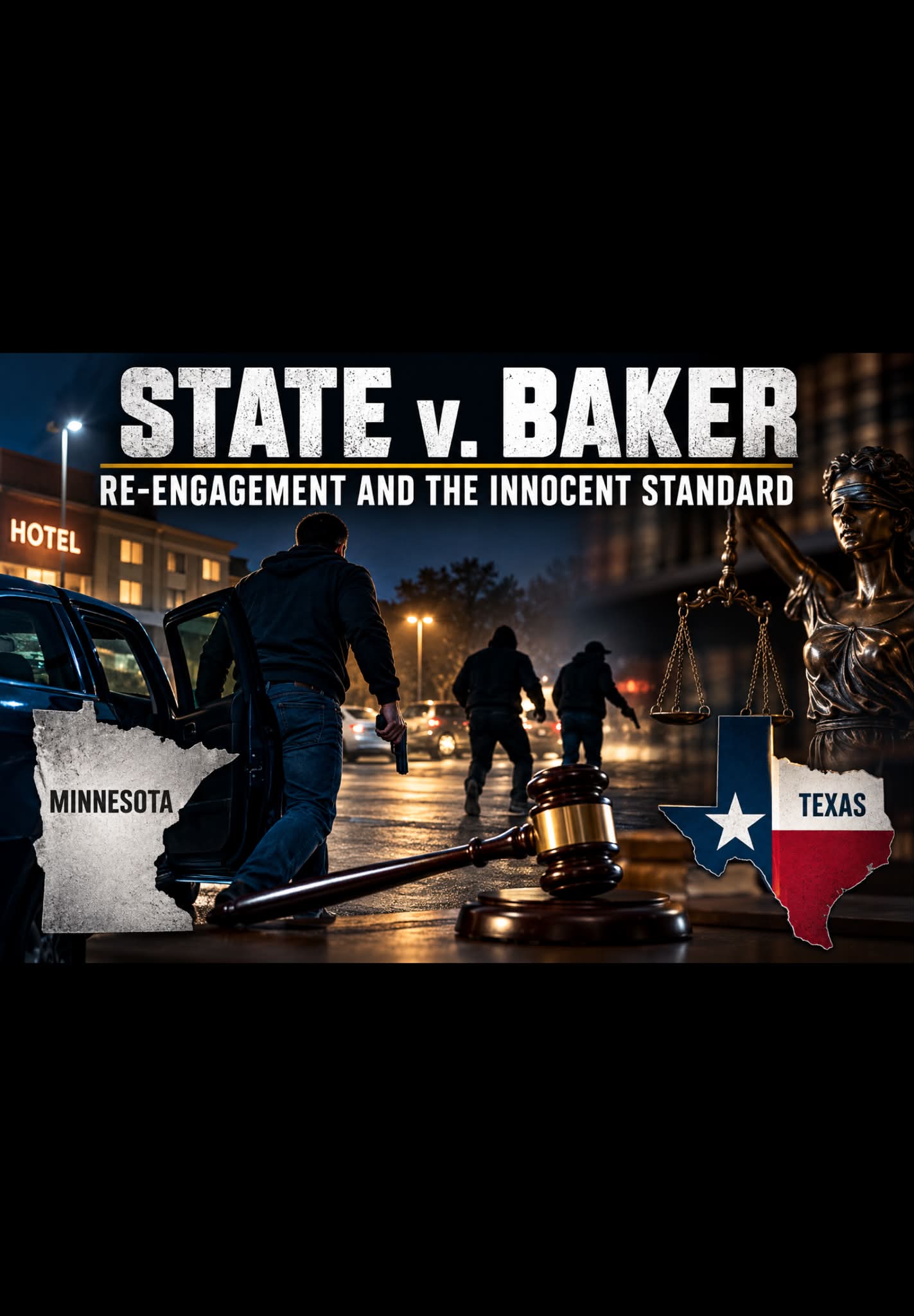
One of Minnesota’s most interesting recent self-defense cases begins with a man who made his legal situation considerably more complicated by getting out of a perfectly good car. On November 9, 2020, Robert Lee Baker III and two women were in a vehicle near an Eagan hotel when two assailants robbed them at gunpoint. The men took Baker’s property and his girlfriend’s purse and began walking away. Baker got out with a .40-caliber handgun already in his hand and demanded the property back.
What happened next was heavily disputed, and Baker’s statements to investigators changed. For purposes of deciding whether he was entitled to self-defense instructions, however, the Minnesota Supreme Court was required to view the evidence in the light most favorable to Baker. Under that version, the assailants raised their guns after Baker demanded the property. Baker then fired. Evidence showed that a shooter could have fired the 16 rounds recovered at the scene in just over five seconds. Eleven struck Maurice Anderson, seven traveling through his body from back to front. Anderson died.
Baker was also legally prohibited from possessing the handgun and pleaded guilty to that offense before his murder trial. He nevertheless requested jury instructions on self-defense and defense of others. The district court refused, bringing us to what we call the innocent standard. Minnesota courts call this the “absence of aggression or provocation on the part of the defendant.” Our term is simply teaching shorthand for the same basic concept: if you are the person who creates or provokes the confrontation, your ability to claim self-defense can disappear.
The district court found that the robbery was over and that Baker had “re-engaged” by exiting the vehicle with a gun. It concluded that he had failed to establish the absence of aggression or provocation and also had a reasonable means of retreat. The jury therefore received neither self-defense nor defense-of-others instructions. Baker was convicted of second-degree intentional murder and sentenced to 438 months.
The Minnesota Supreme Court reversed in 2024, but this distinction is critical: Baker did not win self-defense. He won the right to have a jury consider self-defense. The Supreme Court held that he produced sufficient evidence from which a reasonable juror could find the requirements satisfied. Once a defendant meets that burden of production, the State bears the burden of disproving self-defense beyond a reasonable doubt. Baker’s original jury never got to make that determination because it was never instructed on the defenses.
The re-engagement issue is what makes Baker particularly interesting. The Supreme Court expressly said there was “no dispute that Baker re-engaged” when he got out of the car. But that did not automatically make him the aggressor. The Court reasoned that, viewing the evidence favorably to Baker, a jury could infer that the robbery was still ongoing while the assailants were escaping with the stolen property. Minnesota law permits reasonable force to resist unlawful interference with personal property, and the Court relied on federal authority recognizing that the escape phase can remain part of a robbery. Therefore, under these specific facts, a reasonable jury could find that Baker was not the initial aggressor despite his re-engagement.
That is a much narrower holding than saying Minnesota law gives you permission to restart a fight. It doesn’t. Baker tells us that the word re-engagement does not itself answer the innocent-standard question. We still have to ask what was actually happening when the defendant re-engaged. Had the original confrontation ended, or was the original crime still underway?
There is another distinction worth making. Minnesota allows reasonable force to resist unlawful interference with property, but property alone does not give someone a blank check to intentionally kill another person. My way of teaching this is to distinguish ordinary force from deadly force, although “ordinary force” is our teaching terminology rather than the statutory language. In Baker, I think it is useful to see the confrontation as potentially moving from resistance to an ongoing robbery into a deadly-force problem once guns were allegedly raised. That is my analysis of the facts, however, not a formal two-stage test announced by the Supreme Court. Baker already had his gun in his hand when he exited, and the record does not clearly describe exactly how he was holding it.
The retreat analysis creates an even more interesting problem. According to Baker’s later account, he was about seven feet from the car when he demanded the property back, while the assailants were approximately 30 feet from the car. Once they allegedly raised their guns, the Supreme Court concluded that a jury could find Baker had no reasonable opportunity to retreat. For defense of others, the Court separately considered whether Baker could reasonably believe the two women in the car lacked a safe opportunity to retreat.
But the Supreme Court did not address a question I think deserves considerably more attention: Baker knew these men were armed before he got out of the car. Why doesn’t his earlier decision to leave relative safety matter?
That question may fit as much under aggression or provocation as under retreat. Imagine slightly cleaner facts. Baker’s handgun remains holstered. The robbers walk away with his property, Baker gets out and demands its return, and only then does one robber turn and raise a gun. At the instant that weapon comes up, Baker may be facing an imminent deadly threat. But seconds earlier he voluntarily approached people he knew were armed. Does lawful resistance to an ongoing robbery preserve the innocent standard? Does knowingly walking back toward armed criminals affect some other part of the self-defense analysis? Baker does not answer those questions.
The number of shots presents another important lesson about what appellate courts actually do. Baker fired 16 rounds, 11 hit Anderson, and seven wounds traveled from back to front. Baker also described part of his movement as a “chase,” and his own estimates placed him much closer to Anderson later in the shooting. Those are terrible facts for a defendant. Nevertheless, the Supreme Court called the reasonableness of Baker’s force a “close call.” Because reasonable jurors could draw competing conclusions from a chaotic sequence that evidence indicated could have occurred in approximately five seconds, the Court held that the jury, rather than the judge, should decide whether the degree of force was reasonable.
The retrial ultimately never reached another jury. In 2026, Baker pleaded guilty to second-degree intentional murder and received a 210-month sentence, substantially below his original 438 months. That disposition ended his case without answering the broader questions the Supreme Court decision left behind.
There is an interesting comparison with the Texas case involving Roland Bruce Lee III that we recently examined. Lee fought with Christopher Dixon, separated from him, later returned with a rifle, and ultimately shot Dixon. Lee claimed self-defense but eventually pleaded guilty to manslaughter and received 16 years. His plea is not legal authority establishing anything about Texas self-defense law, so we should not pretend otherwise.
Texas law itself provides the comparison. Texas Penal Code § 9.31 limits self-defense when the actor provokes another person’s use of unlawful force. Texas Court of Criminal Appeals precedent has required evidence of a provoking act or words, that the conduct was reasonably calculated to provoke the attack, and that it was done with the intent to create a pretext for inflicting harm. In other words, merely saying someone “re-engaged” does not automatically resolve provocation under Texas law either.
Minnesota and Texas get there through different legal frameworks, and they should not be treated as interchangeable. But there is an interesting correlation: in both systems, re-engagement by itself does not necessarily answer the provocation question. Two cases and two states certainly aren’t enough to announce some grand theory of American self-defense law. Small samples can produce bad conclusions when we start seeing a pattern and then convince ourselves that the pattern proves more than the evidence actually supports.
The more useful lesson is the difference between what might be legal and what is wise. Even if re-engagement does not automatically destroy your innocent standard, voluntarily going back toward danger creates facts a prosecutor can use. Baker went from being the victim of an armed robbery to spending years litigating whether getting out of that car made him the aggressor. The law may eventually decide that your re-engagement did not legally provoke the second confrontation, but that is a spectacularly expensive question to have answered.
Self-defense law establishes the boundaries of what you may legally do. It should not be confused with tactical advice about what you should do. Baker tells us that re-engagement is relevant, but the label itself does not decide the case. We still have to ask whether the original confrontation actually ended, whether the defendant was lawfully resisting an ongoing crime, when the deadly threat arose, whether retreat was reasonably possible, and whether the force ultimately used was reasonable. Sometimes the best way to preserve the innocent standard is considerably simpler: don’t voluntarily create a second fight for a prosecutor to explain to twelve strangers.
Know the law before the law has to know you.
2A Self-Defense Law
ReasonablenessMinnesota Case Analysis and Use-of-Force Law
Related articles
Minnesota Case Analysis and Use-of-Force Law
Minnesota's Castle Doctrine: The Statute Says Felony, but the Courts Ask a Harder Question
Minnesota law permits deadly force to prevent certain felonies in the home, but that does not make every felony a license to kill. Learn how the courts interpret necessity, reasonableness, retreat, and the rights of co-residents.
October 20, 2026 · 9 min read
Minnesota Case Analysis and Use-of-Force Law
EZEKA v. STATE: A THREAT IS NOT YET AN IMMINENT THREAT
September 30, 2026 · 3 min read
Minnesota Case Analysis and Use-of-Force Law
SELF-DEFENSE SCENARIO: SEE IF YOU GET IT RIGHT
September 21, 2026 · 9 min read