
EZEKA v. STATE: A THREAT IS NOT YET AN IMMINENT THREAT
- Originally published:
- September 30, 2026
By Jeffrey S. Straub · 3 min read · Minnesota
EZEKA v. STATE: A THREAT IS NOT YET AN IMMINENT THREAT
By Jeffrey S. Straub
Sponsored by 2A Self-Defense Law
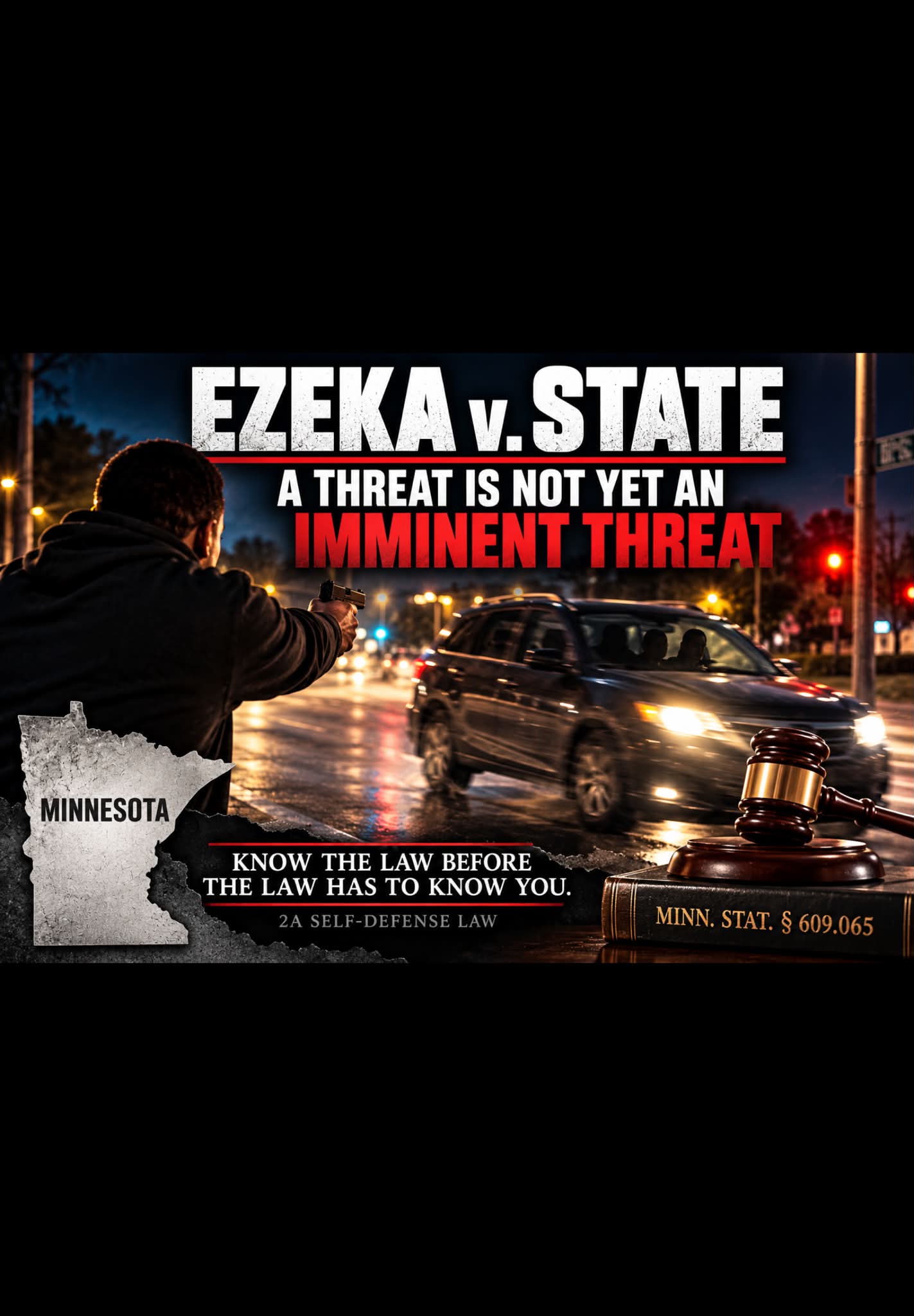
In Ezeka v. State, decided in 2025, the Minnesota Supreme Court gives us an important lesson about deadly force: believing someone is dangerous is not the same thing as facing an imminent threat of death or great bodily harm.
Joshua Ezeka received a phone call warning him that D.G. was near Ezeka’s residence and intended to shoot someone there. That certainly sounds like a serious threat. Ezeka had reason to be concerned, and doing nothing was not his only option. He could have stayed inside, warned the people in the house, called police, moved people to safety, or prepared to defend against an actual attack.
Instead, Ezeka left his residence armed with a handgun and walked to a nearby intersection. When D.G.’s vehicle approached, Ezeka fired nine rounds at it from across the intersection. There was no evidence that anyone in the vehicle fired toward Ezeka, his family, or his home.
One of Ezeka’s bullets struck and killed Birdell Beeks, an innocent bystander traveling in a vehicle with her granddaughter. Ezeka was eventually convicted of first-degree premeditated murder, attempted first-degree premeditated murder, and other offenses.
Years later, Ezeka argued that his attorney had been ineffective for failing to request jury instructions on self-defense and defense of others. The Minnesota Supreme Court rejected the ineffective-assistance claim. Applying Minnesota’s self-defense requirements, the Court noted both that Ezeka was the “first and only aggressor” and that there was no evidence anyone fired toward him, his family, or his home.
Minnesota’s deadly-force statute, Minn. Stat. § 609.065, permits the intentional taking of life when necessary in resisting or preventing an offense that the person reasonably believes exposes the person or another to great bodily harm or death. Minnesota case law requires an actual and honest belief in imminent danger of great bodily harm, together with reasonable grounds for that belief.
For teaching purposes, I separate threats into three categories: past threats, anticipated threats and imminent threats. Someone may have threatened to kill you yesterday. You may reasonably believe he remains dangerous today. You might even have reliable information that he intends to attack you later tonight. Those circumstances may justify taking precautions, leaving, calling police, warning others or preparing to defend yourself. They do not automatically justify using deadly force now.
Ask the question at the instant deadly force is used: What is the imminent threat of death or great bodily harm right now?
That is the central problem with Ezeka’s argument. He had information about what D.G. allegedly intended to do, but the evidence did not show that the anticipated attack had matured into an imminent deadly threat when Ezeka opened fire. The Supreme Court specifically observed that there was no evidence anyone fired toward Ezeka, his family, or his home.
That does not mean Minnesota requires you to wait until someone shoots at you. Self-defense would be fairly useless if the law required you to absorb the first bullet. The question is whether the circumstances establish an imminent threat of death or great bodily harm at the moment deadly force becomes necessary.
This also helps illustrate the difference between Ezeka and State v. Baker. In Baker, evidence viewed favorably to the defendant indicated the robbers allegedly raised their guns before Baker fired. That alleged action could provide evidence of an imminent deadly threat for a jury to consider. This comparison is a teaching illustration, not one made by the Ezeka Court.
Self-defense law does not require you to ignore credible threats. It requires a distinction between preparing for danger and using deadly force against danger that has not yet become imminent.
That distinction can be measured in minutes, seconds, or sometimes the movement of a weapon. Legally, it can be the difference between self-defense and murder.
Know the law before the law has to know you.
2A Self-Defense Law
Minnesota Case Analysis and Use-of-Force Law
Related articles
Minnesota Case Analysis and Use-of-Force Law
Minnesota's Castle Doctrine: The Statute Says Felony, but the Courts Ask a Harder Question
Minnesota law permits deadly force to prevent certain felonies in the home, but that does not make every felony a license to kill. Learn how the courts interpret necessity, reasonableness, retreat, and the rights of co-residents.
October 20, 2026 · 9 min read
Minnesota Case Analysis and Use-of-Force Law
STATE v. BAKER: RE-ENGAGEMENT AND THE INNOCENT STANDARD
September 29, 2026 · 7 min read
Minnesota Case Analysis and Use-of-Force Law
SELF-DEFENSE SCENARIO: SEE IF YOU GET IT RIGHT
September 21, 2026 · 9 min read