
The Minneapolis Homeowner Shooting: Why Every Fact Matters
- Originally published:
- July 26, 2026
By Jeffrey S. Straub · 4 min read · Minnesota
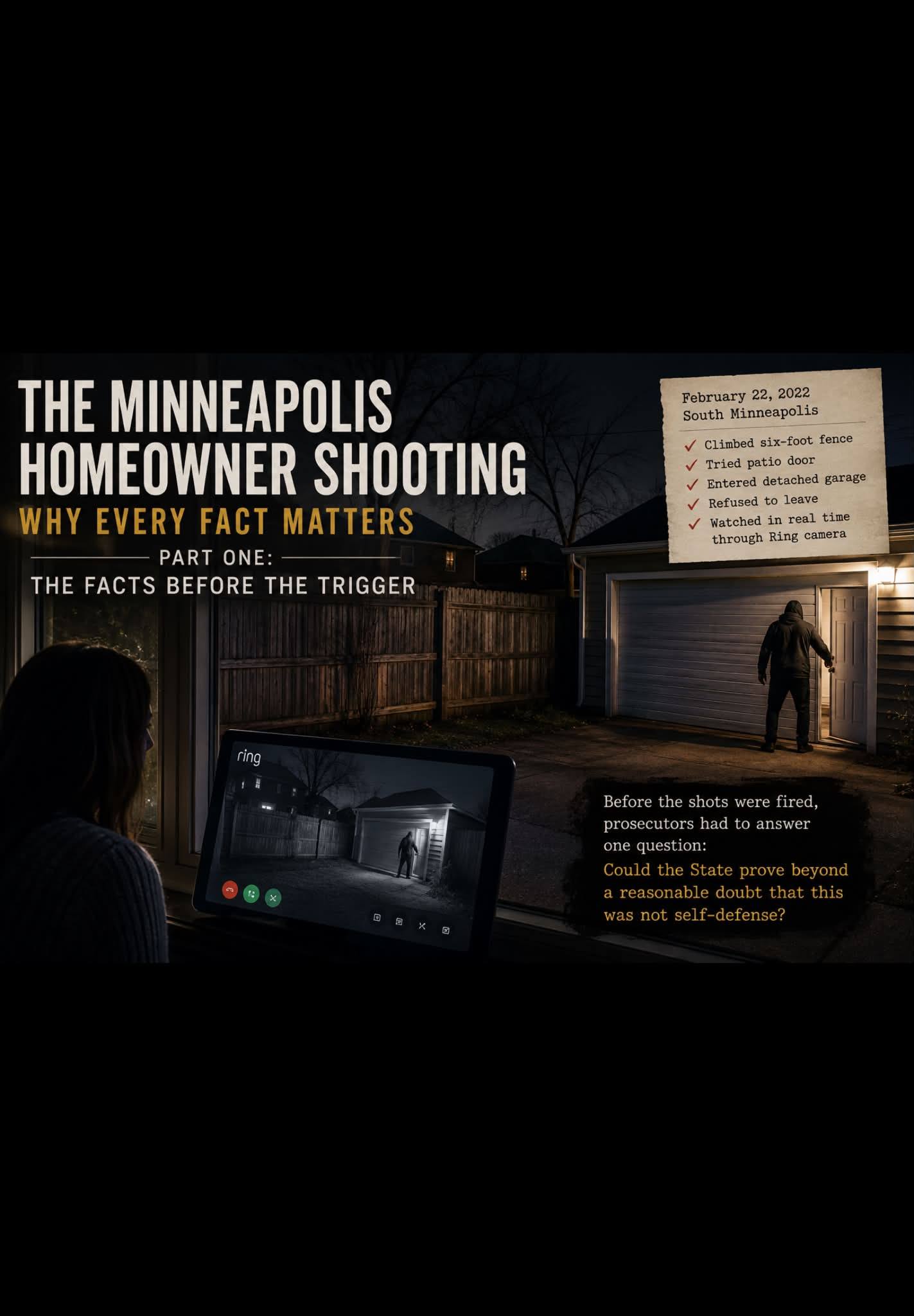
The Minneapolis Homeowner Shooting: Why Every Fact Matters
Part One: The Facts Before the Trigger
By Jeffrey S. Straub
By the time the investigative file reached the Hennepin County Attorney’s Office, one fact was beyond dispute.
A man was dead.
A homeowner had intentionally fired the shot that killed him.
Everything else required careful examination.
That is where public discussion of self-defense cases often diverges from the legal process. Within hours of a high-profile shooting, social media fills with certainty. Some people conclude the shooting must have been justified because the deceased was trespassing. Others insist it must have been murder because investigators later determined he was unarmed. The debate usually centers on one fact, as though one piece of evidence can answer every legal question.
A prosecutor does not have that luxury.
Minnesota law required the Hennepin County Attorney to determine whether the State could prove, beyond a reasonable doubt, that the homeowner had not acted in lawful self-defense. That is an important distinction. The burden was not on the homeowner to prove that every decision was correct. The burden remained on the State to prove that her actions were criminal.
That burden shaped every page of the investigative file.
The incident began on the evening of February 22, 2022, at a home in south Minneapolis. According to the Hennepin County Attorney’s public declination memorandum, a man approached the rear of the property and climbed over a six-foot privacy fence enclosing the backyard. That act, by itself, did not decide the case. Trespass alone does not automatically justify the use of deadly force. It did, however, become the first fact in a sequence of events that investigators would later reconstruct in extraordinary detail.
After entering the backyard, the man walked to the rear patio door and attempted to enter the residence. The door remained locked. Unable to gain entry, he turned his attention to a detached garage located behind the home and entered through a service door.
Meanwhile, inside the residence, the homeowner was not relying on noises from outside or secondhand information from a neighbor. She was watching much of the encounter unfold through a Ring security camera. Every few seconds provided another piece of information. A stranger had entered the backyard. He had tried to open the patio door. He had moved into the detached garage. Most importantly, he had not left.
Those facts matter, not because any one of them automatically authorized deadly force, but because each one contributed to what the homeowner reasonably perceived as the situation continued to unfold.
One of the easiest mistakes to make when evaluating a self-defense case is allowing hindsight to replace perspective. We know how this story ends. Investigators eventually determined that the deceased was not carrying a firearm. We know which witnesses survived. We know what evidence police recovered. None of that information was available to the homeowner as she watched the events develop in real time.
Minnesota self-defense law does not ask whether a danger actually existed in the abstract. It asks whether a reasonable person, standing in the defender’s position and possessing the information available at that moment, could reasonably believe that force was necessary. Those are related questions, but they are not the same question.
As prosecutors reviewed the evidence, they were required to evaluate the case from that perspective, not from the comfort of hindsight.
The homeowner did not immediately resort to deadly force. According to the declination memorandum, she repeatedly ordered the man to leave the property. He refused. Those commands are significant because they provide insight into her state of mind. They suggest someone attempting to stop the confrontation before it escalated further, not someone eager to use force.
The investigation also established an important fact that would later become central to the legal analysis. Although the intruder had entered the detached garage, the homeowner and her adult son did not go outside to confront him. They remained inside the residence, near the threshold of the rear patio door. That distinction would prove critical. Whether a detached garage receives the same legal treatment as the dwelling itself is a separate legal question from whether the homeowner, watching the progression of events in real time, could reasonably perceive an escalating threat approaching her home. The prosecutor’s analysis ultimately focused on where the defenders were located, how the encounter unfolded, and what they reasonably perceived as it happened.
At this point in the encounter, the investigation revealed a steadily escalating sequence of events. A stranger had deliberately entered private property by climbing a six-foot fence. He had attempted to enter the residence itself. Failing that, he entered the detached garage. He ignored repeated commands to leave. From inside the home, the occupants watched the situation continue to deteriorate.
Each of those facts, standing alone, might appear ordinary or insufficient to explain what followed. Together, they formed the factual foundation that prosecutors were required to analyze under Minnesota law.
The most difficult decisions, however, were still ahead.
The homeowner armed herself.
Her adult son retrieved a rifle.
Outside, the intruder remained on the property.
Within moments, warning shots would be fired. The intruder would continue advancing despite repeated commands. Investigators would later describe movements toward his waistband that the occupants perceived as potentially life-threatening. Seconds later, one fatal shot would end the encounter.
Those final moments transformed a suspicious trespass into a homicide investigation. They also presented prosecutors with the central legal question in the case: viewed through the eyes of the people inside the home, and judged under Minnesota’s self-defense statutes and case law rather than hindsight, could the State prove beyond a reasonable doubt that the homeowner and her son had not acted in lawful self-defense?
That question would require a careful examination of Minnesota’s duty to retreat, the protection afforded to those inside their own dwelling, the significance of the warning shots, and why the Hennepin County Attorney ultimately concluded that criminal charges could not be sustained.
To be continued in Part Two…
Minnesota Case Analysis and Use-of-Force Law
Related articles
Minnesota Case Analysis and Use-of-Force Law
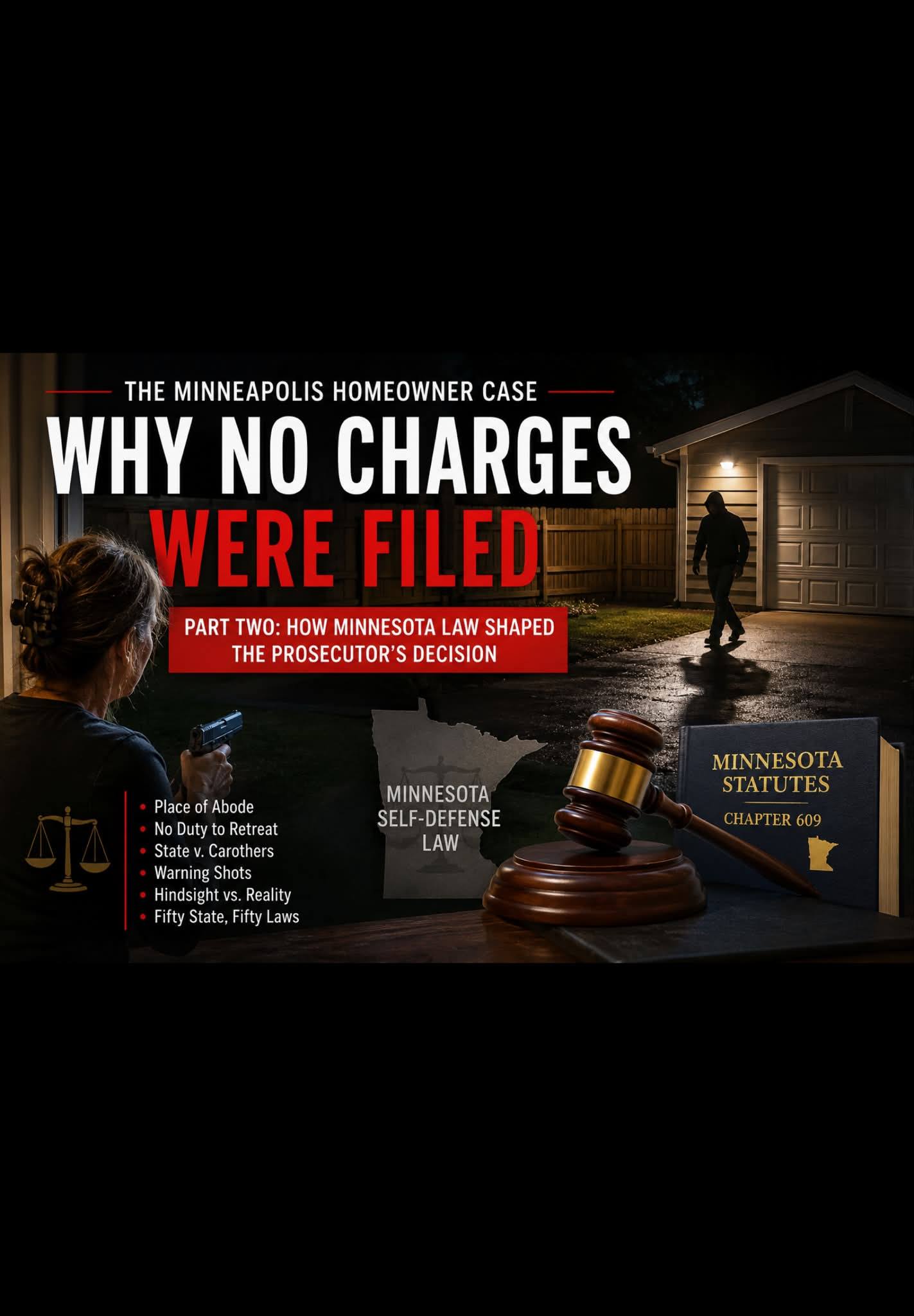
The Minneapolis Homeowner Case: Why No Charges Were Filed
July 26, 2026 · 4 min read
Minnesota Case Analysis and Use-of-Force Law
Minnesota's Castle Doctrine: The Statute Says Felony, but the Courts Ask a Harder Question
Minnesota law permits deadly force to prevent certain felonies in the home, but that does not make every felony a license to kill. Learn how the courts interpret necessity, reasonableness, retreat, and the rights of co-residents.
October 20, 2026 · 9 min read

Minnesota Case Analysis and Use-of-Force Law
EZEKA v. STATE: A THREAT IS NOT YET AN IMMINENT THREAT
September 30, 2026 · 3 min read