
The Minneapolis Homeowner Case: Why No Charges Were Filed
- Originally published:
- July 26, 2026
By Jeffrey S. Straub · 4 min read · Minnesota
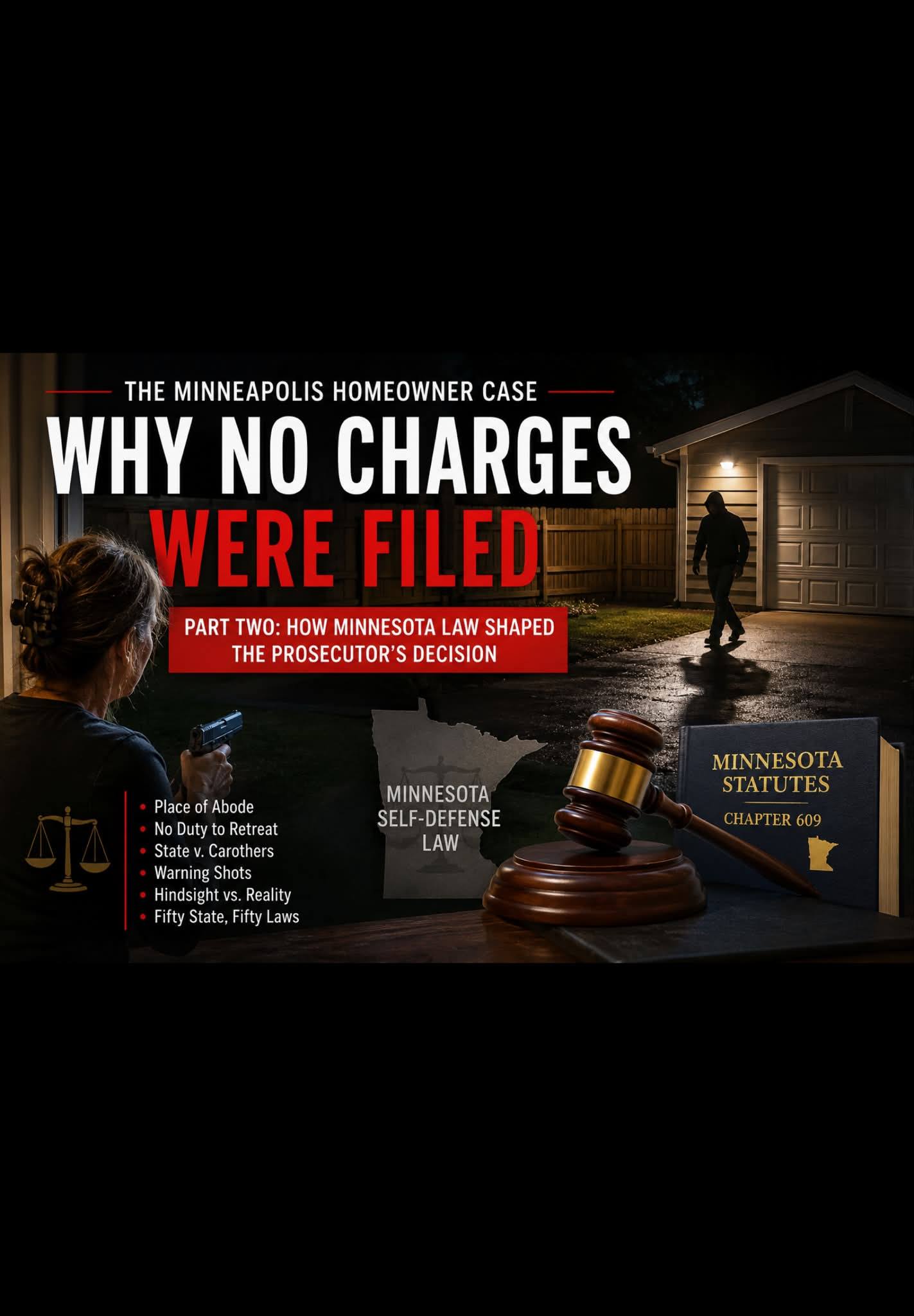
The Minneapolis Homeowner Case: Why No Charges Were Filed
Part Two: How Minnesota Law Shaped the Prosecutor’s Decision
Part One reconstructed the events that unfolded on that February evening and explained the burden facing the Hennepin County Attorney. The question was never whether the shooting was tragic. It was whether the State could prove beyond a reasonable doubt that the homeowner did not act in lawful self-defense.
Part Two begins where the prosecutor’s legal analysis truly began.
One of the greatest misconceptions surrounding self-defense law is the belief that every state follows the same rules. They do not. Every legislature writes its own statutes, and every appellate court interprets those statutes through its own decisions. Minnesota is no exception.
Many Americans recognize the phrase “Castle Doctrine.” Depending upon the jurisdiction, that doctrine may extend beyond the four walls of a home and include areas closely associated with the residence. In some states, questions involving detached garages, workshops, porches, fenced yards, or other residential structures can become part of the legal analysis.
Minnesota has historically approached that question differently.
Rather than broadly extending the no-duty-to-retreat principle across residential property, Minnesota appellate courts have historically focused their analysis on the defender’s place of abode. That distinction is more than semantics. It determines where one of Minnesota’s most significant exceptions to the duty to retreat applies.
The Minnesota Supreme Court’s decision in State v. Carothers illustrates that approach. The Court recognized that when a person is preventing the commission of a violent felony within the place of abode, the traditional duty to retreat does not apply. Instead of relying on broad slogans, the Court directed judges and juries to evaluate the actual circumstances confronting the defender.
That legal framework became critical in the Minneapolis homeowner case.
The prosecutor was not required to determine whether the detached garage itself carried the same legal status as the residence. Instead, the evidence established something more important. The homeowner and her adult son never left the place of abode. They armed themselves inside the home. They remained there while repeatedly ordering the intruder to leave.
That fact became legally significant because Minnesota law places extraordinary importance on the defender’s location during the confrontation.
It also demonstrates why self-defense law cannot be learned from internet videos or television commentators discussing another state’s laws. A factual scenario producing one legal result in Texas, Florida, Arizona, or another jurisdiction may be analyzed differently in Minnesota because the governing statutes and appellate decisions are different. The law changes when you cross a state line.
The warning shots present another example.
Across the country, warning shots have generated intense legal debate. Firearms instructors often discourage them because every projectile fired creates independent legal responsibility. A warning shot that strikes an innocent person or travels unpredictably can lead to criminal prosecution and civil liability entirely separate from any later use of deadly force. In some jurisdictions, highly publicized warning-shot cases even prompted legislative changes.
None of that meant the warning shots automatically defeated the homeowner’s claim of self-defense.
The prosecutor’s task was not to determine whether the homeowner followed the ideal firearms curriculum. The prosecutor’s task was to determine what those warning shots meant when viewed alongside every other piece of evidence.
They occurred after repeated commands to leave. They occurred while the defenders remained inside their place of abode. They occurred before the fatal shot. According to the evidence reviewed by investigators, the confrontation continued to escalate, and the intruder then made a movement toward his waistband. Although investigators later determined he was unarmed, prosecutors could not erase what the defenders reasonably perceived at the moment force was used.
That is one of the central principles of self-defense law.
Reasonableness is judged from the circumstances confronting the defender at the time of the incident, not from facts discovered hours, days, or months later. Prosecutors cannot use hindsight to manufacture certainty that did not exist during a rapidly unfolding confrontation.
By the conclusion of the investigation, the Hennepin County Attorney had assembled every piece of the puzzle.
The privacy fence explained why the homeowner may not have known immediately who was inside the backyard. The repeated commands to leave demonstrated attempts to end the confrontation without deadly force. The warning shots became one factor among many rather than a single controlling fact. The defenders’ decision to remain inside their place of abode placed the case squarely within one of Minnesota’s most important self-defense principles. Finally, the prosecutor had to evaluate all of those facts through the demanding constitutional requirement of proving, beyond a reasonable doubt, that the homeowner did not act lawfully.
After applying Minnesota law to the facts, that burden could not be met.
Reasonable people may continue to debate tactics. They may debate warning shots. They may debate whether they would have acted differently. Those are worthwhile discussions, but they are not the question prosecutors are sworn to answer.
The Hennepin County Attorney’s responsibility was far narrower. The office had to determine whether the evidence, viewed through Minnesota’s statutes and appellate decisions, could convince twelve jurors beyond a reasonable doubt that the homeowner did not act in lawful self-defense.
The answer was no.
That is why no criminal charges were filed.
ReasonablenessMinnesota Case Analysis and Use-of-Force Law
Related articles

Minnesota Case Analysis and Use-of-Force Law
The Minneapolis Homeowner Shooting: Why Every Fact Matters
July 26, 2026 · 4 min read
Minnesota Case Analysis and Use-of-Force Law
Minnesota's Castle Doctrine: The Statute Says Felony, but the Courts Ask a Harder Question
Minnesota law permits deadly force to prevent certain felonies in the home, but that does not make every felony a license to kill. Learn how the courts interpret necessity, reasonableness, retreat, and the rights of co-residents.
October 20, 2026 · 9 min read

Minnesota Case Analysis and Use-of-Force Law
EZEKA v. STATE: A THREAT IS NOT YET AN IMMINENT THREAT
September 30, 2026 · 3 min read