
SELF-DEFENSE SCENARIO: SEE IF YOU GET IT RIGHT
- Originally published:
- September 21, 2026
By Jeffrey S. Straub · 9 min read · Minnesota
SELF-DEFENSE SCENARIO: SEE IF YOU GET IT RIGHT
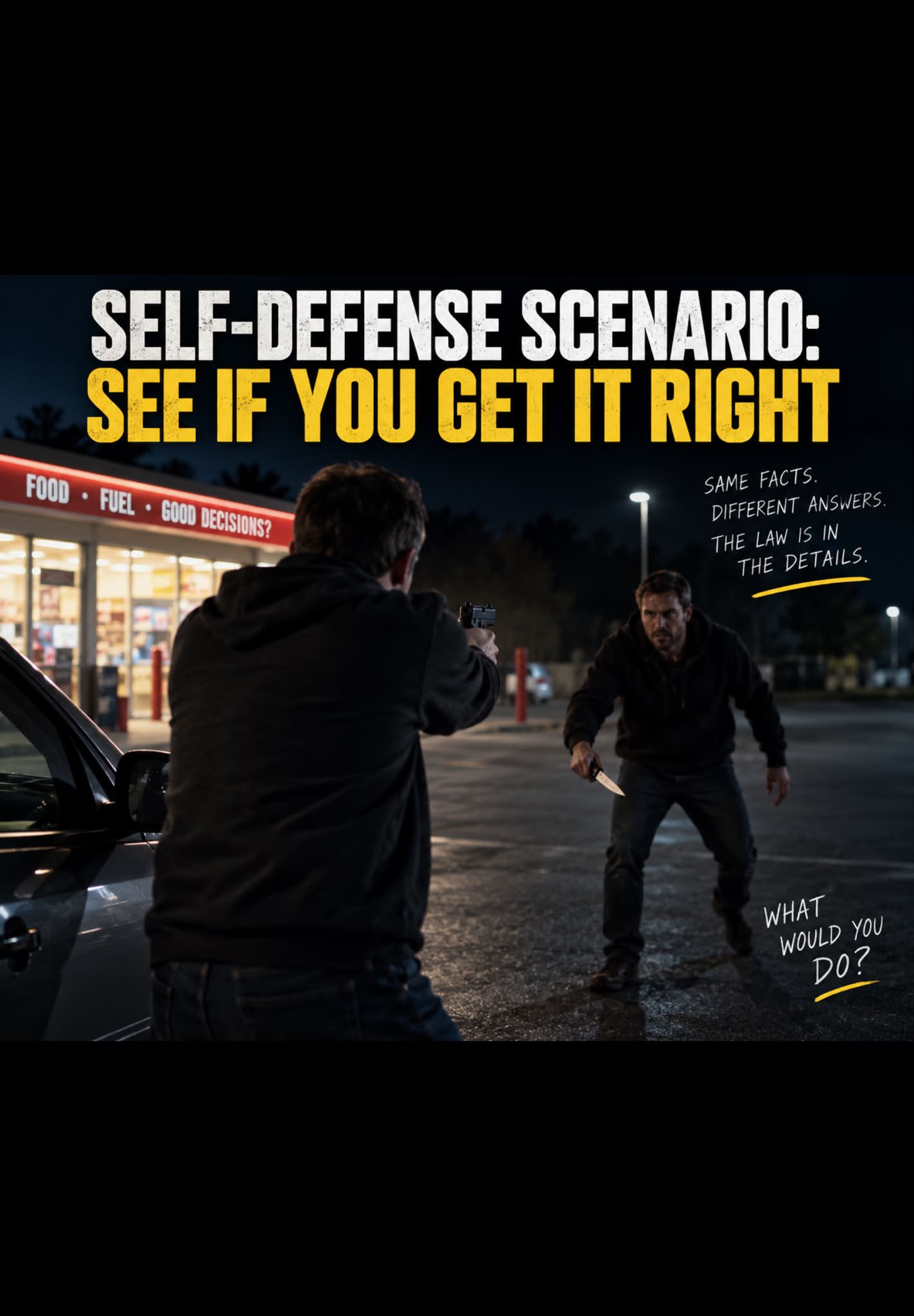
It is 10:45 p.m. at a convenience store in Burnsville, Minnesota. David and Marcus get into an argument after Marcus accuses David of cutting in line. Apparently the orderly acquisition of convenience-store merchandise is worth defending with one’s honor. The argument gets louder until David says, “If you want to do something about it, come outside.” David walks toward the door and Marcus immediately follows.
Outside, neither attempts to leave, which would have been both legally and medically brilliant. Instead, David shoves Marcus. Marcus shoves back. David throws a punch. Marcus returns one, and soon both men are willingly exchanging punches in a parking lot because civilization remains a work in progress.
Marcus lands a hard punch that sends David backward. David recovers and continues fighting. Marcus lands another hard punch. This time David stops fighting, raises both hands, palms outward, and backs away. “Stop. Don’t hurt me. I don’t want to fight.”
Marcus follows. David continues backing away and repeats, “Stop. Don’t hurt me. I don’t want to fight.” Marcus removes a folding knife from his pocket. The blade is initially closed. Marcus opens it and continues toward David.
David keeps retreating toward his vehicle. When Marcus is approximately twelve feet away, David draws his legally carried handgun and holds it at low ready. He tells Marcus to stop. Marcus pauses, looks at David and says, “You’re not going to shoot me.”
This would be an excellent point for Marcus to reconsider several recent life choices.
He does not.
Marcus advances again with the open knife. David still does not shoot. He continues backing away until he reaches his vehicle, restricting his ability to move farther backward. Marcus closes to approximately eight feet and continues advancing with the open knife. David fires once, killing Marcus.
Was the shooting lawful self-defense? Make your decision now. Resist the modern temptation to announce your verdict after watching the imaginary eight-second cellphone clip. We’re going to rewind the encounter and see whether you got it right.
This is an educational hypothetical about Minnesota self-defense law, not legal advice. Real cases turn on evidence, credibility, jury instructions, charging decisions and facts that may never appear in a cellphone or surveillance video. Unfortunately, “I watched the clip twice on Facebook” has not yet been recognized as a substitute for law school.
The first important event happened before anyone produced a weapon. Minnesota Statutes § 609.06 authorizes reasonable force under specified circumstances, including resisting an offense against the person. Minnesota self-defense doctrine also examines aggression or provocation, the defender’s actual belief of danger, whether that belief was reasonable and whether a reasonable opportunity to retreat existed.
In the Five Pillars framework I use for teaching self-defense, I call the first issue the innocent standard. That is a teaching term, not Minnesota statutory language. Minnesota courts generally describe the legal issue in terms of aggression or provocation.
David’s statement, “If you want to do something about it, come outside,” matters. He isn’t inviting Marcus outside to discuss their differences over coffee and perhaps exchange Christmas cards. In context, he is challenging Marcus to continue the confrontation outside. Marcus accepts. They go outside, neither leaves, David shoves Marcus, Marcus shoves back, and both willingly exchange punches. The words and conduct together provide powerful evidence of provocation followed by mutual combat.
State v. Baker, a 1968 Minnesota Supreme Court case, provides a useful comparison. Baker and another man exchanged words, squared off and engaged in what the court expressly described as “mutual combat.” When Baker began getting the worse of the fistfight, he resorted to a hunting knife. His second-degree assault conviction was upheld.
Baker does not mean someone who enters a fight permanently loses self-defense. It demonstrates why a willing participant cannot freeze the encounter at the precise instant he starts losing and suddenly announce that he is now the innocent victim. Self-defense law does not come with a reset button conveniently located next to your bruised ego.
For teaching purposes, call this Fight One. David has a serious problem with the innocent standard because he voluntarily participated in the confrontation. Marcus being better at punching people does not suddenly make David an innocent victim. But what happened at the beginning does not necessarily determine everything that happens afterward. Someone can withdraw, the other person can pursue, the threat can escalate, and the availability of retreat can change.
After Marcus lands the second hard punch, David stops fighting, raises his hands and backs away while saying, “Stop. Don’t hurt me. I don’t want to fight.” When Marcus follows, David repeats it.
That brings us to State v. Graham, a 1972 Minnesota Supreme Court decision recognizing that an aggressor can regain the right of self-defense through an actual, good-faith withdrawal communicated sufficiently that the other person knows or has reasonable grounds to know the confrontation has been abandoned.
This is why merely backing up is not necessarily withdrawal. Someone losing a fistfight might step backward simply to gain distance, improve his position and continue fighting. That is a tactical retreat. A tactical retreat changes your position; a good-faith withdrawal attempts to end the fight. Your feet can be moving backward while your ego remains fully committed to the evening’s festivities.
David does considerably more. He stops fighting, raises his hands, moves away and twice says, “Stop. Don’t hurt me. I don’t want to fight.” His words and physical conduct communicate the same thing.
Interestingly, that mirrors what happened at the beginning. “Come outside,” followed by going outside, shoving and punching, helped establish his participation in the confrontation. Now “Stop. Don’t hurt me. I don’t want to fight,” accompanied by raised hands and continued movement away, communicates the opposite. Words plus conduct helped create the confrontation, and words plus conduct may now establish its abandonment.
There is also a practical reason those words matter. Imagine a witness repeating them six months later in court. “I heard him say, ‘Stop. Don’t hurt me. I don’t want to fight.’” Compare that with, “I heard the guy with the gun say he would shoot him.” Those are very different sentences when twelve strangers are sitting in a jury box staring at you.
Good self-defense communication should make sense twice: once during the encounter and again when repeated by a neutral witness in a courtroom. This is not about inventing magic words. It is about making your actual intention unmistakably clear to the other person and, potentially, everyone watching.
If David genuinely and effectively withdraws, we can conceptually call what follows Fight Two. That is a teaching device, not Minnesota legal terminology. Marcus could allow David to leave, thereby ending the evening with nothing worse than some bruises, wounded pride and perhaps a lifelong inability to enter that particular convenience store without embarrassment. Instead, he pursues David, produces a knife, opens it and continues advancing.
Marcus’s actual intent would matter in determining whether Marcus himself committed assault, but David’s self-defense claim does not require him to develop telepathy. David has to respond to the circumstances as he reasonably perceives them. Those circumstances now include a man pursuing him after he withdrew, ignoring repeated statements that he does not want to fight, opening a knife and continuing to close the distance.
Now Minnesota’s 2024 decision in State v. Blevins becomes critically important. As Minnesota law currently stands on September 21, 2026, Blevins remains controlling Minnesota Supreme Court precedent. The court held that the duty to retreat when reasonably possible applies before committing felony second-degree assault-fear with the dangerous weapon addressed in the case.
The holding was narrow, and not every conceivable display of a firearm automatically constitutes assault-fear. But the practical lesson for an armed Minnesotan is important. If you are outside your home and considering presenting a firearm to stop a threat, you should consider whether reasonable retreat is available before presenting the firearm, not merely before firing it.
That is worth repeating because Minnesota has managed to make the decision about when you may display a defensive weapon legally interesting before anyone has even fired one. If the gun is deliberately presented to stop an approaching person by causing fear of immediate bodily harm or death, you are entering precisely the legal territory Blevins makes important.
So when Marcus opens the knife, we must ask whether David can reasonably retreat before he presents the handgun. David is already moving backward. Marcus is pursuing him with an open knife. The distance is collapsing and David’s vehicle is increasingly restricting his movement. Could David safely turn and run? Could he move around the vehicle? Could he unlock and enter it before Marcus reached him? Would attempting to enter the vehicle temporarily trap him while Marcus closed the remaining distance?
These are the kinds of questions that become wonderfully obvious six months later while sitting comfortably in a courtroom with photographs, diagrams and unlimited time to think.
David does not have unlimited time.
Blevins requires retreat when reasonably possible, not retreat regardless of danger. Whether a reasonable opportunity exists depends upon the circumstances. The fact that there is technically somewhere David could move does not necessarily mean he has a reasonable opportunity to escape an advancing person armed with an open knife.
At approximately twelve feet, David presents his handgun. Marcus stops, sees the gun and says, “You’re not going to shoot me.” Marcus has now correctly identified the firearm but apparently drawn the wrong conclusion from its presence. He advances again with the open knife.
David still does not shoot. He continues retreating until his vehicle restricts further backward movement and Marcus closes to approximately eight feet.
Now, finally, we reach the gunshot.
Because David intentionally fires and kills Marcus, Minnesota Statutes § 609.065 becomes central. It permits an intentional taking of life when necessary in resisting or preventing an offense the actor reasonably believes exposes the actor or another to great bodily harm or death.
At the moment David fires, Marcus is approximately eight feet away and advancing with an open knife. David previously withdrew from the fistfight, repeatedly communicated that withdrawal, was pursued, continued retreating after the knife appeared, presented the handgun at approximately twelve feet, and continued retreating even after presenting it. Marcus saw the handgun, verbally acknowledged it and nevertheless resumed advancing. David eventually reached his vehicle, restricting further backward movement, while Marcus continued closing the distance.
None of those facts alone decides the case. “He had a knife” is not a legal cheat code. Eight feet is not a statutory shooting distance. David’s withdrawal does not erase Minnesota’s other self-defense requirements. The vehicle does not automatically prove retreat was impossible. Self-defense law stubbornly refuses to become as simple as internet comments would prefer.
But neither can those facts be discarded.
The ultimate § 609.065 question is whether David reasonably believed Marcus presented an imminent threat exposing him to great bodily harm or death and whether deadly force was necessary under the circumstances. That determination has to be made from the entire sequence, not merely from a photograph of David pulling the trigger.
Change only a few facts and watch the analysis change. If David never withdraws and simply shoots Marcus because he is losing the fistfight, Baker becomes extremely uncomfortable authority for him. If David merely backs up to obtain a better fighting position, that may be tactical retreat rather than genuine withdrawal. If David genuinely withdraws but has an obvious and reasonably safe avenue of retreat before presenting the handgun, Blevins becomes a serious problem. If Marcus pursues David with an open knife while David continues retreating until his movement is restricted, the analysis changes again.
We changed only seconds and feet, yet potentially changed the legal outcome. That is the point. Self-defense is not a snapshot. Your legal position when you pull the trigger may have been shaped by decisions made thirty seconds earlier. Aggression matters, mutual combat matters, good-faith withdrawal matters, communication matters, escalation matters, reasonable fear matters, distance matters, restricted movement matters, and under current Minnesota law, reasonable retreat can matter before a firearm is fired and, under Blevins, potentially before it is presented.
A tactical retreat changes your position; a good-faith withdrawal attempts to end the fight. Good self-defense communication should make sense both during the encounter and when repeated later by a neutral witness.
So when somebody shows you the final ten seconds of a self-defense shooting and confidently announces that it was “obviously justified” or “obviously murder,” remember that the internet has never suffered from a shortage of people willing to reach a verdict before obtaining the facts. Rewind the video. The answer may be hiding thirty seconds earlier.
Minnesota Case Analysis and Use-of-Force Law
Related articles
Minnesota Case Analysis and Use-of-Force Law
Minnesota's Castle Doctrine: The Statute Says Felony, but the Courts Ask a Harder Question
Minnesota law permits deadly force to prevent certain felonies in the home, but that does not make every felony a license to kill. Learn how the courts interpret necessity, reasonableness, retreat, and the rights of co-residents.
October 20, 2026 · 9 min read
Minnesota Case Analysis and Use-of-Force Law
EZEKA v. STATE: A THREAT IS NOT YET AN IMMINENT THREAT
September 30, 2026 · 3 min read
Minnesota Case Analysis and Use-of-Force Law
STATE v. BAKER: RE-ENGAGEMENT AND THE INNOCENT STANDARD
September 29, 2026 · 7 min read