SHE SHOT HER HUSBAND THROUGH A PILLOW. MURDER, RIGHT?
- Originally published:
- September 19, 2026
By Jeffrey S. Straub · 6 min read
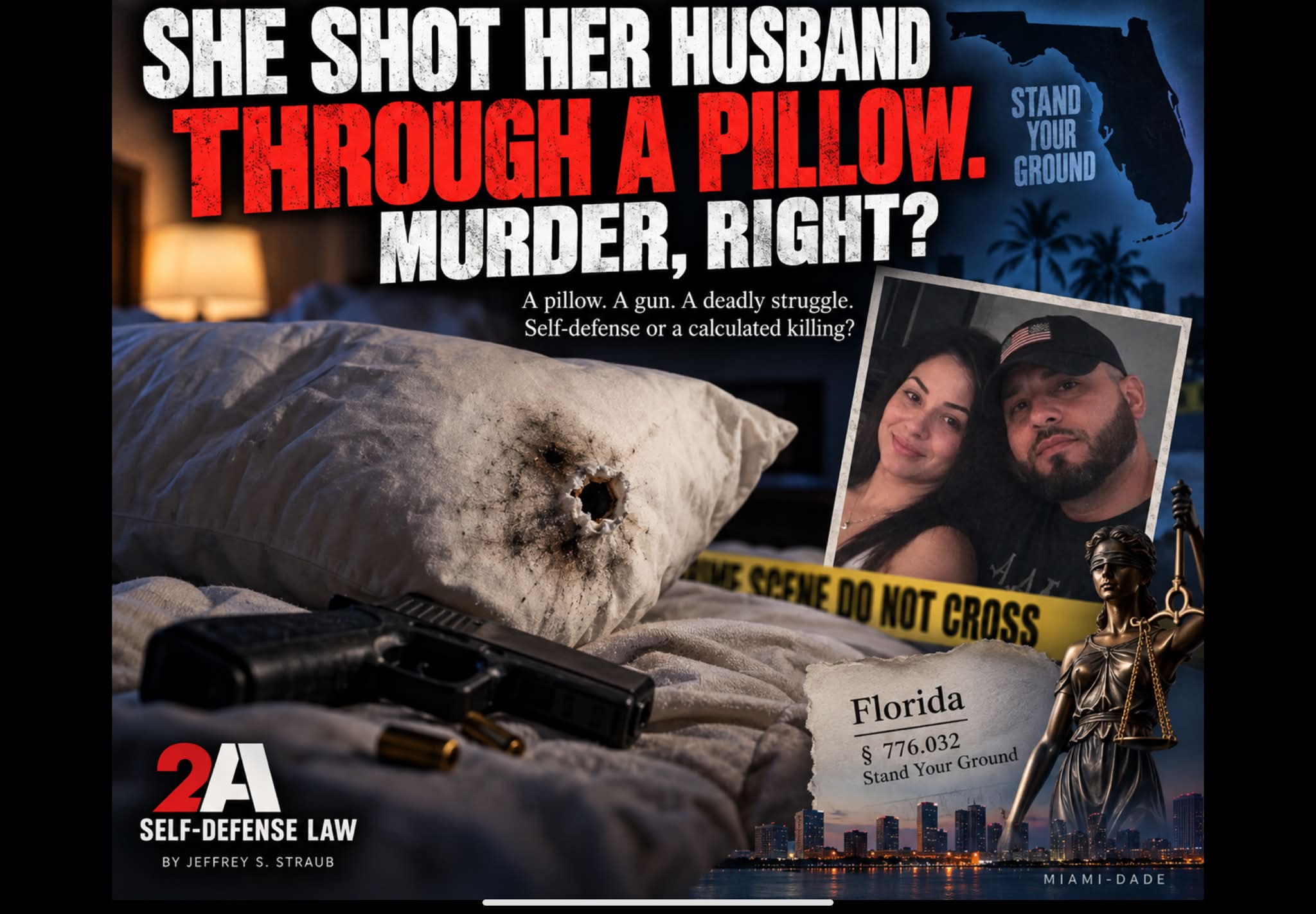
SHE SHOT HER HUSBAND THROUGH A PILLOW. MURDER, RIGHT?
By Jeffrey S. Straub
2A Self-Defense Law
At first glance, the case against Aimee Martinez sounds less like self-defense and more like something Hollywood has trained us to recognize as murder. Martinez admits shooting and killing her husband, Osmanny Montano. Investigators found a pillow with a projectile hole, soot and burn marks, and later firearms testing indicated that the pillow had apparently been folded around the gun when it discharged. Martinez denied shooting through a pillow. We have all seen this movie before. A killer puts a pillow around a gun to muffle the shot and executes the victim. Assassins use pillows. Case closed. Except real homicide investigations are considerably less cooperative than Hollywood screenwriters, and once we back this story up a few minutes, what initially looks like an obvious murder begins looking like a surprisingly plausible self-defense case.
Martinez shot Montano twice inside their Miami-Dade home on March 10, 2019. They had been married for less than five months. Montano, 34, was a U.S. Army veteran diagnosed with post-traumatic stress disorder. According to Martinez, the couple were already sleeping in separate bedrooms because Montano was experiencing what she described as a PTSD episode. She said he came upstairs screaming at her, and their argument eventually moved downstairs, where Montano began hitting himself in the face and throwing keys at her. According to Martinez, something unusual was already happening before she ever touched the firearm.
Martinez eventually removed herself from the confrontation downstairs and went back upstairs. Florida law did not require her to retreat, but her decision to physically separate herself from Montano could still be relevant to understanding her state of mind and whether she reasonably feared that the confrontation was escalating. There is an important complication: Martinez didn’t simply go upstairs and stay there. She retrieved her .40-caliber handgun from a clothes basket beside the bed and concealed it underneath her. The prosecution can argue that arming herself suggests preparation for a continuing confrontation; the defense can argue that it demonstrates how seriously she had begun to perceive the threat. According to Martinez, she did not then return downstairs to Montano. Montano subsequently came upstairs, entered the bedroom, discovered the firearm and attempted to take it from her. She said he got on top of her and struggled for the weapon. Martinez fired once and says Montano continued attacking, so she fired a second time. He was struck in the chest and neck and died.
Toxicology testing showed that Montano had several substances in his system, including cocaine, methadone, benzodiazepines and dextromethorphan. We don’t presently know which were being used medically, nor can we conclude that cocaine caused his alleged behavior. But the toxicology evidence potentially provides context for Martinez’s description of him behaving erratically. Martinez also claimed essentially from the beginning that she had been attacked. During the 911 call immediately after the shooting, she told the dispatcher that her husband had attacked her and that she had shot him.
Martinez says the first shot didn’t stop Montano and that he continued attacking, which is why she fired again. There isn’t enough evidence to say cocaine explains why he allegedly continued after being shot. More importantly, being struck by a .40-caliber bullet doesn’t necessarily cause instantaneous incapacitation. Legally, the important question isn’t why Martinez fired twice. If her account is true, it is whether she reasonably believed the threat continued when she fired the second shot.
Then we return to that damned pillow. Investigators found it on the bedroom floor between the bed and closet. When unfolded, it reportedly contained burning, soot and a projectile hole, although there was no blood on it. Testing led investigators to conclude that the burn pattern was consistent with the pillow having been folded around the firearm when it discharged. That is undeniably strange evidence, particularly because Martinez denied shooting through a pillow. But “consistent with” is a forensic observation, not an explanation of intent. We don’t know why the pillow was around the firearm or whether it became involved during the alleged struggle. The pillow is evidence demanding an explanation, not evidence that supplies its own explanation.
The prosecution has considerably more than a pillow. Investigators say there was no soot or stippling around Montano’s wounds, which they contend is inconsistent with Martinez’s description of an extremely close-range shooting. They also point to bullet trajectories, casing locations, blood evidence and a projectile strike on a closet door. Investigators concluded that the physical evidence refuted Martinez’s description of how the shooting occurred. That investigation eventually resulted in her arrest in 2023, more than four years after Montano died. Martinez is now charged with second-degree murder and maintains that she acted in self-defense.
This is where the case becomes particularly interesting for anyone who studies self-defense law rather than reducing Stand Your Ground to three words on a bumper sticker. Martinez is invoking Florida’s Stand Your Ground immunity statute and asking a judge to prevent the prosecution from proceeding. Under Florida Statute § 776.032, once a defendant raises a prima facie claim of self-defense immunity at a pretrial hearing, the burden shifts to the State, which must overcome that immunity claim by clear and convincing evidence.
If Martinez wins, the prosecution ends. If she loses, however, she hasn’t been convicted of anything. She can proceed to trial and assert self-defense again, where the prosecution faces the criminal burden necessary to obtain a conviction. The same homicide can therefore generate two separate battles over self-defense under different procedural circumstances and different burdens.
There can also be strategic value in the immunity hearing itself. Prosecutors may have to put witnesses on the stand, introduce forensic evidence and explain their theory before trial. Defense lawyers can cross-examine those witnesses, challenge forensic conclusions and see how the State’s evidence performs under attack. We don’t know whether that consideration motivated Martinez’s attorneys. Winning immunity is obviously valuable by itself. But for a defendant with sufficient resources to litigate both proceedings, even losing the immunity hearing can provide useful information before trial.
That brings us back to the conflict at the center of the case. Prosecutors have physical evidence they contend contradicts Martinez’s description of the shooting. Martinez has circumstances potentially supporting her claimed fear: an Army veteran diagnosed with PTSD, what she described as an ongoing episode serious enough that they were sleeping separately, allegedly erratic behavior, her decision to remove herself from the downstairs confrontation, Montano subsequently following her upstairs and entering the bedroom, and toxicology showing cocaine and several other substances. Neither side’s evidence makes the other side’s evidence disappear.
Perhaps prosecutors will establish that the forensic reconstruction makes Martinez’s description physically impossible or unbelievable. Perhaps the defense will provide reasonable explanations for some of those apparent contradictions. What we shouldn’t do is what Hollywood has trained us to do: see a pillow around a gun and supply motive, intent and guilt ourselves.
The Martinez case demonstrates something larger about Florida’s Stand Your Ground law. It isn’t merely a rule saying someone doesn’t have to retreat. Florida created an immunity from prosecution through which a defendant can force the government to overcome a self-defense claim before a criminal trial begins. If the defendant loses that first fight, self-defense can be fought again before the jury.
The pillow may have gotten our attention, but it may not ultimately be the most important thing in this case. The real story is what happens when suspicious physical evidence, a plausible claim of fear and two separate stages of self-defense litigation collide in the same homicide prosecution. A pillow might make this look like murder in the movies. Fortunately for Martinez, Florida law requires considerably more than a good movie plot.
National Cases and Constitutional Issues
Related articles
National Cases and Constitutional Issues
The First Shot, the Second Shot, and Everything She Did Afterward
October 16, 2026 · 6 min read
National Cases and Constitutional Issues
He Got Out of the Fight. Then He Got a Rifle. Was He Still Acting in Self-Defense?
September 26, 2026 · 10 min read
National Cases and Constitutional Issues
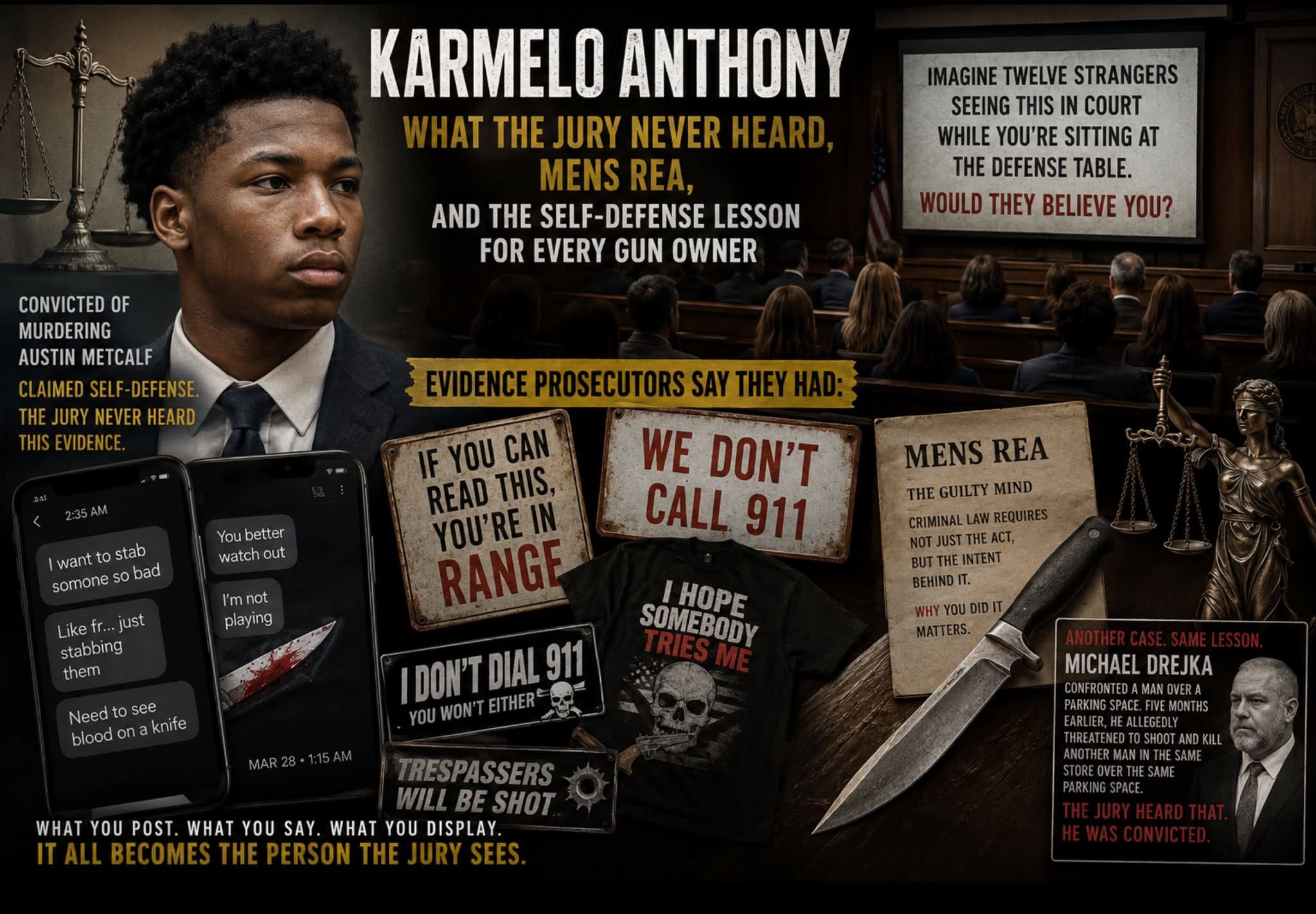
KARMELO ANTHONY: WHAT THE JURY NEVER HEARD, MENS REA, AND THE SELF-DEFENSE LESSON FOR EVERY GUN OWNER
August 22, 2026 · 8 min read