
He Got Out of the Fight. Then He Got a Rifle. Was He Still Acting in Self-Defense?
- Originally published:
- September 26, 2026
By Jeffrey S. Straub · 10 min read
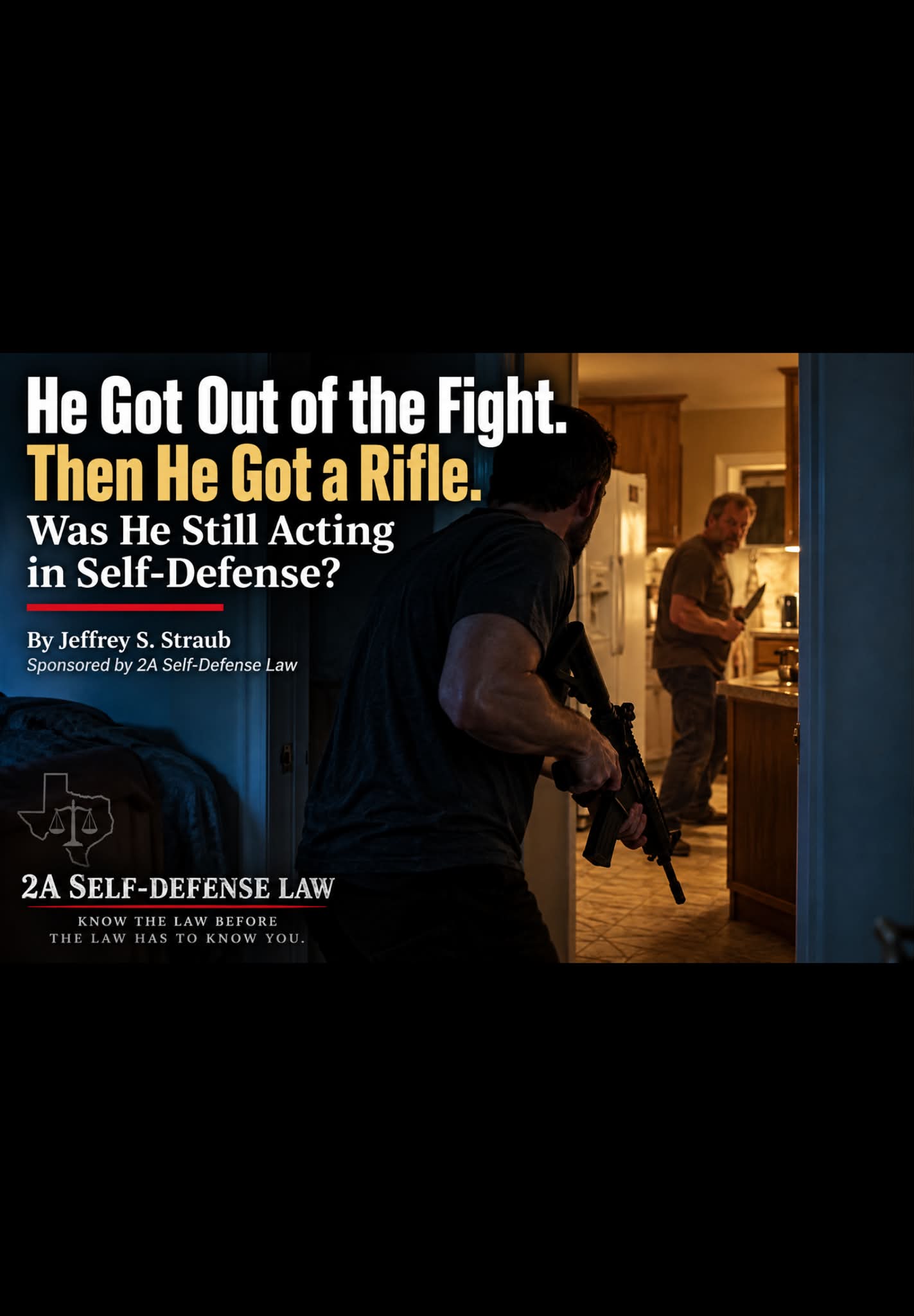
He Got Out of the Fight. Then He Got a Rifle. Was He Still Acting in Self-Defense?
By Jeffrey S. Straub | Sponsored by 2A Self-Defense Law
Self-defense cases are easiest to understand when everything happens in one continuous sequence. Someone attacks you, the threat escalates, you reasonably believe you’re facing death or serious bodily harm, and you use deadly force to stop it. Even then, attorneys can spend several days arguing over something that happened in six seconds. But at least the sequence makes sense. The October 2025 shooting of Christopher Dixon in Killeen, Texas, isn’t one of those cases. Here we have an argument, a fistfight, a separation, a bedroom, an alleged search for a knife, a rifle, another physical struggle, an alleged knife on the floor and finally a gunshot to the head. If somebody wanted to design a self-defense hypothetical specifically to make law students miserable, this would be a respectable effort.
The most interesting question isn’t simply whether 39-year-old Roland Bruce Lee III was justified when he shot his 58-year-old stepfather, Christopher Dixon. There is a more difficult question buried several minutes earlier. If you successfully disengage from a fistfight, arm yourself because you believe the other guy is getting a weapon, and then move back toward him, have you forfeited your right to self-defense? The easy answer is, “He got a rifle and went back. Obviously he became the aggressor.” The problem with easy answers in self-defense law is that statutes and case law have an annoying habit of wanting more information.
Before going further, one fact needs to be nailed firmly to the floor. Lee did not take a self-defense case to a jury and lose. Shortly before his scheduled trial, he pleaded guilty to the reduced charge of manslaughter. At a sentencing hearing in September 2026, he was sentenced to 16 years in prison. There was therefore no jury verdict deciding that Lee wasn’t acting in self-defense, no jury finding that he provoked Dixon, and no appellate opinion explaining where his self-defense rights disappeared. Anyone saying, “The jury rejected his self-defense claim,” has accomplished the rather impressive feat of inventing a jury.
The relationship between Lee and Dixon was already strained. Dixon was married to Lee’s mother, Janet Dixon, who had died only weeks before the shooting following a prolonged illness. Lee reportedly moved from West Virginia several months earlier to help care for her. According to testimony at sentencing, Lee and Dixon had been butting heads. Lee claimed Dixon had previously become physical with him and had once threatened him with a knife. There was also testimony concerning Lee’s belief that Dixon had caused the death of Lee’s dog the day before the shooting. Those allegations provide context. They don’t establish that Dixon was the aggressor on October 25, and they certainly don’t provide Lee with a coupon redeemable for one lawful homicide.
The immediate argument was apparently over White Claw and a payment card. According to Detective Jonathan Mueller’s account of Lee’s police interview, Lee purchased White Claw using a card associated with the household. Dixon confronted him. The argument apparently cooled temporarily after Lee gave Dixon some of the alcohol, meaning White Claw somehow managed to become both part of the dispute and the first peace treaty. Later, according to the account presented at sentencing, Dixon raised the card issue again and the confrontation became physical. Unfortunately, we don’t know who threw the first punch or initiated physical contact. Under Texas Penal Code § 9.31, a person generally may use force when and to the degree he reasonably believes it is immediately necessary to protect himself against another person’s use or attempted use of unlawful force. Who initiated that unlawful force therefore matters quite a bit.
Lee then reportedly went to his bedroom, physically separating himself from Dixon. That matters because Texas law recognizes that provocation can restrict self-defense but also recognizes abandonment. Section 9.31 addresses circumstances in which someone who provoked another person’s use of force subsequently abandons the encounter, or clearly communicates his intent to abandon it when he reasonably believes he cannot safely do so, and the other person nevertheless continues or attempts to use unlawful force. Even someone who helped start trouble doesn’t receive permanent aggressor status for the rest of the evening.
According to Lee’s account, while in the bedroom he heard Dixon rummaging around in the kitchen and believed Dixon was looking for a knife. Lee claimed Dixon had threatened him with one previously. That remains Lee’s allegation rather than an independently established fact, but what Lee reasonably believed at the time matters to the self-defense analysis. Lee then retrieved an AK-style 5.56 rifle, and this is where it becomes tempting to stop thinking. Lee got out of the fight, got a rifle and came back, so he re-engaged and lost self-defense. Case closed. Texas law has a problem with that shortcut.
The Texas Court of Criminal Appeals addressed the doctrine traditionally called “provoking the difficulty” in Smith v. State. The court identified three requirements: the defendant performed acts or used words that provoked the attack, those acts or words were reasonably calculated to provoke the attack, and the defendant acted with the intent that the provocation produce the attack so he would have a pretext for harming the other person. That final requirement is critical. Conduct that contributes to another person’s attack doesn’t automatically eliminate self-defense without evidence of the required intent.
The Court of Criminal Appeals revisited the doctrine in Elizondo v. State, a particularly useful case here. Elizondo was involved in a confrontation and moved toward his truck, where he retrieved a firearm. The State viewed his conduct as evidence that he was getting a gun rather than abandoning the confrontation. The Court of Criminal Appeals concluded the evidence wasn’t sufficient to support a provocation instruction because the required evidence of intent was missing. Merely getting the gun and continuing to participate in a developing confrontation wasn’t enough by itself.
That distinction is enormous for Lee. Getting the rifle isn’t automatically provocation. Leaving the bedroom isn’t automatically provocation. If Lee thought Dixon was getting a knife and he needed to be capable of defending himself, retrieving the rifle could be defensive preparation. If Lee thought the fight wasn’t over and got the rifle so they could finish it, we’re looking at something entirely different. Same rifle, same hallway, same two men, but very different legal consequences.
Texas Penal Code § 9.04 adds another wrinkle. Texas distinguishes between threatening deadly force and actually using deadly force. Producing a weapon for the limited purpose of creating apprehension that deadly force will be used if necessary does not itself constitute the use of deadly force. Texas courts have recognized that distinction in cases including Gamino v. State. In ordinary English, getting the gun out doesn’t necessarily mean you’ve legally crossed the same line as firing it. Sometimes displaying a firearm is intended to prevent the confrontation from reaching the point where anybody needs to shoot.
According to Lee’s statement as presented at sentencing, however, he didn’t simply retrieve the rifle and remain in his bedroom. He moved toward the area adjacent to the kitchen where Dixon was located. That makes his purpose critical. If Lee reasonably believed Dixon was obtaining a knife to continue the attack, moving into a position to respond to that threat is one scenario. If the fight had ended, everything was quiet, and Lee retrieved his rifle and returned to continue the argument, that is another. This is why Smith and Elizondo matter. They stop us from replacing legal analysis with geography. Moving from the bedroom toward the kitchen doesn’t itself tell us whether Lee was defending himself or provoking Dixon.
Texas retreat law makes this even more interesting. Texas Penal Code § 9.32(c) provides that a person who has a right to be present at the location where deadly force is used, has not provoked the person against whom deadly force is used, and is not engaged in criminal activity at the time is not required to retreat before using otherwise justified deadly force. Section 9.32(d) goes further by providing that when those conditions are satisfied, the factfinder may not consider whether the actor failed to retreat when deciding whether he reasonably believed deadly force was necessary.
That means “Lee could have stayed in his bedroom” isn’t the legal knockout punch it initially sounds like. Assuming Lee had a right to be elsewhere in the house, Texas law didn’t transform the bedroom into a legal cage simply because he had previously gone there. But don’t create the opposite bumper sticker either. “It’s my house, so I can walk wherever I want with my rifle” doesn’t resolve the case because the no-duty-to-retreat provision itself requires, among other things, that the actor hasn’t provoked the person against whom deadly force is used.
According to Lee, another physical struggle occurred after he returned armed. Dixon fell and allegedly dropped a knife. Lee claimed Dixon then reached toward the knife while getting back up. Lee fired once, striking Dixon in the head. At sentencing, Lee reportedly said he feared for his life because Dixon “was getting up.” If Lee’s account is accurate, we have now arrived at a different legal question from whether he should have left the bedroom.
Actually firing the rifle requires its own analysis under Texas Penal Code § 9.32. Texas permits deadly force when the actor would otherwise be justified under § 9.31 and reasonably believes deadly force is immediately necessary to protect against another person’s use or attempted use of unlawful deadly force. The word “immediately” matters. A previous knife threat doesn’t establish immediate necessity. Hearing someone rummaging in a kitchen doesn’t establish immediate necessity. If Dixon actually had a knife within reach and was attempting to retrieve it during an ongoing violent struggle, however, Lee potentially faced precisely the kind of deadly threat § 9.32 addresses.
This gives us two legal questions that shouldn’t be mashed together. The first is why Lee armed himself and moved back toward Dixon. That concerns provocation, abandonment and whether Lee was preparing for danger or intentionally helping create another confrontation. The second is what was happening at the instant Lee fired. That concerns whether Lee reasonably believed deadly force was immediately necessary. One question does not automatically answer the other.
Then we encounter the ugliest factual dispute. Detective Mueller reportedly testified that he believed the scene had been manipulated and that the knife near Dixon appeared to have been placed there. If investigators could establish that Lee positioned the knife after shooting Dixon, his self-defense explanation would have a catastrophic credibility problem. But Mueller’s opinion was challenged by Lee’s attorney, particularly concerning blood evidence, and Mueller acknowledged that he wasn’t a blood-spatter expert. The publicly available reporting doesn’t give us an independent forensic finding conclusively establishing that Lee planted the knife. A detective’s observation is evidence worth considering. It doesn’t acquire a lab coat merely because it helps one side’s argument.
Reporting from the sentencing hearing also indicated that Dixon suffered blunt-force injuries and 11 fractured ribs. Without the complete autopsy and forensic record, however, we can’t confidently determine exactly when or how those injuries occurred. They demonstrate substantial violence, but they don’t automatically tell us who was legally responsible for initiating each stage of it.
This is also where communication could have changed the evidentiary picture dramatically. Imagine Lee had called 911 from the bedroom and said, “We just had a fight. I’ve gotten away from him. I think he’s getting a knife. I don’t want to fight him anymore. Send police.” That recording wouldn’t automatically establish self-defense, but it would provide contemporaneous evidence of Lee’s state of mind before anyone died. The same applies face-to-face. “Stop. Don’t hurt me. I don’t want to fight,” sounds almost painfully simple. That’s exactly why it works. Good self-defense communication should make sense twice: once during the encounter and again when repeated by a neutral witness in a courtroom.
Lee never asked a jury to resolve these questions. Shortly before his scheduled trial, he pleaded guilty to manslaughter and was later sentenced to 16 years. That tells us how the prosecution ended. It doesn’t tell us whether a jury would have believed Lee’s account of the knife, whether the knife was actually staged, who initiated either confrontation, or whether Lee’s actions satisfied Texas’s provocation doctrine.
That is why the lesson isn’t “never get your gun after a fight.” Texas law doesn’t support that rule. If someone has attacked you, you’ve separated from him, and you reasonably believe he’s retrieving a deadly weapon to continue the attack, preparing yourself to meet that threat may be entirely reasonable. The lesson isn’t “never leave the room,” either. Texas law doesn’t require you to surrender your house one room at a time until you’re standing in the backyard wondering whether the guy with the knife now owns the refrigerator.
The lesson is that arming yourself and re-engaging are not automatically the same thing. Smith and Elizondo tell us that provocation requires more than simply pointing at conduct that contributed to a confrontation. Sections 9.31 and 9.32 require us to examine justification, provocation and immediate necessity. Section 9.04 reminds us that producing a weapon isn’t necessarily the same thing as using deadly force. Texas retreat law reminds us that a qualifying defender isn’t legally required to flee merely because escape might have been possible.
The trigger pull lasted a fraction of a second, but the legal problem developed over several minutes. Getting the rifle may not have been the critical mistake at all. It could have been reasonable preparation for a threat Lee believed was coming. The harder questions are what Lee intended to accomplish after he picked it up, what Dixon did in response, and whether deadly force was immediately necessary when Lee finally pulled the trigger. Self-defense law doesn’t judge the firearm sitting in your hands. It judges the circumstances, your choices and what you chose to do with it. 2A Self-Defense Law: Know the law before the law has to know you.
National Cases and Constitutional Issues
Related articles
National Cases and Constitutional Issues
The First Shot, the Second Shot, and Everything She Did Afterward
October 16, 2026 · 6 min read

National Cases and Constitutional Issues
SHE SHOT HER HUSBAND THROUGH A PILLOW. MURDER, RIGHT?
September 19, 2026 · 6 min read
National Cases and Constitutional Issues
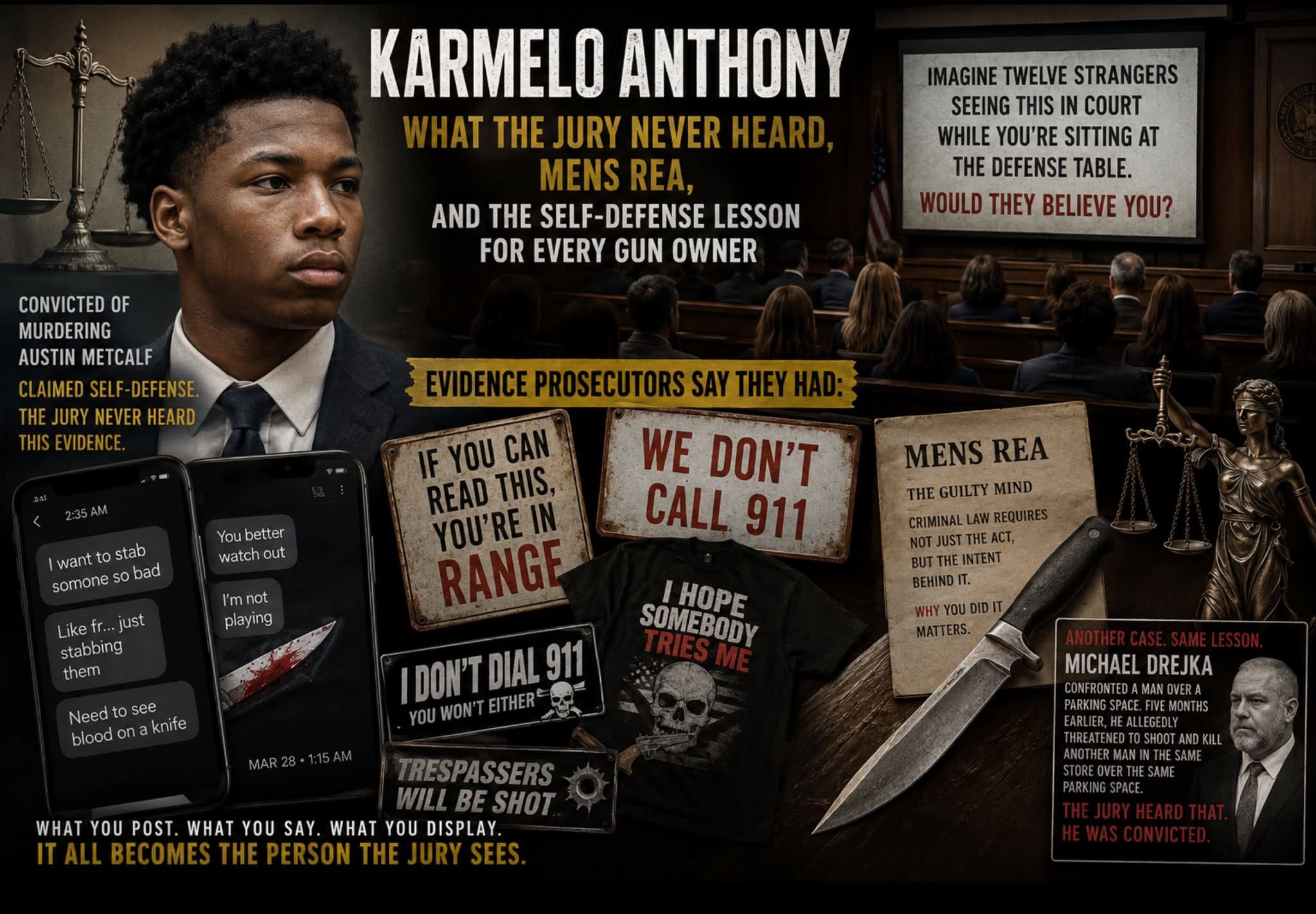
KARMELO ANTHONY: WHAT THE JURY NEVER HEARD, MENS REA, AND THE SELF-DEFENSE LESSON FOR EVERY GUN OWNER
August 22, 2026 · 8 min read