KARMELO ANTHONY: WHAT THE JURY NEVER HEARD, MENS REA, AND THE SELF-DEFENSE LESSON FOR EVERY GUN OWNER
- Originally published:
- August 22, 2026
By Jeffrey S. Straub · 8 min read
KARMELO ANTHONY: WHAT THE JURY NEVER HEARD, MENS REA, AND THE SELF-DEFENSE LESSON FOR EVERY GUN OWNER
By Jeffrey S. Straub
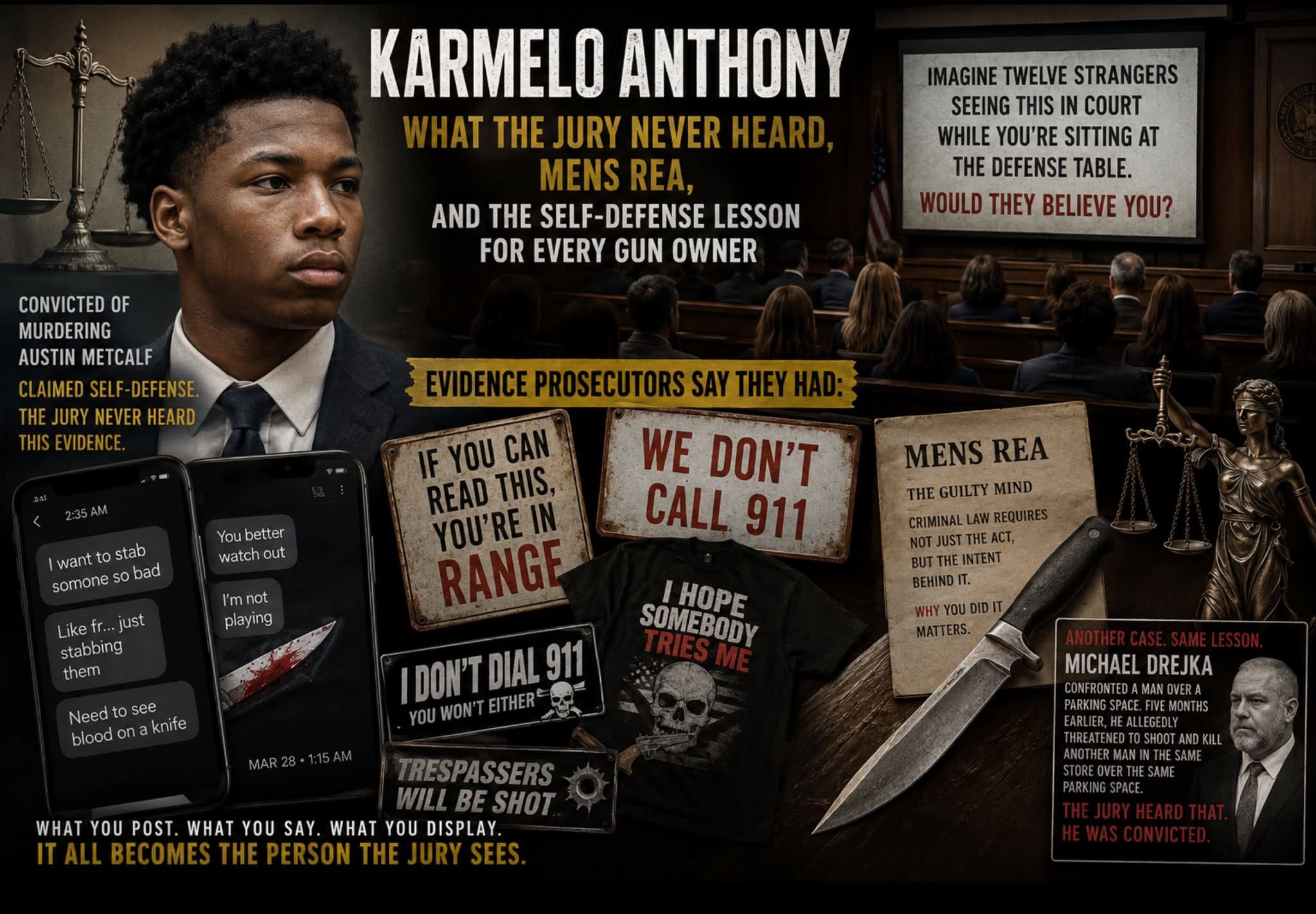
Karmelo Anthony was convicted of murdering 17-year-old Austin Metcalf after stabbing him during a confrontation at a Texas high-school track meet. Anthony claimed self-defense. The jury rejected that claim and convicted him, but some of the most disturbing information prosecutors say they possessed about Anthony was never heard by the people deciding his guilt.
That is what makes this case so interesting to me from the standpoint of self-defense law. I’m not interested in retrying Anthony on Facebook. I’m interested in what prosecutors say they knew about him, what the jury didn’t know, and what might happen in another self-defense case if comparable evidence is legally admitted.
During proceedings after Anthony’s conviction, prosecutors disclosed allegations and evidence concerning his conduct, communications and apparent interest in knives and violence. According to testimony and evidence presented during those proceedings, Anthony’s former girlfriend had become frightened enough by his behavior that she reported him to school officials on the morning of April 2, 2025, the same day Austin Metcalf was killed. She reportedly believed Anthony was stalking her.
Prosecutors also disclosed communications they said involved knives, guns, fighting and violence. Among the material described publicly was an alleged message involving a graphic fantasy about stabbing someone and blood on a blade. Prosecutors also referenced other weapon-related material and an earlier alleged school-related threat.
Now stop for a moment and consider the timing.
This isn’t simply a hypothetical situation where prosecutors searched backward ten years after a homicide and found an offensive joke. According to what prosecutors presented during the post-trial proceedings, at least some of the alleged conduct involving Anthony’s former girlfriend was occurring right around the time of the homicide, including her report to school officials on the morning Metcalf was killed.
There is an important legal qualification here. The jury that convicted Anthony did not hear this material, and those allegations were not established by the murder verdict. An agreement between the prosecution and defense kept potentially damaging character and extraneous-conduct evidence concerning both Anthony and Metcalf away from the jury. I am therefore not presenting every allegation as a proven fact about Anthony.
In some ways, however, the fact that the jury never heard it makes the case even more valuable as a teaching example.
Imagine that you are sitting on Anthony’s jury and that a judge has determined some of this evidence is legally admissible. You hear Anthony’s claim that he acted in self-defense during a sudden confrontation. Then you are shown legally admissible communications involving knives, stabbing or violence, perhaps coupled with evidence of his behavior immediately before the killing.
Would you evaluate his state of mind exactly the same way?
That question takes us directly into mens rea, the concept sometimes translated as the “guilty mind.” Criminal law doesn’t concern itself solely with the physical act. Depending upon the offense, the person’s mental state can be enormously important. Intent, knowledge, recklessness and other mental states can help distinguish one crime from another and criminal conduct from conduct that may be legally justified.
Self-defense makes the question especially interesting because the physical act doesn’t tell us everything.
One person can shoot or stab another because he reasonably believes he is facing an imminent threat of death or great bodily harm. Another person can perform essentially the same physical act because he is angry, wants revenge, or wants to punish somebody.
A knife enters another person’s body in either scenario.
The question becomes why it happened and whether the use of force was legally justified.
That is where someone’s previous statements and conduct can become enormously dangerous evidence. The prosecution generally cannot simply introduce evidence saying, “This is a bad person, therefore he probably committed this crime.” Character and propensity evidence are restricted for very good reasons.
But that does not mean everything from your past is automatically protected from the jury.
Depending upon the jurisdiction and circumstances, prosecutors may seek to introduce particular prior statements or conduct for another legally permissible purpose, such as proving motive, intent, knowledge, preparation, plan or absence of mistake, or rebutting something the defense itself has placed into issue. The defense can challenge that evidence, and a judge can exclude it for several reasons, including the danger of unfair prejudice.
The Anthony case demonstrates how consequential that fight can become.
One of the major issues in Anthony’s effort to obtain a new trial concerned whether putting Anthony himself on the witness stand could have opened the door to damaging evidence that both sides had previously understood would remain outside the trial. His attorneys argued that the dispute affected Anthony’s ability to exercise his right to testify because taking the stand risked exposing him to evidence the jury otherwise wouldn’t hear.
Think about what that means.
Evidence that never reached the jury nevertheless became important enough that the possibility of it reaching the jury became part of the legal battle over whether Anthony himself could safely testify.
That should get the attention of anybody who owns or carries a firearm for self-defense.
Your Facebook page isn’t a private conversation with your current friends once you’re involved in a homicide investigation. Neither are your text messages necessarily going to remain forgotten pieces of your past. The stupid meme about hoping somebody breaks into your house, the photograph of your gun captioned “I hope somebody tries me,” the T-shirt joking about killing people, or the bumper sticker threatening anyone who comes onto your property may suddenly look considerably different when investigators and prosecutors examine them after someone is dead.
The same applies to physical signs.
I recently visited a property where signs along the driveway included messages such as “If you can read this, you’re in range” and “We don’t call 911.” I have no reason to believe the homeowner intends to hurt anybody. They may simply be jokes or an attempt to discourage trespassing.
Now change one fact.
Someone gets shot on that property.
The homeowner claims self-defense and tells a jury that he desperately wanted to avoid shooting anyone but reasonably believed he faced an imminent deadly threat. If a judge determines those signs are admissible for some legitimate evidentiary purpose, imagine photographs of them appearing on a courtroom screen while the homeowner is making that claim.
The signs don’t prove murder. They don’t eliminate someone’s right to self-defense. They may not be admissible at all.
But why create the evidence?
There is a real homicide case that shows what can happen when evidence concerning previous conduct actually does reach a jury.
Michael Drejka shot and killed Markeis McGlockton outside a Florida convenience store in 2018. Drejka had confronted McGlockton’s girlfriend about parking in a disabled parking space. McGlockton came out of the store and violently shoved Drejka to the ground. Drejka drew his handgun and shot McGlockton as McGlockton was moving away.
Drejka claimed self-defense.
Approximately five months earlier, however, Drejka had been involved in another confrontation at the same convenience store over the same disabled parking space. Richard Kelly testified that Drejka confronted him, photographed his vehicle and threatened to shoot and kill him. Evidence was also presented that Drejka later contacted Kelly’s employer and said Kelly was lucky Drejka hadn’t been carrying a gun because he could have shot him.
Drejka’s attorneys fought to keep that previous incident away from the jury.
They lost.
The trial court admitted the evidence, and the Florida appellate court subsequently upheld its admission as relevant to Drejka’s state of mind and self-defense claim. Drejka was convicted of manslaughter.
That distinction is important. The legal argument wasn’t simply, “Drejka did something bad before, therefore Drejka is a bad man and must be guilty.” The previous incident had striking similarities to the fatal confrontation and was considered relevant to an issue the jury legitimately had to evaluate.
Same store. Same disabled parking space. Only months apart. Another confrontation. And an alleged threat involving shooting someone.
Now put yourself in the jury box.
Drejka is asking you to believe that during the fatal encounter he reacted to an unexpected attack because he genuinely believed deadly force was necessary. The prosecution has just shown you another remarkably similar confrontation in which he allegedly threatened to shoot somebody.
You cannot make the jury unhear that.
That brings us directly back to Anthony.
We don’t know what Anthony’s jury would have done if it had heard some or all of the additional evidence prosecutors disclosed after his conviction. Perhaps a judge would have excluded most of it. Perhaps the defense would have successfully limited it. Perhaps some of it would have been admitted and the jury still would have reached exactly the same verdict.
But ask yourself the question that matters for the armed citizen.
Would you want your self-defense case to depend upon winning that evidentiary fight?
If you carry a firearm, you should be the person walking away from unnecessary confrontations. You don’t need to police somebody else’s parking space, chase a shoplifter, confront the driver who cut you off, follow somebody because he insulted you, or turn an argument with a stranger into a contest over who gets the last word.
And you certainly don’t need to spend years manufacturing evidence suggesting that you fantasize about the day you finally get to shoot somebody.
Carrying a firearm should make you less interested in confrontation, not more interested in it. You possess the ability to turn a completely meaningless argument into a homicide investigation in seconds.
The strongest self-defense case isn’t simply one where the physical evidence supports you. It is one where your behavior supports what you eventually tell the jury. You avoided trouble when you reasonably could. You attempted to disengage. You didn’t threaten anybody. You weren’t looking for an excuse to use your weapon. You didn’t unnecessarily escalate the encounter. When you finally used force, you did so because you reasonably believed it was necessary to protect yourself or somebody else from an imminent threat.
Jurors are human beings. A judge can give limiting instructions and lawyers can spend hours arguing about the technical purpose for which particular evidence may be considered. But once jurors legitimately learn something about you, they cannot erase it from their minds.
Karmelo Anthony’s case provides an unusually powerful example because we now know about potentially devastating material his jury never heard. Michael Drejka provides the other side of the lesson because his jury actually did hear evidence concerning a remarkably similar previous confrontation.
Somewhere between those two cases is the lesson for the rest of us.
Before posting the tough-guy Facebook meme, putting the threatening bumper sticker on your truck, wearing the T-shirt joking about killing somebody, sending the text about hoping someone “tries” you, or hanging “If you can read this, you’re in range” at the entrance to your property, imagine an entirely different audience.
Imagine twelve strangers seeing it projected onto a courtroom screen while you’re sitting at the defense table telling them that you never wanted to hurt anybody and used deadly force only because you reasonably believed you had no other choice.
Then decide whether it’s still funny.
Jeffrey S. Straub
This article is for educational discussion of self-defense and evidence law. Allegations discussed concerning Karmelo Anthony that were not presented to his murder jury should not be understood as facts established by that verdict. Self-defense and evidentiary laws vary by jurisdiction, and nothing here constitutes individualized legal advice.
National Cases and Constitutional Issues
Related articles
National Cases and Constitutional Issues
The First Shot, the Second Shot, and Everything She Did Afterward
October 16, 2026 · 6 min read
National Cases and Constitutional Issues
He Got Out of the Fight. Then He Got a Rifle. Was He Still Acting in Self-Defense?
September 26, 2026 · 10 min read
National Cases and Constitutional Issues
SHE SHOT HER HUSBAND THROUGH A PILLOW. MURDER, RIGHT?
September 19, 2026 · 6 min read