
Provocation, Resisting Arrest, and Minnesota Self-Defense Law
- Originally published:
- January 25, 2026
By Jeffrey S. Straub · 3 min read · Minnesota
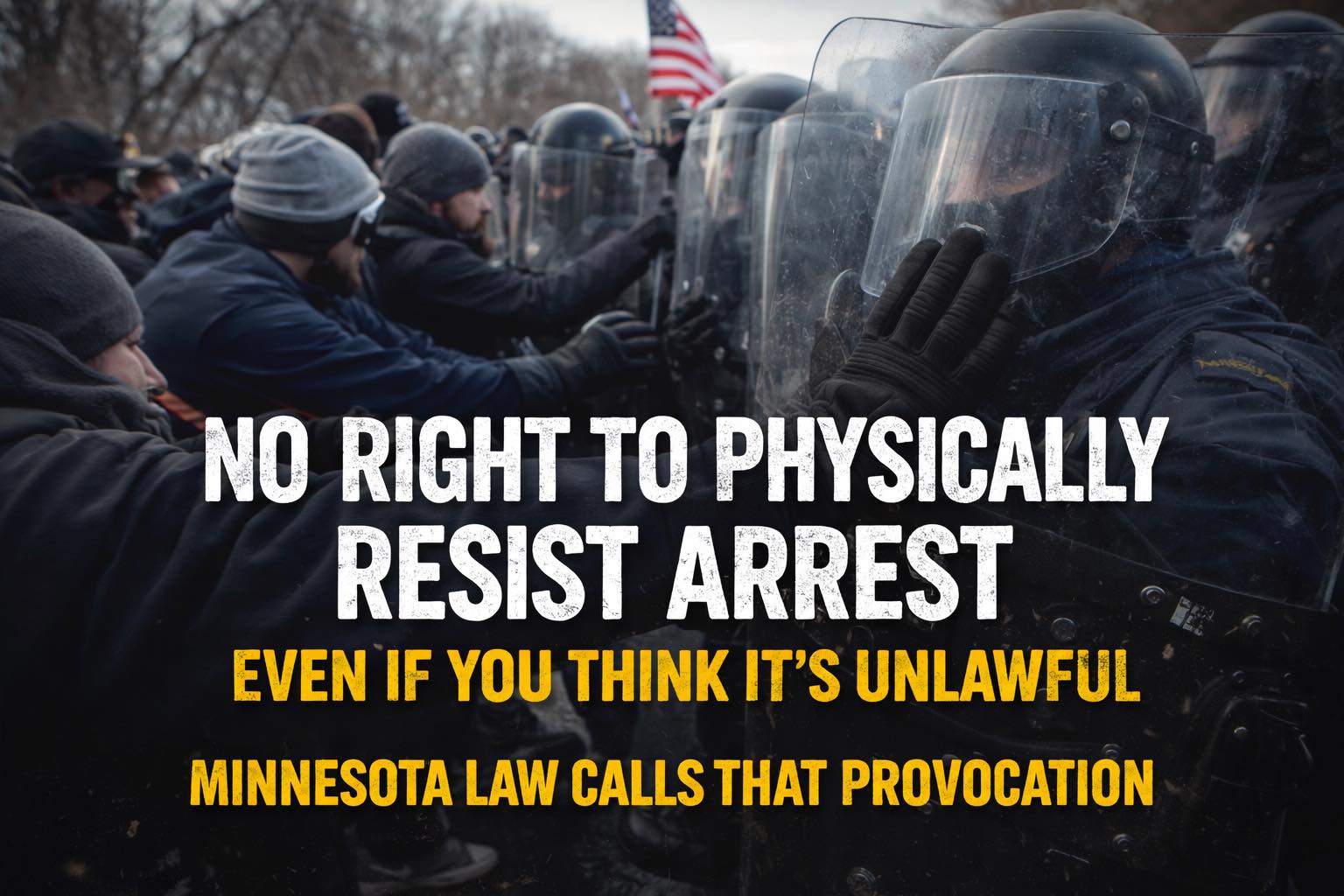
I keep seeing people argue about “provocation” after the ICE shooting in Minneapolis like it’s a vibe check or a moral judgment. That’s not how Minnesota law works. At all.
So let me explain this the way a Minnesota court actually sees it, not the way Twitter does. First thing you have to understand, and this is non-negotiable in Minnesota: There is no general right to physically resist an arrest, even if you believe the arrest is unlawful.
That’s not my opinion. That’s settled Minnesota case law. The Minnesota Supreme Court said it straight out in State v. Wick (1983): Minnesota does not recognize a right to use force to resist an unlawful arrest or search. Period. The remedy is court later, not street justice now. That rule didn’t come out of nowhere. Wick relied on earlier cases, State v. Hoagland (1978), In re Burns (1979), State v. Kittleson (1981), all moving in the same direction. And the court doubled down again in City of St. Louis Park v. Berg (1988).
Translation into plain English: If you start physically fighting an arrest, you’ve just committed a new crime, regardless of whether the arrest itself turns out to be bad.
That’s where Minn. Stat. § 609.50 comes in, obstructing legal process. That statute criminalizes resisting, interfering with, or obstructing an officer performing official duties. Minnesota courts treat physical interference with an arrest, pushing in, grabbing, blocking, encircling, as textbook 609.50.
Now here’s where people start getting uncomfortable. Once someone, or a group, moves from yelling to physical interference, the legal story flips. This is where what I’m calling organizational provocation shows up. There’s no statute with that title, but the concept absolutely exists in how courts analyze these cases. When a crowd: swarms officers, interferes with an arrest, encircles or presses in, grabs at people or equipment,
that’s not “just protest” anymore. That’s escalation. And under Minnesota law, escalation matters. Why? Because from that moment forward, the law treats the interferers as new suspects, not concerned bystanders. And that escalation becomes part of the totality of the circumstances used to judge what happens next.
Now let’s talk about the part people keep trying to rewrite after the fact. When courts evaluate an officer’s use of force, they do not ask: what social media thinks, what looks bad in hindsight, or what someone watching video later believes.
They ask one thing: What would a reasonable officer perceive in that moment?
That standard comes from Graham v. Connor (1989) and is fully baked into Minnesota law through cases like State v. Basting (1997) and others. The analysis explicitly excludes hindsight. And Minnesota’s deadly-force statute, Minn. Stat. § 609.066, allows deadly force only if the officer reasonably believes it’s necessary to protect against death or great bodily harm.
So in a “pressure cooker” situation, crowd interference, physical escalation, chaos, the crowd’s conduct isn’t background noise. It’s part of what shapes the officer’s perception in real time. That’s the part activists hate. And it’s also the part law-and-order folks sometimes oversimplify.
Because here’s the honest truth: This framework is brutal on everyone. From one angle, it feels rigged because people are told “don’t resist, sue later,” while officers get a deferential standard when things spiral. From the other angle, it’s the only way the law knows how to prevent street-level brawls from turning into full-blown riots.
But love it or hate it, this is the doctrine. In Minnesota, once physical resistance or interference begins: self-defense narratives collapse, obstruction charges attach, and the officer’s use of force is judged through a reasonable-officer, totality-of-the-circumstances lens.
That doesn’t mean officers get a free pass. It means the fight over legality happens after, in court, not during the arrest. You can protest. You can yell. You can film. You can sue.
But the moment a crowd physically interferes with an arrest, Minnesota law stops treating that as expression and starts treating it as provocation and everything downstream changes fast.
That’s not politics. That’s not narrative control. That’s Minnesota law as it actually exists.
Minnesota Case Analysis and Use-of-Force Law
Related articles
Minnesota Case Analysis and Use-of-Force Law
Minnesota's Castle Doctrine: The Statute Says Felony, but the Courts Ask a Harder Question
Minnesota law permits deadly force to prevent certain felonies in the home, but that does not make every felony a license to kill. Learn how the courts interpret necessity, reasonableness, retreat, and the rights of co-residents.
October 20, 2026 · 9 min read
Minnesota Case Analysis and Use-of-Force Law
EZEKA v. STATE: A THREAT IS NOT YET AN IMMINENT THREAT
September 30, 2026 · 3 min read
Minnesota Case Analysis and Use-of-Force Law
STATE v. BAKER: RE-ENGAGEMENT AND THE INNOCENT STANDARD
September 29, 2026 · 7 min read