
It May Be Lawful. And It Can Still Be Awful.
- Originally published:
- January 25, 2026
By Jeffrey S. Straub · 4 min read · Minnesota
It May Be Lawful. And It Can Still Be Awful.
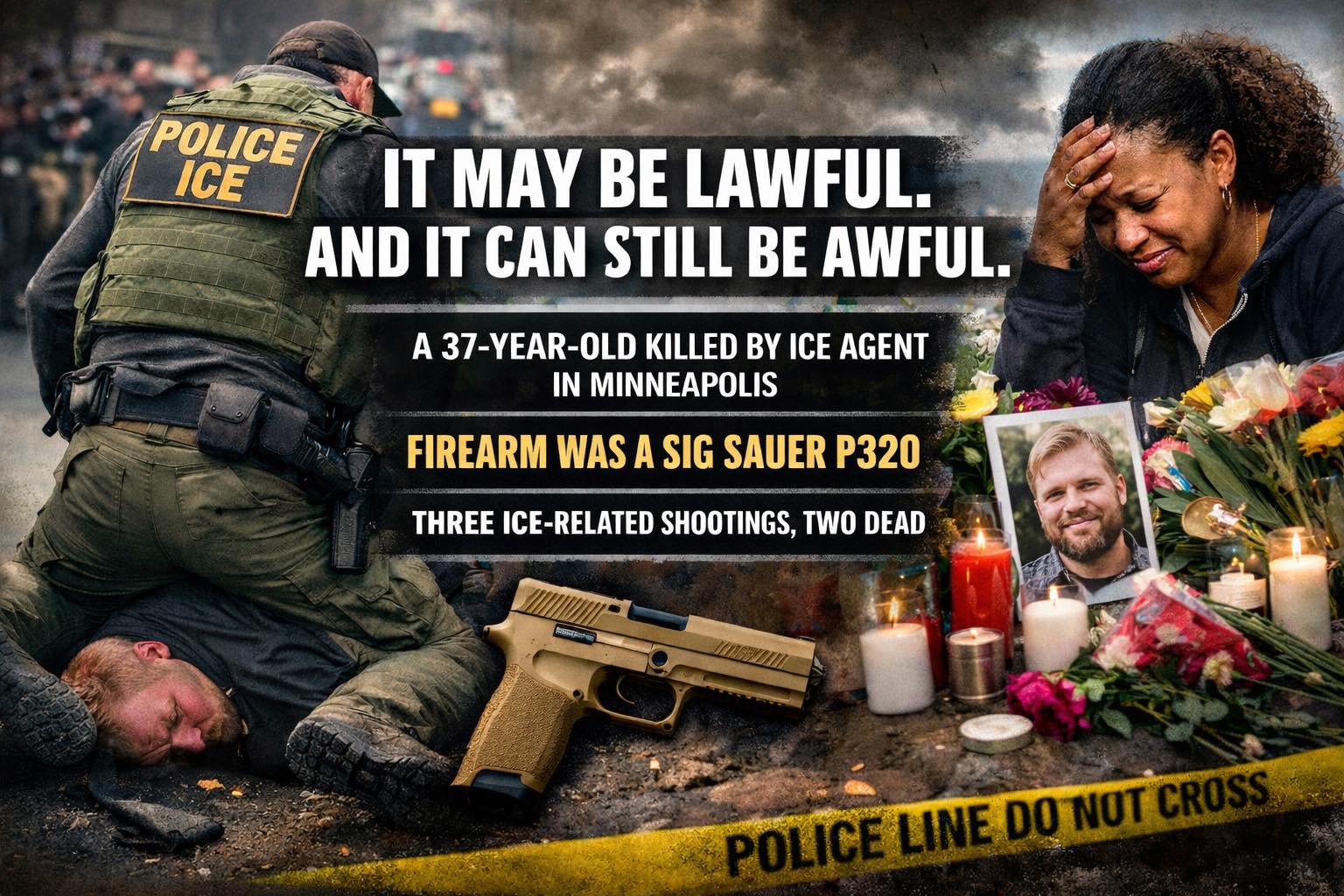
A 37-year-old Minneapolis man is dead after a federal Border Patrol agent shot him during an immigration enforcement action. The video is out there now. People are already picking sides, freezing frames, and making declarations like they know exactly what should have happened.
Before we go any deeper, let’s ground ourselves in how the law actually works, because it doesn’t work the way armchair analysis on social media does.
This wasn’t a quiet traffic stop. It wasn’t a simple arrest. It happened in the middle of a tense, live federal immigration enforcement operation, with protesters, agents, confusion, pepper spray, physical struggle, and a firearm in the mix. That context matters.
And here’s the legal knife-edge: The standard for using deadly force isn’t perfect knowledge. It isn’t “he knew exactly what was happening.” It isn’t “he had every fact in front of him.” It’s reasonable perception in the moment itself.
That’s not my opinion. It comes straight from Graham v. Connor, the Supreme Court case that governs use-of-force law everywhere in the U.S. The Court said force must be judged from the perspective of a reasonable officer on the scene, recognizing they’re making split-second decisions under stress, not with the luxury of calm hindsight.
Minnesota law tracks this too. Under Minn. Stat. § 609.06 and the relevant jury instructions, deadly force is justified if an officer reasonably believes there’s imminent risk of death or great bodily harm. That’s the legal calculus, what the officer reasonably believed right then, not what we see hours later on video.
Now look at what actually unfolded on street level. Video, witness accounts, and preliminary reporting show the man was holding a cell phone, not a gun, in the initial moments. He was filming. He stepped toward agents after another person was pushed. Agents sprayed him with a chemical irritant. He was taken to the ground. He was wrestling with multiple officers. Then the moment everyone circles: the jacket rode up and a firearm became visible during the struggle.
In that chaos, once an officer knows or reasonably believes a gun is present in a physical struggle, the threat picture changes instantly. You don’t need brandishing. You don’t need pointing. You don’t need a shot fired first.
A firearm in a ground fight is one of the most dangerous things an officer can face. The law doesn’t require cops to wait until someone fires at them to perceive a deadly threat and that’s baked into decades of use-of-force doctrine and case law.
Now let’s add a piece of factual texture that people have been glossing over. The man’s family said he was a lawful concealed carrier who normally didn’t carry in public, but he did that day. That’s context, not character judgment. And it raises a real question:
Why carry that day?
Was it just personal protection? Or was it because of the environment, protests, controversy, politics, rhetoric that’s been painting federal agents as illegitimate, dangerous, even morally contemptible?
We don’t know what was in his mind. But we do know how social incentives work.
When a group is repeatedly framed as illegitimate or hostile, when people are encouraged to “get between” officers and others, you lower the psychological barrier to confrontation. People start to feel justified inserting themselves, even physically, into police encounters. And once they do that while armed, the risk of a tragic outcome spikes dramatically.
Minnesota has now had three ICE-related shootings, two of which have been deadly, in a short span of time. That’s not normal. That’s a pattern.
Here’s another piece of the puzzle that’s getting a lot of attention: The firearm involved, reportedly a SIG Sauer P320, is a widely carried pistol, including by law enforcement and civilians alike. But it is also a gun that has been at the center of safety controversy for years. Early models were implicated in drop-fire issues, and there have been numerous reports alleging uncommanded discharges, that is, firing without a trigger pull. 
The manufacturer has issued upgrades and disputes that there’s a defect, but the fact remains this model has history in the safety conversation. In this case, available video and accounts do not clearly show the gun firing on its own, and we do not know whether any discharge occurred while an officer was trying to secure it. That’s a factual issue for a thorough investigation, not speculation.
Point is: the presence of a real firearm, with a contested safety reputation, carried that day by a man who didn’t normally carry, becomes one more variable in an already volatile scene.
So here’s the uncomfortable truth people keep missing: You can conclude the officer’s actions were legally justified under the “reasonable perception” standard and still look at the totality of circumstances and call the outcome awful.
Those things are NOT mutually exclusive.
In the real world
• a man is dead,
• a family is grieving,
• agents are traumatized,
• a city is polarized,
• and the public is asking whether anything is actually safer now than before.
Legally? The shooting may end up being justified under Graham v. Connor and Minnesota’s use-of-force standard.
Morally and socially? It can still be awful.
And that dual truth, lawful and awful, is exactly why we need a real conversation about how our rhetoric, our politics, and our individual choices create conditions where those tragic moments become not just possible, but predictable. 
Minnesota Case Analysis and Use-of-Force Law
Related articles
Minnesota Case Analysis and Use-of-Force Law
Minnesota's Castle Doctrine: The Statute Says Felony, but the Courts Ask a Harder Question
Minnesota law permits deadly force to prevent certain felonies in the home, but that does not make every felony a license to kill. Learn how the courts interpret necessity, reasonableness, retreat, and the rights of co-residents.
October 20, 2026 · 9 min read
Minnesota Case Analysis and Use-of-Force Law
EZEKA v. STATE: A THREAT IS NOT YET AN IMMINENT THREAT
September 30, 2026 · 3 min read
Minnesota Case Analysis and Use-of-Force Law
STATE v. BAKER: RE-ENGAGEMENT AND THE INNOCENT STANDARD
September 29, 2026 · 7 min read