
Innocence, Retreat, and the White-Knight Trap
- Originally published:
- December 15, 2025
By Jeffrey S. Straub · 5 min read · Minnesota
Innocence, Retreat, and the White-Knight Trap
Why Defense of Others Is Where Good Intentions Go to Court
By Jeffrey Straub
Sponsored by 2A Self-Defense Law
Most people think self-defense law works like a checklist you can memorize. Were you innocent? Was the threat imminent? Was the force proportional? Could you retreat? Answer the questions, check the boxes, move on. That might work in theory. It doesn’t work in real life. And it definitely doesn’t work that way in Minnesota.
In actual cases, innocence and retreat don’t live in separate compartments. They interact. They bleed into each other. A shift in one changes how the other is judged. Even though the law treats them as distinct concepts, juries don’t experience them that way. The cleanest way to describe that relationship is quantum entanglement: two separate things that remain distinct, but once connected, a change in one immediately affects the other. That’s innocence and retreat in Minnesota.
People like to focus on who “started it.” That matters, but it’s not the whole story. Innocence isn’t determined at the exact second force is used. It’s evaluated across a timeline. What you said. Where you went. Whether you escalated. Whether you stayed when you didn’t have to. Whether you inserted yourself into something you didn’t fully understand. Once a jury starts thinking, “This didn’t have to happen,” innocence starts to weaken. Fear sounds less convincing. Necessity sounds less inevitable. That’s where retreat quietly reenters the picture, not as cowardice, not as morality, but as context.
Minnesota is not a Stand Your Ground state. Outside the home, there is a judicially created duty to retreat if it can be done safely. Inside the home, the Castle Doctrine applies and there is no duty to retreat. Mixing those two up gets people charged. It also matters that retreat isn’t limited to the moment someone pulls a trigger.
In State v. Blevins, the Minnesota Supreme Court dealt with a felony assault-fear case involving a dangerous weapon designed to cause harm, a machete. The court held that if safe retreat is reasonably available, the duty to retreat applies before displaying that weapon. The ruling didn’t say defensive displays are always illegal. What it did say is that brandishing is not some automatic legal buffer that replaces retreat. Once a weapon enters the picture, prosecutors don’t spend much time on your intent. They ask one question first: why didn’t you leave? And once that question lands, innocence and retreat stop being separate conversations.
Before we even get to defense of others, there’s a scenario a lot of men carry around in their heads, whether they talk about it or not.
It’s the moment where you step in. Where someone needs help and you’re the one who answers. Where the lines are clear, the threat is obvious, and doing the right thing feels undeniable. It’s the white-knight moment. The instinct to protect. To stop something ugly. To be the guy who didn’t look away while someone else was being hurt. There’s nothing wrong with that instinct. In a lot of ways, it’s healthy. It’s wired deep into how men see themselves.
The problem is that the law doesn’t get to see that version of the story. It doesn’t see intention. It doesn’t see identity. It doesn’t see the role you thought you were stepping into. It only sees facts and sometimes those facts don’t line up with the role you thought you were playing. That’s why defense of another is such a legal minefield.
Picture this.
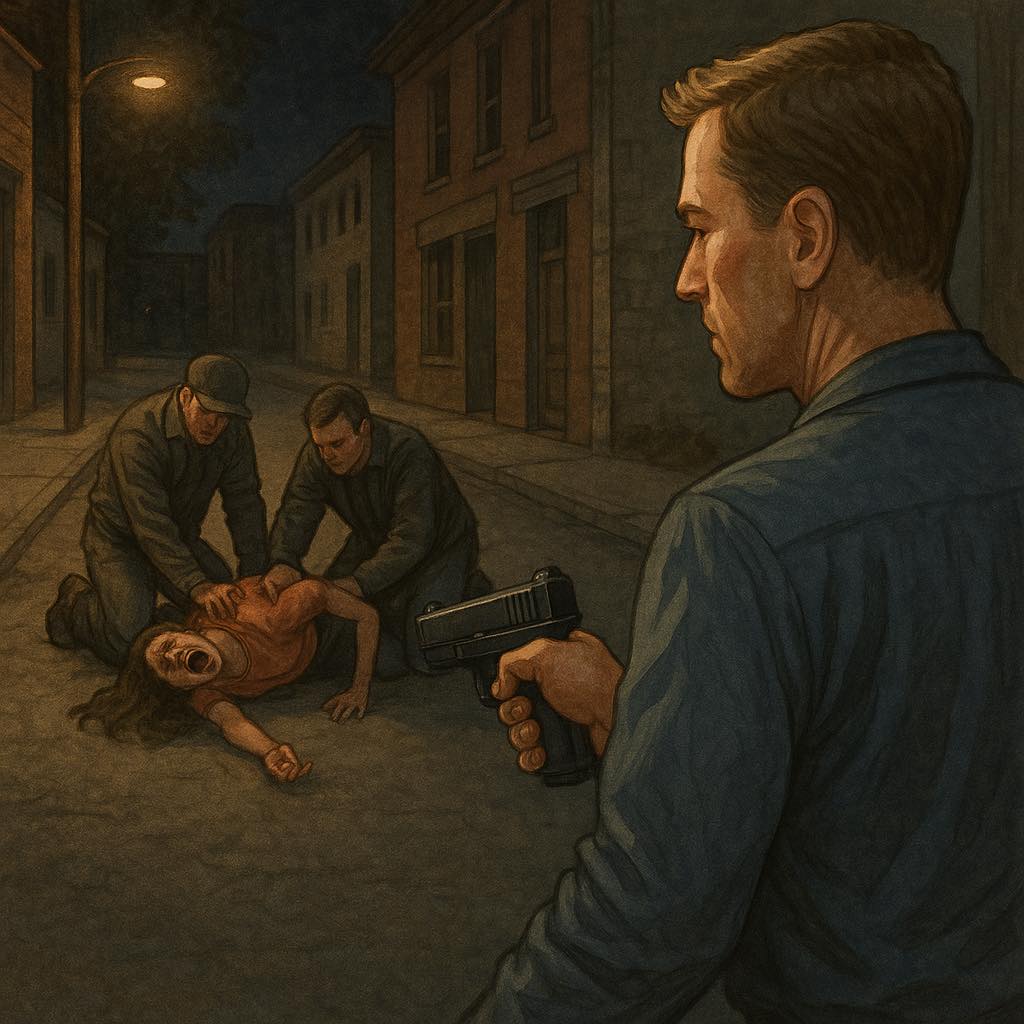
You’re walking down the street late at night. It’s quiet. Then you hear it. A woman screaming. Not yelling. Screaming.
“Rape! Rape! Somebody help me!”
Your heart rate jumps. Adrenaline hits. You’re not thinking about statutes or case law. You round the corner and see two men on top of a woman. She’s struggling. She’s screaming. It looks exactly like what you think it looks like.
So you draw your weapon.
In that moment, most men reading this feel the same thing: of course you do. That’s the scenario people use in every argument about defense of others. The one that feels morally obvious. But here’s the part no one wants to talk about. Later, you find out those two men were vice officers. Undercover. Making an arrest for prostitution. The woman was resisting, loudly, desperately, convincingly. Your intentions didn’t change. Your reaction felt justified. But the legal framework just shifted under your feet.
Now the question isn’t whether you were brave. It’s whether the person you defended was actually or reasonably appeared to be, entitled to use that level of force herself. If she wasn’t, your justification doesn’t survive the unraveling. That’s the risk most people never train for.
Defense of others isn’t judged by how bad the situation looked to you emotionally. It’s judged by whether your belief about what was happening was reasonable in light of what the law later determines was actually happening. And this is where innocence and retreat fully entangle. You didn’t know the backstory. You didn’t know who started what. You didn’t know whether lawful authority was involved. But by stepping in, you tied your legal fate to someone else’s situation, a situation you didn’t witness from the beginning and couldn’t control.
This is where State v. Valdez matters and where people misunderstand what it actually protects. Valdez does not say, “If you think someone’s in trouble, you’re covered.” It says that when you are defending another person, you do not have an independent duty to retreat yourself if you reasonably believe that person cannot safely retreat. That’s an important protection. But it’s not a blank check.
The law still asks whether your belief about that person’s situation was reasonable. Whether the person you stepped in for reasonably appeared to have no safe option. Whether your intervention mirrored what that person would have been legally justified in doing themselves. In other words, Valdez protects you from being forced to abandon someone you reasonably believed had no other option. It does not protect you from being wrong. And that’s where the white-knight instinct gets men into trouble.
Defense of others feels morally clean. Legally, it’s one of the riskiest positions you can take. Because now innocence isn’t just yours. It’s shared. Your innocence depends on their apparent innocence. Your necessity depends on their apparent options.
If the person you defend started the fight, escalated it, or could safely disengage and you reasonably should have perceived that your justification weakens. Not because you’re a bad person. Not because your intentions were wrong. But because defense of others links your legal fate to facts you may never fully know in real time.
Here’s the part that’s uncomfortable but necessary to say. Strength, in self-defense law, isn’t always stepping forward. Sometimes it’s the discipline to slow down when certainty feels good but knowledge is thin. That doesn’t mean “never help.” It means understand the risk you’re taking when you do.
Innocence and retreat aren’t interchangeable. But in Minnesota, they are absolutely entangled. And once one fails, the other usually follows. You don’t protect yourself legally by explaining better afterward. You protect yourself by making decisions earlier that don’t require explanation at all.
InnocenceMinnesota Case Analysis and Use-of-Force Law
Related articles
Minnesota Case Analysis and Use-of-Force Law
Minnesota's Castle Doctrine: The Statute Says Felony, but the Courts Ask a Harder Question
Minnesota law permits deadly force to prevent certain felonies in the home, but that does not make every felony a license to kill. Learn how the courts interpret necessity, reasonableness, retreat, and the rights of co-residents.
October 20, 2026 · 9 min read
Minnesota Case Analysis and Use-of-Force Law
EZEKA v. STATE: A THREAT IS NOT YET AN IMMINENT THREAT
September 30, 2026 · 3 min read
Minnesota Case Analysis and Use-of-Force Law
STATE v. BAKER: RE-ENGAGEMENT AND THE INNOCENT STANDARD
September 29, 2026 · 7 min read