A Screwdriver, a Daycare, and the Reality of Deadly Force
- Originally published:
- August 14, 2026
By Jeffrey S. Straub · 8 min read · Minnesota
A Screwdriver, a Daycare, and the Reality of Deadly Force
By Jeffrey S. Straub
2A Self-Defense Law
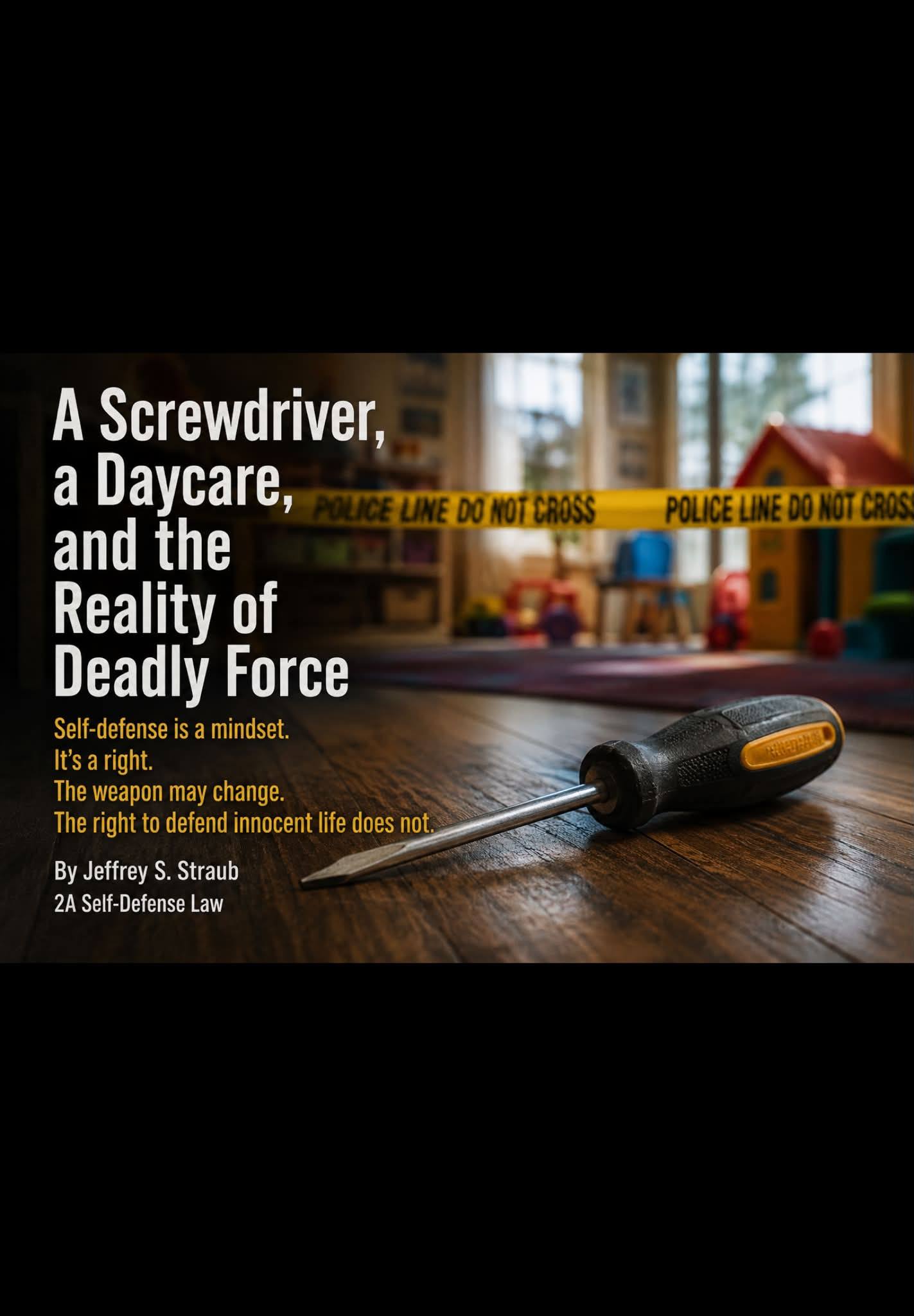
A screwdriver is probably one of the most ordinary tools in America. Most of us have several scattered around our homes, sitting in kitchen drawers, garages, junk drawers and toolboxes. They are designed to put things together, take things apart and help us repair the things that make our lives easier. But put that same screwdriver into the hands of someone intent on killing another human being, and it becomes something entirely different. It becomes deadly force.
That is one of the lessons I keep coming back to after the horrific events at Brown Bear Childcare in Hopkins, Minnesota, on August 12, 2026. Police were called to the in-home daycare shortly after 9:00 that morning after a parent arriving with children heard screaming and encountered an attack taking place inside. Investigators say 41-year-old Nathan Brown killed his wife, 41-year-old Kristen Brown, and their 7-year-old daughter, Evie Brown. Six other young children were inside the daycare. Thankfully, none of those children was physically injured. Brown then went upstairs, entered a closet and took his own life with a handgun.
Those facts alone produced the kind of story that immediately attracts enormous public attention. There was a daycare. There were children. There was a murder-suicide. And there was a gun. But then another important detail became public. According to the search warrant released after the killings, Nathan Brown did not use that handgun to murder Kristen and Evie. He used a screwdriver.
Investigators also believe Brown had earlier killed a 78-year-old relative in Burnsville, where authorities say he had recently been living. Police are still investigating the motive and circumstances that led to this horrific sequence of events. Reports indicate Kristen had recently informed daycare parents that she intended to close the daycare because of relationship problems involving Nathan. There is a great deal we still don’t know about that relationship, and I’m not going to fill those gaps with speculation. But we do know what police say was in his hand when he murdered his wife and daughter: a screwdriver.
That detail matters to me because when we talk about self-defense and deadly force, our minds almost automatically go to firearms. Maybe we picture a knife. Perhaps we imagine the classic armed robber pointing a handgun across a convenience-store counter. Real violence doesn’t have to cooperate with our imagination. A screwdriver can be deadly force. A hammer can be deadly force. A baseball bat can be deadly force. A vehicle can be deadly force. Even hands and feet can produce death or great bodily harm depending upon how they are used and the circumstances of the attack. The object itself is only part of the equation.
Self-defense is a mindset before it is ever a particular tool. You don’t get to schedule an attack. You don’t get to decide where it happens. You don’t get to decide whether your children are standing next to you when it happens. And you certainly don’t get to choose what the attacker will use. The attacker gets a vote. If someone is violently attacking you with a screwdriver and you reasonably believe that person is about to kill you or cause great bodily harm, it makes very little difference that the object in his hand was purchased from the tool aisle rather than the gun counter. That screwdriver doesn’t suddenly become harmless because the manufacturer designed it to install screws. The danger comes from the human being using it.
There is also a political dimension surrounding this tragedy that I think deserves examination, particularly because of the timing. Within hours of the Hopkins killings, Minneapolis Mayor Jacob Frey began his August 12 Minneapolis budget address by discussing what was then still an unfolding situation in Hopkins. At the time Frey spoke, authorities were responding to what he characterized as a critical incident at an in-home childcare facility. He said Minneapolis’ hearts and prayers were with Hopkins, said he had contacted Hopkins Mayor Patrick Hanlon, and offered whatever assistance Minneapolis could provide. At that point, the full circumstances that would eventually emerge from the investigation were not yet publicly known. Authorities were still determining exactly what had happened, who was involved and whether there was any broader danger. Under those circumstances, offering assistance to a neighboring community dealing with a potentially serious incident involving children was a reasonable response.
What makes Frey’s early attention to the incident noteworthy in hindsight is the political context that surrounds it. Frey has been a vocal advocate for additional firearm restrictions. As the investigation progressed, however, the facts became considerably more complicated than the early words “daycare,” “murder-suicide” and “gun” might have suggested. The firearm found at the scene was not, according to investigators, the weapon Brown used to murder Kristen and Evie. The handgun was used to kill himself. His wife and daughter were killed with a screwdriver. That distinction matters when a tragedy inevitably enters the larger political conversation about violence and firearms.
The timing becomes even more interesting because Minnesota had just implemented new domestic-violence legislation on August 1, only eleven days before these murders. Among those changes is a standardized procedure for court-ordered firearm surrender in qualifying domestic-violence cases. Under the new process, firearms subject to a transfer order can be surrendered to law enforcement, transferred to a federally licensed firearms dealer, or transferred under specified conditions to an eligible third party. The law also requires documentation of the transfer or a declaration that the person possesses no firearms, along with a court compliance process.
That new law should not be confused with Minnesota’s Extreme Risk Protection Order law, commonly called the red-flag law, which was already in effect. The two legal mechanisms are different, although both can ultimately result in firearms being removed from someone’s possession. Red-flag laws are intended to address people believed to present a danger to themselves or others by restricting their access to firearms. Supporters argue that they provide an opportunity to intervene before someone commits violence or suicide. Critics raise substantial concerns about due process and the government’s ability to restrict a constitutional right based upon predictions about what someone might do. Those are legitimate debates.
But for purposes of examining what happened in Hopkins, let’s remove that debate entirely and give firearm-removal laws the perfect hypothetical. Assume somebody recognized Nathan Brown as dangerous before August 12. Assume every legal requirement necessary to remove his firearms had been satisfied, a judge issued the appropriate order, Brown complied completely, and every handgun, rifle and shotgun he possessed was surrendered. Put the handgun he eventually used on himself into a police evidence room and lock it away. For purposes of this hypothetical, Nathan Brown has absolutely no access to a firearm on the morning of August 12.
Now compare that hypothetical with what investigators say actually happened inside that Hopkins daycare. Kristen Brown and 7-year-old Evie Brown were not murdered with that handgun. They were murdered with a screwdriver. Removing the handgun would have removed the handgun. It would not have removed the screwdriver. More importantly, it would not necessarily have removed the violent intent of the human being holding it.
That distinction is important because political discussions about violence have a tendency to become discussions about objects. We begin believing that if we can control the object, we have controlled the danger. Sometimes removing a firearm may prevent a suicide. Sometimes it may prevent a homicide. Sometimes intervention may give a family the opportunity to escape an extraordinarily dangerous situation. Nothing about this case proves otherwise. But removing one particular weapon from a dangerous person is not the same thing as removing the danger from that person.
Hopkins demonstrates that distinction in perhaps the most brutal way imaginable. Even if Nathan Brown’s handgun had been surrendered the day before these murders, the object investigators say he actually used to kill Kristen and Evie would still have been perfectly legal. It could have been sitting in a toolbox, a kitchen drawer or on a workbench. It could have been purchased at virtually any hardware store in Minnesota, because it was a screwdriver.
There is another part of this story that I think anyone serious about self-defense should consider. According to investigators, a father arrived at the daycare with two of his children and heard screams coming from the basement. He went inside and initially believed Nathan Brown was performing CPR. Then he realized that what he was witnessing was an attack. Imagine how quickly that man’s understanding of his surroundings had to change. One moment he was a father dropping his children off at daycare. Seconds later he was standing inside a homicide scene with children around him and trying to understand what was happening.
There was no warning announcing that a deadly-force encounter was beginning. There was no neat description of the threat and no opportunity to sit down and analyze every possibility. There was confusion, incomplete information and children nearby, while an ordinary household tool had become a deadly weapon. That is much closer to what real-world self-defense can look like than the perfectly constructed scenarios we sometimes debate from the comfort of our living rooms.
Self-defense isn’t fundamentally about firearms. The Second Amendment protects the right to keep and bear arms, and firearms are extraordinarily effective defensive tools, but the human right of self-defense is larger than the particular instrument used to exercise it. A firearm can be used by a murderer. A firearm can be used by someone to take his own life. A firearm can also be used by an innocent person trying to stop someone attacking him, his family or another innocent person with something as ordinary as a screwdriver. The moral difference isn’t contained inside the object. It is found in who is using force, why that force is being used, what threat exists at that moment, and whether the response to that threat is legally justified.
That is why self-defense must begin with mindset: awareness, recognition, avoidance when reasonably possible, understanding what constitutes a threat of death or great bodily harm, and recognizing that the object coming toward you doesn’t have to look like a traditional weapon before it can kill you.
A screwdriver was designed to build things, take things apart and repair what was broken. On an August morning in Hopkins, Minnesota, investigators say one was instead used to destroy a family. Whatever political discussion eventually grows out of this tragedy, we should remember that uncomfortable fact. You can regulate a particular tool. You can prohibit a particular tool. Under appropriate legal circumstances, you can even remove that tool from a particular person’s possession. But none of those things, standing alone, removes violent intent from the human heart. The weapon may change. The right to defend innocent life does not.
AvoidanceMinnesota Case Analysis and Use-of-Force Law
Related articles
Minnesota Case Analysis and Use-of-Force Law
Minnesota's Castle Doctrine: The Statute Says Felony, but the Courts Ask a Harder Question
Minnesota law permits deadly force to prevent certain felonies in the home, but that does not make every felony a license to kill. Learn how the courts interpret necessity, reasonableness, retreat, and the rights of co-residents.
October 20, 2026 · 9 min read
Minnesota Case Analysis and Use-of-Force Law
EZEKA v. STATE: A THREAT IS NOT YET AN IMMINENT THREAT
September 30, 2026 · 3 min read
Minnesota Case Analysis and Use-of-Force Law
STATE v. BAKER: RE-ENGAGEMENT AND THE INNOCENT STANDARD
September 29, 2026 · 7 min read