
The Five Pillars of Self-Defense: Proportionality
- Originally published:
- January 7, 2026
By Jeffrey S. Straub · 5 min read · Minnesota
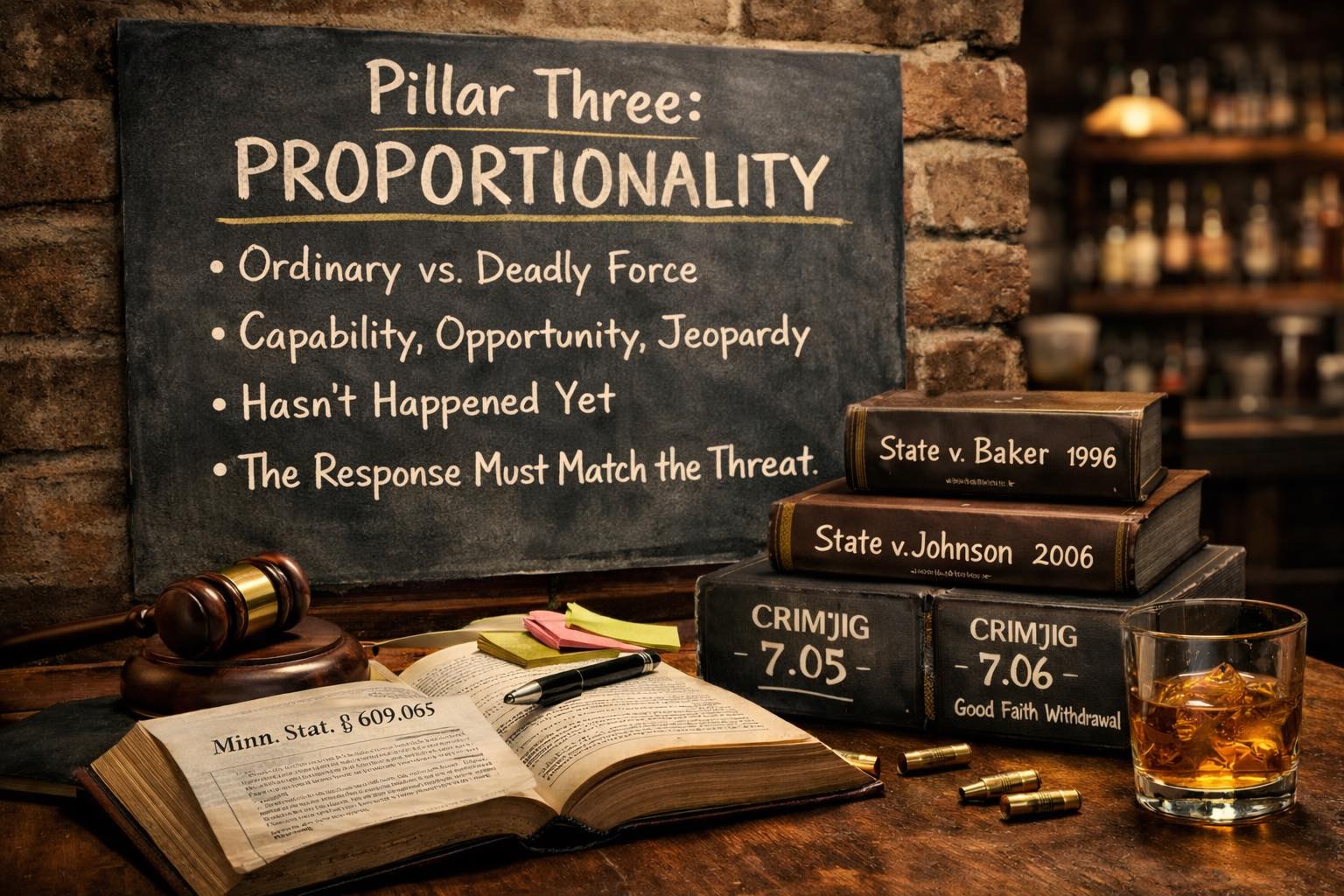
If innocence is about who lit the fuse, and imminence is about whether the fuse is actually burning, proportionality is the part where people get themselves in real trouble. This is where fear starts whispering, “End it now,” and the law calmly asks, “With what, and why?”
Minnesota doesn’t give you points for how scared you were. It cares about what you were actually stopping. Not the worst thing you imagined might happen later, not the thing you were afraid could happen someday but the harm that was about to happen right then, and whether the force you used matched that moment.
That’s why Minnesota law draws a hard line between ordinary force and deadly force. Under Minn. Stat. § 609.06, a person may use ordinary force, generally non-deadly force, to resist an offense against the person. Under Minn. Stat. § 609.065, deadly force is different. It’s only justified when a person reasonably believes it is necessary to prevent death or great bodily harm or, in limited circumstances, a violent felony in the home. Necessary is doing real work there. It’s not “helpful,” it’s not “decisive,” and it’s definitely not “I wanted it over.”
The Minnesota Supreme Court has said this repeatedly, even if not always in the same words. In State v. Baker, 582 N.W.2d 660 (Minn. 1998), the court made clear that force can be justified in principle and still fail legally if it exceeds what appeared reasonably necessary under the circumstances. Proportionality isn’t about whether force worked, it’s about whether it overshot the threat.
Here’s where people trip: volume is not capability. Someone screaming that they’re going to kill you doesn’t automatically justify deadly force. Words alone don’t create proportionality. Minnesota courts have been consistent that unlawful or aggressive conduct, by itself, does not green-light a lethal response. What matters is whether the threat actually exposed the defender to death or great bodily harm.
Minnesota looks at whether the threat had the ability to cause death or great bodily harm, the opportunity to apply that force immediately, and whether their actions showed it was about to happen, what trainers call Ability, Opportunity, and Jeopardy. The law doesn’t use those labels, but juries are instructed to think that way through CRIMJIG 7.05 and 7.06, and appellate courts repeatedly affirm that approach.
So take the classic example. A guy with a bat screaming threats from 100 yards away is not the same threat as a guy with a bat closing distance. Same implement, totally different legal problem. At 100 yards, there’s no immediate opportunity. That matters. You don’t get to introduce a rifle into that situation just because the other person is angry and armed with something scary.
Minnesota case law supports this common-sense distinction. Courts have repeatedly rejected self-defense claims where the level of force used did not match the immediacy or severity of the threat, even when the other person was behaving unlawfully. As the court reinforced in State v. Johnson, 719 N.W.2d 619 (Minn. 2006), deadly force is not justified to stop minor assaults or non-deadly threats simply because the situation feels dangerous. But as distance collapses and movement commits, that analysis changes fast.
And here’s an important point people misunderstand all the time: Minnesota law does not require you to wait until harm is already happening. You don’t have to be stabbed, shot, or hit first. Once a reasonable person would conclude that harm is about to occur, the law does not demand you absorb the first blow to earn the right to defend yourself. Minnesota courts have consistently recognized that self-defense operates before impact, not after, when the threat is imminent. That’s imminence working together with proportionality, pre-impact action is allowed when the facts support it.
Now let’s talk about fists, because this is where internet law does real damage. Ordinary punches are generally treated as ordinary force, not deadly force. The law does not assume that every fistfight equals a lethal threat. Minnesota courts have repeatedly rejected the idea that rare outcomes redefine ordinary categories of force.
But context can elevate things. Multiple attackers. Strikes to the head. Being driven to the ground. Disparity in size or strength. A vulnerable defender. Concrete, curbs, stairs. Those factors can turn what starts as an unarmed assault using ordinary force into a reasonable fear of death or great bodily harm. Minnesota case law recognizes this through a totality-of-the-circumstances analysis, even when no single factor would be enough on its own.
Known fighting skill fits into that same analysis. Not as a label, not as a trump card, but as a risk factor. If you know, before the encounter, that someone has advanced training or a demonstrated ability to seriously injure people, that knowledge can reasonably inform how dangerous the attack appears in that moment. Minnesota courts permit juries to consider what the defender knew at the time, not credentials discovered later.
This is also where people misuse the Tueller Drill. The drill isn’t a law. There is no magic distance where deadly force suddenly becomes legal. Minnesota courts have never adopted a fixed number like “21 feet.” What the concept does help explain is how quickly distance can disappear, especially when weapons, movement, reaction time, and individual skill sets are involved. Courts evaluate this through reasonableness, not yardsticks.
That’s why proportionality is inseparable from imminence. A threat doesn’t have to land to be imminent, but it does have to be real, immediate, and capable. Fear pushes people toward maximum force. The law pulls them back toward matched force.
And one more thing that matters more than people realize: this analysis can’t be reverse-engineered after the fact. Minnesota appellate courts consistently focus on what the defendant perceived in real time, not what they learned or articulated later. The facts that make up Ability, Opportunity, and Jeopardy need to have been perceived as the situation unfolded, not assembled afterward into a legal theory.
That’s why so many self-defense claims survive innocence and imminence but die here. Proportionality is the gatekeeper. Minnesota law doesn’t reward imagination or worst-case thinking. It asks a colder question: was the force you used reasonably necessary to stop that threat, right then?
If innocence asks who started it, and imminence asks whether it was about to happen, proportionality asks the question that decides everything, did you answer the threat you were actually facing, or the one you were afraid of?
ProportionalityInnocenceImminenceReasonablenessFive Pillars of Self-Defense
Part of the Five Pillars series
This article belongs to the Five Pillars of Self-Defense educational series.
Pillar Three: Proportionality — permanent educational page