Pillar One: Innocence
- Originally published:
- January 5, 2026
By Jeffrey S. Straub · 2 min read · Minnesota
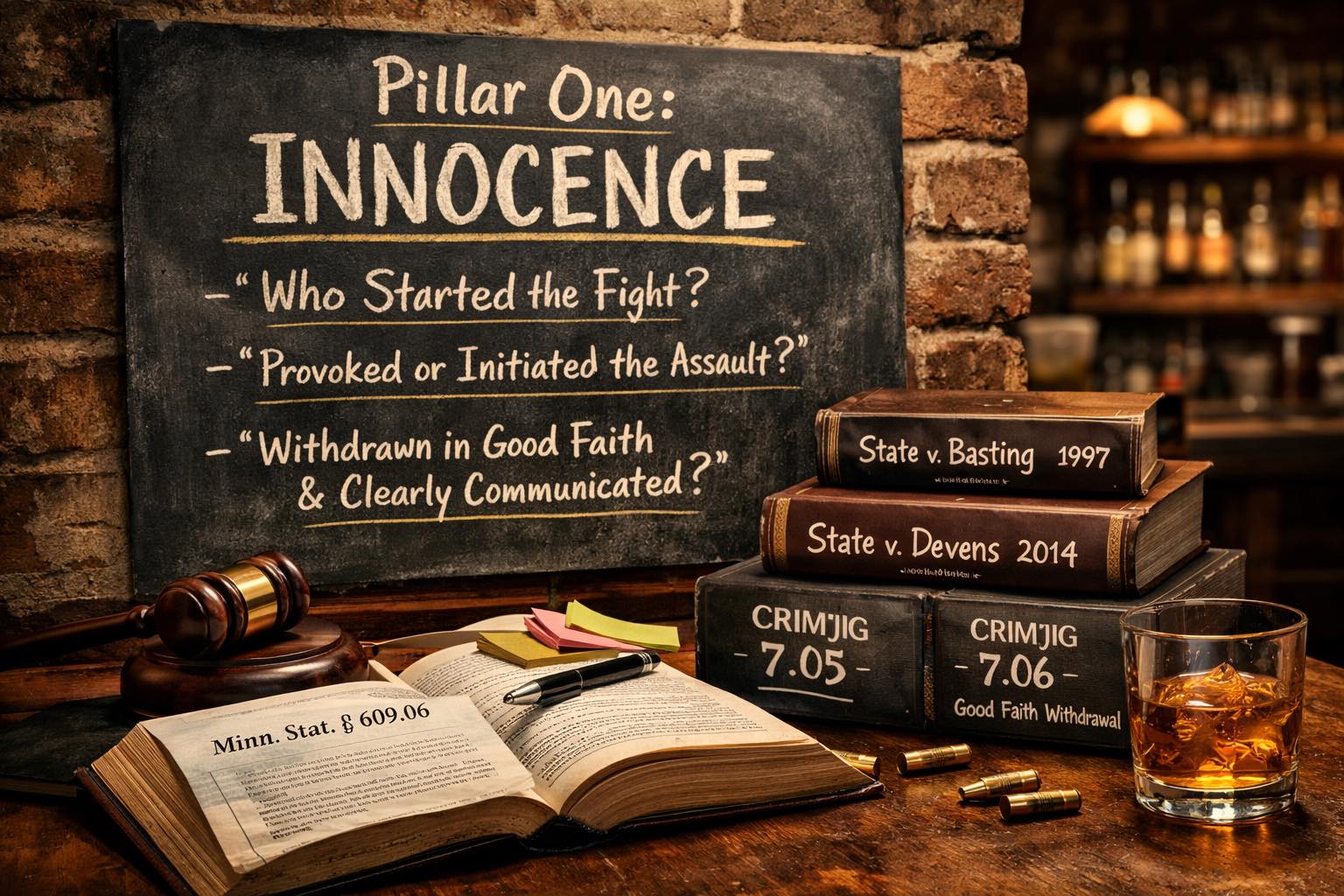
Pillar One: Innocence
(or: how Minnesota decides who screwed this up first)
If you strip all the chest-thumping out of self-defense law in Minnesota, Innocence comes down to one brutally simple question: Did you start the physical problem you later claim you had to solve?
That’s it. Everything else people argue about, fear, adrenaline, training, vibes, comes after that question.
Minnesota’s force statute, Minn. Stat. § 609.06, doesn’t even bother defining “aggressor.” It just says you’re allowed to use reasonable force when you’re resisting an offense against the person. The courts fill in the rest. And they do it with a very adult tone: if you’re the one who provoked or initiated the assault, you don’t get to hide behind self-defense when it goes bad.
That’s not a political opinion. That’s straight out of State v. Basting. The court doesn’t dance around it. It says, in plain English, that someone who provokes an assault can’t claim self-defense unless they clearly stop and communicate that they’re done. Not hint. Not hope. Clearly inform the other person that the fight is over.
Which already tells you something important: Minnesota assumes adults can tell the difference between a misunderstanding and someone pulling the pin on a grenade.
Now here’s where people screw this up. They hear “provokes” and think it means anything. A smart remark. A dirty look. Being an asshole. That’s not how Minnesota reads it. Courts care about conduct, not tone. Words alone don’t usually make you the aggressor. They start caring when the situation moves from argument to action, when someone takes that step that turns talk into force.
That’s why CRIMJIG 7.05 and 7.06 don’t ask juries whether the defendant was “nice” or “polite.” They ask whether the defendant was not the aggressor, or if they were, whether they withdrew in good faith and clearly communicated that withdrawal. And that language matters. Juries don’t get the internet version of self-defense. They get that sentence. Over and over.
State v. Devens drives the point home even harder. The court makes it clear that being the initial aggressor poisons the well. You don’t cleanse that poison by calming down internally. You cleanse it by actually disengaging in a way the other person understands. And whether that happened isn’t up to you, it’s up to the jury, looking at your behavior through a microscope after the fact.
Here’s the uncomfortable part nobody likes admitting: Once a jury decides you were the aggressor, they stop giving you the benefit of the doubt on everything else. Your fear sounds exaggerated. Your timing sounds suspicious. Your memory gets picked apart. Innocence is the lens through which all the other pillars get judged.
That’s why Minnesota self-defense cases so often collapse before the moment of force. Not at the trigger pull. Not at the punch. But at the point where someone could have walked away, shut up, stayed in the car, or just let it go and didn’t.
The law isn’t asking you to be perfect. It’s asking you not to be the person who made the situation worse and then tried to blame fear when it blew up. If you weren’t innocent when the force started, Minnesota isn’t interested in the rest of your story.
And that’s Pillar One.
InnocenceFive Pillars of Self-Defense
Part of the Five Pillars series
This article belongs to the Five Pillars of Self-Defense educational series.
Pillar One: Innocence — permanent educational pageRelated articles

Practical Scenarios and Defensive Force
The Five Pillars of Self-Defense
March 28, 2025 · 1 min read
Five Pillars of Self-Defense
The Five Pillars of Self-Defense: Imminence
January 6, 2026 · 3 min read
Five Pillars of Self-Defense
The Five Pillars of Self-Defense: Proportionality
January 7, 2026 · 5 min read