Potential Activist Liability in the Renee Good “ICE Watch” Case
- Originally published:
- January 10, 2026
By Jeffrey S. Straub · 17 min read · Minnesota
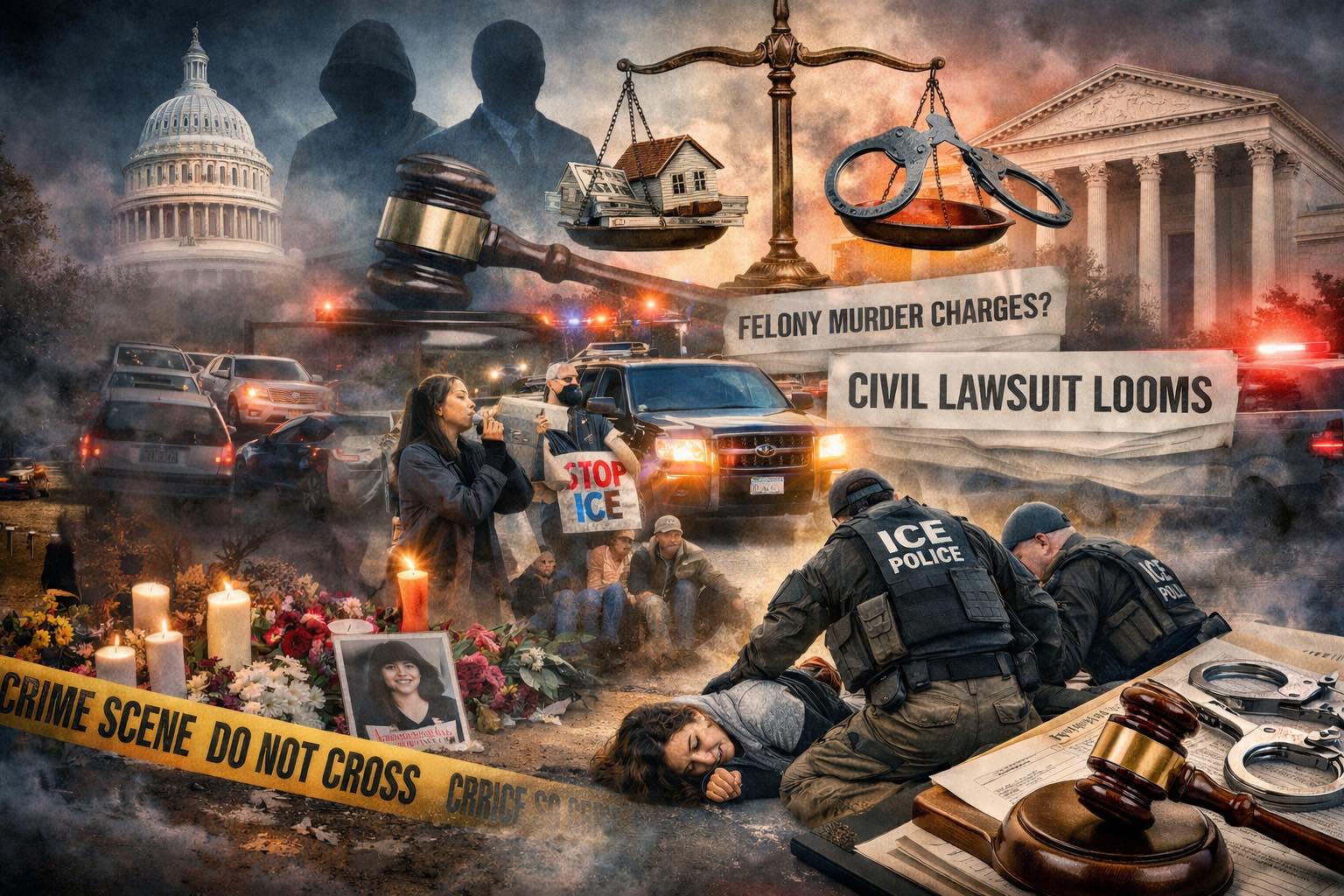
Potential Activist Liability in the Renee Good “ICE Watch” Case
Background: Renee Good’s Actions and ICE Watch Tactics
For the sake of this discussion, we are starting with a clear assumption: there was no Fourth Amendment violation and no ICE policy violation by federal agents in the shooting death of Renée Nicole Good. We aren’t debating whether Immigration and Customs Enforcement had a lawful reason to be in Minneapolis or whether agents followed their own internal rules. Instead, we are looking at what happened, how it happened, and what that means when civilians engage directly with trained federal officers.
Renee Nicole Good, 37, was fatally shot by an ICE agent in Minneapolis on January 7, 2026 during a tense confrontation. Federal officials allege Good spent that morning shadowing ICE vehicles and ultimately used her SUV to block agents on a residential street. Video evidence confirms that as ICE officers approached her maroon Honda Pilot, Good’s car reversed, then moved forward in proximity to an agent, prompting the officer to fire multiple shots. Good’s formal affiliation with any activist organization remains unconfirmed, her mother insisted “she was not part of anything like that”, yet DHS sources claimed she “worked as a member of ‘ICE Watch’” in Minneapolis. Indeed, Good’s conduct closely mirrored tactics widely attributed to “ICE Watch” networks: monitoring ICE movements, honking to alert neighbors, and physically obstructing enforcement vehicles.
ICE Watch is not a single official group but a loosely organized network of community observers active in sanctuary cities. Public reports describe volunteers training to spot unmarked ICE vehicles (e.g. looking for out-of-state plates and tinted windows) and to mobilize rapidly via group chats when ICE agents are in their neighborhood. ICE Watch volunteers often identify themselves as “legal observers,” armed with whistles, cameras, and know-your-rights knowledge, but in practice many go further, some have linked arms to block arrests and even used their cars to impede ICE operations. Federal officials accuse these networks of aiming to “monitor, track, interfere and oppose” immigration enforcement actions . In Good’s case, her wife acknowledged they had joined other residents that day in watching and protesting ICE’s activity in the neighborhood. Good was heard blowing a whistle and telling an ICE agent “I’m not mad at you” moments before the shooting, while her wife shouted at agents nearby. In short, even absent proof of formal membership, Good’s behavior aligns point-for-point with the ICE Watch playbook, suggesting she was acting in concert with the broader activist strategy.
Patterns of Interference: Consistency and Foreseeability
Eyewitness accounts underscore that Good’s tactics were not an isolated occurrence but part of a pattern of interference encouraged by activist networks. Neighbors on Portland Avenue reported waking to “loud honking” and seeing Good’s SUV parked in the street, blocking other vehicles just before ICE agents confronted her. This use of car horns and strategic vehicle placement corresponds to ICE Watch training: volunteers are taught whistle and horn signals to alert communities of ICE’s presence and to summon reinforcements. In fact, dozens of protesters have successfully blocked ICE arrests in Minneapolis by swarming with whistles blaring and even deploying cars to obstruct agent vehicles. The foreseeability of such confrontations is evident from similar incidents in recent weeks. For example, on the same day as Good’s death, another individual in Minneapolis allegedly rammed a government vehicle and led agents on a chase to a local high school while attempting to impede an immigration arrest. Federal officials say that four vehicle-interference incidents occurred nationally that day, three of them in Minneapolis alone, highlighting a spike in confrontational tactics that mirror what Good was doing.
Even outside the city, reports suggest the same playbook in action. In suburban St. Louis Park, witnesses described caravans of cars honking repeatedly when ICE agents were spotted at a workplace raid, as if to raise an alarm and possibly box in the ICE vehicles (much like Good’s SUV blocking the street). Neighbors and community members have been forming “sanctuary block watches” near schools and workplaces, often wearing plastic whistles around their necks as a sign of readiness  . These consistent behaviors, honking horns, flashing lights, physically surrounding or halting ICE agents, demonstrate a clear pattern. Any organizers or trainers involved in ICE Watch would reasonably anticipate that volunteers might engage in such tactics when responding to ICE operations. Thus, if activist leaders encouraged or instructed participants in methods like vehicle blocking or aggressive tailing of ICE convoys, it was foreseeable that confrontations could escalate to violence. Good’s tragic death, while not intended by anyone, was a predictable risk of the confrontational strategy publicly promoted by ICE Watch-style groups. This foreseeable alignment between Good’s actions and the tactics encouraged by activist networks is critical when assessing potential liability for third parties who may have facilitated those actions.
Potential Criminal Liability for Organizers and Trainers
The criminal law provides several avenues by which third parties, such as protest organizers, trainers, or “tactical instructors”, could face liability for Renee Good’s death and the illegal actions leading up to it. Prosecutors will examine whether activist leaders knowingly encouraged or planned the unlawful interference, as this could expose them to charges ranging from felony murder to aiding and abetting or conspiracy. Below we analyze each potential theory of criminal liability in turn:
Felony Murder and “Organizer” Liability
Under Minnesota’s felony murder rule, if a death occurs during the commission of a felony, all participants in that underlying felony can be held liable for murder, regardless of who directly caused the death. In Good’s case, authorities assert that she was committing serious felonies at the time of her death, such as obstruction of justice or even assault on a federal officer (by allegedly using her vehicle as a weapon). If so, her fatal shooting could legally be deemed a “death occurring in the course of a felony.” Importantly, Minnesota law has historically allowed accomplices to be convicted of murder in such scenarios even when the person killed is the co-felon and the lethal force came from someone else (for example, a police officer). Prosecutors could argue that activist trainers or leaders who sent Good into harm’s way were constructive accomplices in the felony interference. By this theory, a trainer who instructed Good in blockade tactics, knowing she intended to hinder ICE, became a participant in her unlawful act and when that act resulted in a death, that trainer could face felony murder liability just as if they were at the scene.
It is worth noting that Minnesota recently reformed its aiding-and-abetting murder statute to limit such liability to “major participants” who act with extreme indifference to life. A defense for any activist accused under a felony-murder theory would be that they were not a “major participant” in Good’s individual actions and never intended or foresaw a lethal outcome. However, if evidence shows an organizer deliberately coached volunteers in aggressive interference tactics (like using cars to blockade agents) despite the obvious mortal risks, a court could find that to be extreme indifference to human life. In that event, Minnesota’s felony murder doctrine or its federal counterparts, might support a homicide charge. Federal law similarly permits “felony murder” charges for deaths caused in the course of certain felonies, and while usually applied to protect innocent victims, it has been invoked against accomplices when an enforcement officer or co-conspirator is killed during a crime. In short, if Good’s death is deemed to have occurred during the commission of a felony interference, prosecutors could test novel arguments to charge those who trained or directed her under a felony murder theory. Such an approach would be aggressive, but officials like Homeland Security Secretary Kristi Noem are already framing Good’s death as “preventable” and caused by the criminal actions of a broader network, even dubbing it “an act of domestic terrorism”. That rhetoric signals an appetite to hold not just the front-line activist, but also any orchestrators, accountable for the lethal outcome.
Aiding, Abetting, and Conspiracy Charges
More straightforward are potential charges for aiding and abetting Good’s unlawful interference, or for conspiracy to obstruct ICE operations. Both Minnesota and federal law treat those who assist or encourage a crime as equally guilty as the person who directly commits it. If activists instructed Good in tactics (e.g. how to form a vehicular blockade or how to tail ICE convoys) or if they coordinated via messaging apps to guide her movements, they could be charged as aiders and abettors. Minnesota’s accomplice liability statute provides that anyone who “intentionally aids, advises, hires, counsels, or conspires with” another to commit a crime is liable for that crime. Here, any organizer who advised Good to engage in surveillance or interference with ICE arguably meets that definition. For instance, a leader telling volunteers “If you see ICE, block them in and don’t let them leave” would be counseling others to break the law (obstructing legal process, assaulting officers, etc.). If Good followed such an instruction, the person who gave it aided and abetted her crimes, and could be prosecuted for the same offenses (such as assault on an officer) even if they were nowhere near the scene.
Federal law likewise has robust conspiracy statutes that could apply. 18 U.S.C. §372, for example, makes it a felony to conspire to “prevent, hinder, or delay the execution of any law of the United States” or to attack federal officers in performance of their duties. Coordinated ICE Watch activity arguably falls under “hindering the execution” of federal immigration law. If investigators can show that Good and others were part of an agreed plan (formal or informal) to systematically impede ICE operations, then conspiracy charges can ensnare all members of that plan. This could include activists who organized training sessions, distributed “rapid response” signals, or manned a command center directing cars to converge on ICE agents. Notably, federal authorities have already launched investigations into ICE Watch-style groups to determine “their sources of training and funding”, a strong indicator that DOJ is contemplating conspiracy or “material support” charges for those behind the scenes. Any activist found to have supplied equipment (like whistles or walkie-talkies), real-time intel on ICE movements, or tactical guidance might face charges for facilitating the interference. Additionally, if it’s proven that someone encouraged Good to use her car aggressively (essentially turning a vehicle into a weapon), that person could be indicted as an accomplice to an assault on a federal officer, a serious federal felony on its own. In sum, traditional principles of accomplice liability and conspiracy can readily be applied to hold activist encouragers criminally responsible alongside Good. The key elements prosecutors would need are evidence of intent (that the organizers knew their guidance would lead to unlawful interference) and agreement (even an unspoken coordination to impede ICE). Given the public social media posts and Signal chats advertising “ICE rapid response” teams, prosecutors may find ample proof of a concerted effort to interfere with ICE, which could spell criminal indictments for the architects of that effort.
Parallels from Protest and Mob Violence Cases
The scenario of an activist leader facing legal repercussions for the actions of a follower is not without precedent. History provides parallels in cases of protest organizers being held liable (or at least charged) for violence or obstruction committed by their crowd. One notable example is the prosecution of the Chicago Seven after the 1968 Democratic Convention riots, federal authorities charged protest leaders with conspiring to incite a riot. While those conspiracy charges ultimately fell apart in court (all seven were acquitted of conspiracy, though some were initially convicted on separate riot-related counts later overturned), the case showed the government’s willingness to target organizers for the collective acts of protestors. More recently, after the 2017 inaugural Disrupt J20 protests in Washington, D.C., over 200 activists were indicted en masse on riot and conspiracy charges for property damage committed by a black-bloc subgroup. Most of those defendants were not proven to have personally engaged in violence and were eventually acquitted or had charges dropped, reinforcing that mere association with a protest is not enough for criminal liability. However, the initial charges underscore that prosecutors will test collective liability theories in politically charged cases.
Legal standards in the United States place limits on criminalizing protest leadership, chiefly through the First Amendment’s protection of advocacy. The Supreme Court’s Brandenburg v. Ohio doctrine requires that speech inciting others to lawless action can only be punished if it was intended and likely to produce imminent lawless action . Thus, an activist leader can’t be jailed just for fiery rhetoric or organizing a protest where someone else commits a crime, unless the state can prove the leader intentionally provoked the illegal act at that moment. In the context of ICE Watch, if organizers couched their training in terms of legal observation and community aid, they might argue they never explicitly urged anyone to break the law. But if evidence shows they directly encouraged illegal interference (for example, instructing volunteers to form physical barricades or to chase ICE vehicles), that crosses from protected advocacy into the realm of solicitation or incitement, which enjoy no First Amendment shield.
There are also analogues in mob violence cases where instigators faced liability. For instance, leaders of violent mobs have been prosecuted for conspiracy to commit violence even if they personally did not throw a punch. A modern parallel is the federal charging of organizers for the January 6, 2021, group leaders who never entered the Capitol were convicted of seditious conspiracy because they had planned and encouraged the crowd’s forcible interference with government proceedings. While the immigration activism in Minnesota is of a different character, the through-line is that organizers can be criminally liable if they planned or directed unlawful actions that others carried out. Homeland Security’s statements after Good’s death explicitly invoke this idea: Secretary Noem described the incident as part of a pattern of “domestic terrorist attacks” involving vehicles and vowed to have DOJ prosecute such cases. That rhetoric suggests authorities may treat ICE Watch confrontations akin to organized violent resistance, pursuing charges against not just the individuals at the scene but also any coordinators. Historical experience cautions, however, that such prosecutions must overcome high burdens of proof regarding intent and causation. Unless the state can show a clear line of instruction or agreement from an organizer to the actor (Good), sweeping charges risk being seen as criminalizing association or advocacy, which courts will not uphold. Nonetheless, organizers should be aware that encouraging others to commit even “minor” crimes like obstruction can make them criminally complicit in any foreseeable violence that results. In other words, if you urge a crowd to “stop ICE by any means,” you may well answer for the worst outcome of that call to action.
Civil Liability: Wrongful Death Claims by Good’s Family
Beyond criminal law, civil litigation offers another path for accountability. Renee Good’s family could potentially bring a wrongful death lawsuit against individuals or organizations that trained, instructed, or materially encouraged her confrontational actions. Such a civil claim would argue that these parties breached a duty of care and proximately caused Good’s death by inducing her to engage in dangerous illegal activity. For example, if an activist group hosted a training where they told volunteers to use their cars to block ICE vehicles, a plausible claim is that this negligent or reckless instruction led to Good’s fatal encounter. Good herself may have been acting out of altruism to “protect her neighbors”, but those who put her in that position might be blamed for creating an unreasonable risk. In a wrongful death suit, the family could seek monetary damages for their loss, alleging that but for the encouragement or planning by the defendants, Renee Good would not have been at the scene or placed in peril.
However, these cases face significant legal hurdles, particularly where political speech and protest organization are involved. U.S. courts have been reluctant to impose civil liability on protest organizers for the unlawful acts of participants absent evidence of intentional incitement or direction. In the landmark NAACP v. Claiborne Hardware case, the Supreme Court held that leaders of a civil rights boycott could not be held liable for isolated violent acts by a few participants unless the plaintiffs proved the leaders specifically intended to incite and further those violent acts . Translated to our context: Good’s family would have to show that an activist defendant intended for Good (or others) to physically obstruct ICE with force and that they directed that specific tactic, rather than merely promoting general protest or observation. That is a high bar. Simply training people on “how to do an ICE watch” (which might include legal observing and community support elements) would likely be deemed protected activity, not a civil wrong. The First Amendment often shields even radical or unpopular advocacy from tort liability, to avoid chilling free speech.
One possible avenue for the family is to frame the claim not purely as speech-based but as negligent assembly or training, essentially, that the organizers failed to exercise due care in unleashing unprepared volunteers into a volatile law enforcement confrontation. They might argue it was highly foreseeable that telling civilians to interfere with armed federal agents could result in serious harm or death, and thus the organizers had a duty to warn of the risks or refrain from encouraging such direct action. A creative attorney could point to analogies like a ski instructor who takes a novice down a double-black-diamond slope, except here the “slope” involved potential deadly force by ICE. If a jury is convinced that activist leaders acted with reckless disregard for human life by urging tactics that any reasonable person would know could be met with gunfire, liability could be found under general tort principles. Notably, in other states, victims of politically motivated violence have successfully sued the organizers of rallies or marches that turned violent. For instance, organizers of the 2017 so-called "white" nationalist rally in Charlottesville were sued in civil court under a conspiracy theory and held liable for the violence that erupted, with jurors finding they foreseeably incited clashes that led to a counter-protester’s death (Heather Heyer). Though the political sides are different, the legal principle is comparable: did the defendant foment a situation likely to cause injury?
That said, any such lawsuit by Good’s family would encounter the defense that Good herself was engaged in unlawful conduct at the time of her death. A defendant organizer could argue that Good assumed the risk of injury by voluntarily interfering with law enforcement, or that her own negligence in accelerating toward an officer was the superseding cause of her death. Minnesota’s comparative fault rules might reduce or bar recovery if Good is found substantially responsible for the incident. The family’s counter would be that Good was misled or induced by trusted activists into a dangerous course of action without appreciating the full consequences, in essence, that she was a victim of bad advice or even manipulation by movement leaders. It’s a novel argument, but not entirely implausible if evidence showed, say, organizers downplayed the risks (“ICE won’t hurt you, just block them”) or pressured vulnerable community members to participate.
Crucially, courts will also weigh First Amendment concerns. As Justice Sotomayor noted recently, imposing “severe civil liability” on protest organizers for others’ actions typically demands a showing of intent, not mere negligence. In a high-profile case in Louisiana, a police officer injured during a 2016 Black Lives Matter protest sued organizer DeRay Mckesson for negligence in leading the protest onto a highway where someone threw an object at the officer. After years of litigation, that claim was ultimately dismissed, the courts required proof that Mckesson intended the violent outcome, or at least consciously disregarded a known likely danger, which was not met. Good’s family would likely face a similar requirement: unless they can show an ICE Watch trainer knew their instruction would probably get someone killed (and went ahead anyway), a wrongful death tort might not stick. Nonetheless, the tragic and unusual facts here might prompt a sympathetic fact-finder to let a case proceed to discovery, especially if there are indications of an organized campaign that flirted with unlawfulness. Civil litigation could also bring to light internal communications within activist circles about tactics, which, even if not resulting in liability, could influence public opinion or policy on such activism.
In summary, the civil path is challenging but conceivable. Renee Good’s family could pursue damages against anyone who substantially contributed to the chain of events that led to her death by training or encouraging her to interfere with ICE. They would argue those defendants created an unsafe situation and bear responsibility for its deadly outcome. Any such lawsuit would have to overcome powerful free speech protections and arguments that Good knowingly put herself in danger. The tone of the current climate, however, is not in activists’ favor, even Minnesota’s Governor and Mayor have condemned the escalation that led to Good’s death, and federal officials are painting activist groups as culpable. If the family does sue, it would effectively put the ICE Watch tactics on trial, testing whether political activists can be held financially liable for the fallout of direct-action protests. Given the high stakes and novel issues, this is a story still unfolding in the courts of law and public opinion.
Conclusion
The Renee Good case starkly illustrates the legal risks that activist tactics can generate. While Good herself will not face charges, she paid the ultimate price, the focus now shifts to those who may have influenced her actions. Prosecutors are undoubtedly asking: who taught or encouraged her to do this? The answers carry weight. Activists and organizers tied to “ICE Watch” now find themselves in the crosshairs of potential criminal prosecution for aiding in the interference or even for Good’s death under a felony-murder theory. At the same time, they could face civil suits contending that their encouragement of illegal obstruction was a proximate cause of a preventable tragedy.
All of this is unfolding under the assumption that ICE’s underlying operation was lawful and by-the-book, meaning the usual arguments about unconstitutional enforcement or provocation by agents are set aside. That assumption narrows the inquiry to the activists’ conduct: in a lawful enforcement scenario, those who deliberately interfered (or led others to do so) will shoulder the blame. The legal system has long walked a fine line in such matters, trying to deter violent or unlawful protest without squelching legitimate dissent. In Minnesota, that balance will be tested in the coming months. Good’s case may well become a case study in activist liability, a cautionary tale that when protest crosses into physical interference, third-party instigators can be swept into liability for the worst outcomes.
For now, what is clear is that Renee Good’s death has had a chilling effect and prompted urgent discussions among both activists and officials. Community groups are likely re-evaluating their methods, while law enforcement and prosecutors (state and federal) are gathering evidence on the ICE Watch networks . The outcome of any charges or lawsuits stemming from this incident will set critical precedents. They will define where protected activism ends and punishable conduct begins, at least in the context of immigration enforcement protests. In the eyes of the law, noble intentions do not immunize one from consequences, particularly when those intentions are carried out through potentially unlawful means. Activists, trainers, and organizations involved in anti-ICE direct actions should heed the lessons of this incident: if you train or encourage someone to break the law, you may answer for everything that follows, even the tragic and unintended.
Minnesota Case Analysis and Use-of-Force Law
Related articles
Minnesota Case Analysis and Use-of-Force Law
Investigating the ICE Shooting of Renee Nicole Good: Legal, Policy, and Tactical Perspectives
January 7, 2026 · 35 min read
Minnesota Case Analysis and Use-of-Force Law
Minnesota's Castle Doctrine: The Statute Says Felony, but the Courts Ask a Harder Question
Minnesota law permits deadly force to prevent certain felonies in the home, but that does not make every felony a license to kill. Learn how the courts interpret necessity, reasonableness, retreat, and the rights of co-residents.
October 20, 2026 · 9 min read
Minnesota Case Analysis and Use-of-Force Law
EZEKA v. STATE: A THREAT IS NOT YET AN IMMINENT THREAT
September 30, 2026 · 3 min read