Pillar Five: Reasonableness — The Standard That Decides Everything
- Originally published:
- March 10, 2026
By Jeffrey S. Straub · 4 min read · Minnesota
Pillar Five: Reasonableness — The Standard That Decides Everything
Reasonableness is the pillar everyone talks about, but it’s also the one most people misunderstand. If innocence asks who started the conflict, imminence asks whether the threat was about to happen, proportionality asks whether the force matched the threat, and avoidance asks whether safe retreat was available, reasonableness asks the question that ultimately decides the case.
Would a reasonable person have seen the situation the same way you did?
That question sounds simple, but legally it actually contains two separate ideas that work together. The first is subjective reasonableness. That simply means what you actually believed at the time. Did you genuinely believe you were facing death or great bodily harm? Were you honestly afraid? Self-defense law does not require perfect judgment, but it does require that the fear be real. If a person fabricates fear after the fact, the claim collapses immediately.
But the law doesn’t stop there. It adds a second layer, which is objective reasonableness. This is where the jury comes in. The question becomes whether a reasonable person standing in the same position, seeing what you saw and experiencing the same unfolding moment, would have shared that belief. In other words, the law protects genuine human reactions under stress, but it does not allow deadly force to be justified by fear that society would consider unreasonable.
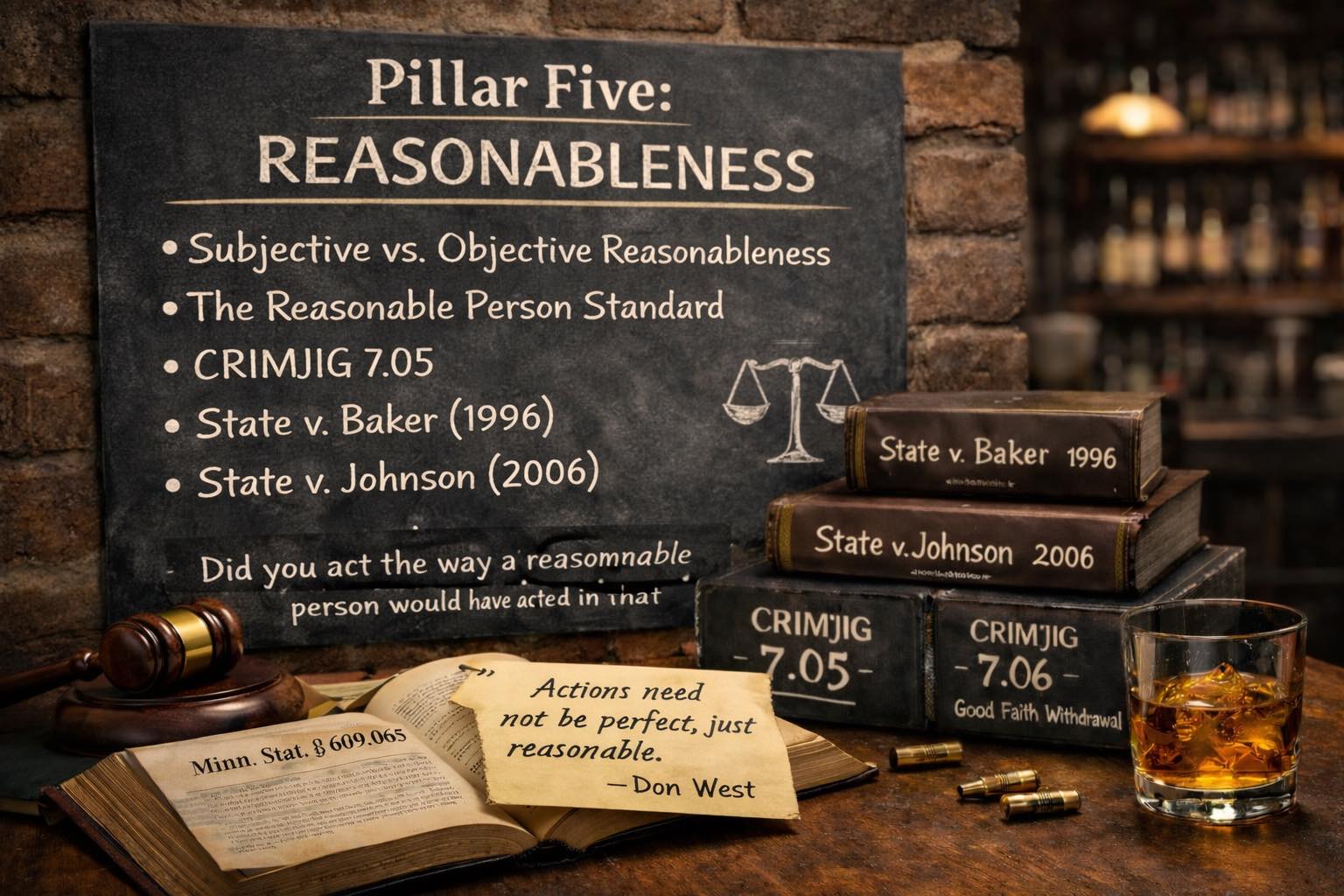
There’s an important point here that trial lawyer Don West has explained well over the years, and it’s something people often forget when they start thinking about self-defense law. People sometimes get themselves twisted up believing they have to do everything perfectly during a use-of-force event. They start imagining that every movement must be flawless and every decision must be the best possible one. That’s not the standard the law applies. The law does not require perfect judgment in a moment of fear. It requires reasonable judgment. In other words, when a person is forced into a defensive situation, the question is not whether every action was perfect. The question is whether the actions were reasonable given what was happening in that moment.
Minnesota law reflects that balance directly. Under Minn. Stat. § 609.065, deadly force may only be used when it is necessary to prevent death, great bodily harm, or the commission of a violent felony in one’s abode. The key word in that statute is “necessary,” and courts interpret that necessity directly through the lens of reasonable belief. A person must actually believe deadly force was required, and that belief must also be reasonable under the circumstances. Minnesota’s general force statute, Minn. Stat. § 609.06, operates in the same way for ordinary force. Again, the law allows force that is reasonable given the situation as it appeared in the moment.
Jurors hear this explained most clearly through Minnesota’s self-defense instruction, CRIMJIG 7.05. That instruction tells jurors that the defendant must have acted with an honest belief that force was necessary to prevent death or great bodily harm, and that the belief must have been reasonable when viewed under the circumstances as they existed at the time. Notice what the instruction does there. It deliberately combines the two concepts. The belief must be honest, and it must be reasonable.
Minnesota appellate courts reinforce this approach repeatedly. In State v. Baker and State v. Johnson, the courts explain that jurors must evaluate events from the defendant’s perspective at the time the force was used, not from the calm hindsight of a courtroom months later. At the same time, that perspective is filtered through the lens of a reasonable person placed in the same situation. The law does not ask jurors to imagine a perfectly calm observer with unlimited time to think. It asks them to imagine a reasonable person standing where the defendant stood, with the same incomplete information and the same rapidly unfolding threat.
This is why reasonableness ends up tying the other pillars together. If you were the aggressor, reasonableness disappears. If the threat was not imminent, reasonableness disappears. If the force used was wildly disproportionate, reasonableness disappears. If safe retreat was clearly available and ignored, reasonableness becomes much harder to defend. Each pillar supports the others, and reasonableness is the lens through which jurors decide whether the entire structure holds together.
It’s also why prosecutors spend so much time attacking this pillar. They slow the incident down and dissect every detail. They talk about distance, timing, body language, lighting, escape routes, and every decision the defendant made in a matter of seconds. Their job is to make the defendant’s split-second choices look, in the calm light of a courtroom, like errors a reasonable person wouldn’t have made.
In the end, the jury is not just evaluating what happened. They are evaluating what you believed was happening, what you saw, what you perceived, what you thought was about to occur.
And that leads to the quiet question that sits at the center of every self-defense case.
Did you act the way a reasonable person would have acted in that moment, or did your fear go beyond what the law considers reasonable?
That answer is what ultimately decides whether self-defense stands or falls.
ReasonablenessInnocenceImminenceProportionalityAvoidanceFive Pillars of Self-Defense
Part of the Five Pillars series
This article belongs to the Five Pillars of Self-Defense educational series.
Pillar Five: Reasonableness — permanent educational page