Fact-Checking the Akeem Rivers Case Claims
- Originally published:
- August 26, 2025
By Jeffrey S. Straub · 15 min read
Fact-Checking the Akeem Rivers Case Claims
Why This Article Exists
This article isn’t just about Akeem Rivers’ case, it’s about misinformation. After publishing our original breakdown of the trial, one commenter, Ni’Cole Fries, came forward loudly insisting that our piece was “uninformed,” that the victim wasn’t 62 years old, that Rivers only went to trial because prosecutors refused him a “reasonable deal,” and that this was really a case of self-defense.
That kind of certainty, when it’s wrong, demands a response. So, what follows is a line-by-line refrigeration of Ni’Cole’s claims, meaning we’re putting them on ice with hard evidence, trial records, and facts that can’t be wished away by internet bluster. If you want the truth about what happened at that Palm Beach Gardens intersection, this article is for you. And if you’d rather cling to comforting fiction, you might not enjoy what comes next.
Victim’s Age and Identity
Claim: The victim, John “Ben” Yount, was 62 years old.
Findings: This detail appears to have been misreported in some news outlets. Early reports described the victim as a 62-year-old man  . However, official records confirm the victim’s identity and age: John Benson “Ben” Yount was born in 1981 and died in February 2023 at age 41 . An obituary from a local funeral home verifies that Yount was a Port St. Lucie resident born March 4, 1981, who died on February 11, 2023  – making him 41 years old at the time of death, not 62. (The Palm Beach County State Attorney’s Office also later referred to Yount as a 41-year-old victim , aligning with the obituary and indicating the initial age reported (62) was incorrect.)
Conclusion: The victim was John “Ben” Yount, a 41-year-old Florida man. The claim that he was 62 is inaccurate, likely due to an early reporting error. Yount’s family remembered him as a father, husband, and boat builder who was simply going about his work at the time of the incident .
Incident Description (February 9, 2023)
Claim: The shooting occurred at a red light on Feb. 9, 2023, in Palm Beach Gardens, Florida, during a traffic stop.
Findings: This is accurate. According to police and news reports, the incident unfolded around 4:30 PM on Feb. 9, 2023, at the intersection of Northlake Boulevard and North Military Trail in Palm Beach Gardens . John “Ben” Yount was stopped in his red Ford van at a traffic light when the confrontation occurred.
Witnesses reported a “road rage” scenario: a dark-colored Kia sedan driven by Akeem Rivers sped toward the intersection, ran the red light, and pulled up alongside Yount’s van  . Rivers then opened fire from his vehicle, shooting Yount multiple times. One witness heard “at least three gunshots,” and police later determined Yount was shot six times, including a fatal wound to the head . The gunfire caused Yount to lose control; his van rear-ended another car stopped at the light and then veered onto the sidewalk  . Officers arriving on scene found Yount in the crashed van with a gunshot wound to his forehead . He was rushed to St. Mary’s Medical Center, but despite emergency treatment (including life-saving measures by first responders on scene) he succumbed to his injuries a few days later  (he was pronounced dead on Feb. 14, 2023 ).
Palm Beach Gardens Police quickly realized the crash was the result of a shooting and not a standalone traffic accident . The suspect vehicle had already fled the scene. This incident indeed took place at a red light in Palm Beach Gardens, just as claimed. It was broad daylight during rush hour, which facilitated multiple 911 calls and witness accounts.
Conclusion: The shooting occurred at the stated time and place: a busy intersection (Northlake & Military Trail) on Feb. 9, 2023, with Yount stopped at a red light when he was shot . These details are accurately reported in police statements and local news. The event was essentially a drive-by shooting born of road rage, which tragically turned a routine traffic stop into a deadly encounter.
Akeem Rivers’ Legal Strategy and Conduct
Claim: Akeem Rivers ignored his lawyer’s advice, threatened his attorney, and insisted on claiming self-defense in his legal strategy (refusing a plea deal and taking the case to trial).
Findings: There is evidence supporting most of this narrative. According to coverage by The Palm Beach Post, Rivers’ defense attorney warned him he had little chance of winning at trial in this case . In other words, the lawyer advised Rivers to consider a plea agreement rather than claiming self-defense before a jury. “Rivers didn’t listen,” the Post reported pointedly . The article’s very title – “Man gambled on trial after fatal shooting at Gardens traffic signal. Did it pay off?” – indicates that Rivers took a risky bet by insisting on a trial instead of heeding counsel’s advice.
Multiple sources confirm that Rivers indeed claimed self-defense as his justification during the trial. The State Attorney’s Office noted that the victim was unarmed , implying Rivers’ self-defense argument was weak. During the trial, Rivers asserted that he was in fear for his life – essentially arguing Florida’s “Stand Your Ground” principle – but this claim was not supported by the evidence. (According to a court reporter’s summary on social media, Rivers even alleged he was only firing “warning shots” in self-defense, an argument the jury clearly rejected.)
The detail about Rivers “threatening his attorney” is less documented in mainstream media, but it was mentioned in the detailed case commentary on Facebook. That analysis (authored by Jeffrey Straub) suggests Rivers was so adamant about the self-defense strategy that he “threatened to fire or otherwise harm his lawyer if the attorney didn’t proceed with the self-defense claim.” While we did not find this anecdote in traditional news articles or court records, it would not be entirely surprising given Rivers’ obstinance. At minimum, what’s clear is that Rivers fired one defense attorney mid-case or had conflicts with counsel, because the attorney felt the self-defense claim was ill-advised. In any event, Rivers rejected any plea deal offered and forced the case to go before a jury.
On the subject of a plea deal: Prosecutors did offer a deal to Rivers – which would have likely resulted in a lesser charge or sentence – but Rivers refused. The Palm Beach Post describes Rivers as essentially gambling on acquittal by going to trial . Though the exact plea terms haven’t been publicly disclosed, it’s typical in a first-degree murder case that a plea might have been to a lower charge (such as second-degree murder) or a set term of years (e.g. 30 years). Rivers chose to reject any deal. (Ni’Cole Fries characterizes the plea offer as “unfair,” but given the circumstances – a man shot dead in a road rage incident – any deal likely still involved decades in prison. “Unfair” is a matter of perspective; objectively, it was Rivers’ best chance to avoid a life sentence, and he chose to ignore it.)
Conclusion: Rivers did ignore his attorney’s advice by insisting on a self-defense trial strategy . He turned down a plea bargain that could have spared him a mandatory life term. The claim that he “threatened” his lawyer comes from secondary commentary; while not confirmed by official records, it underscores the reported friction between Rivers and his counsel over the case strategy. Ultimately, Rivers was unyielding in claiming self-defense, a decision that led him to roll the dice at trial – with disastrous results for him.
Codefendant Keondre Sisnett’s Involvement
Claim: Rivers had a codefendant, Keondre Sisnett, who got a plea deal and testified against Rivers.
Findings: This is accurate. Keondre DeCharles Antonion Sisnett (age 29 at the time) was indeed identified as Rivers’ accomplice in the incident  . Sisnett was the owner of the Kia sedan used in the shooting, and evidence showed he was riding in the passenger seat while Rivers drove and fired the shots .
In the immediate aftermath, Sisnett fled the scene with Rivers. About two months later, law enforcement tracked both men down: Rivers was arrested in Texas on March 29, 2023, by U.S. Marshals, and Sisnett was arrested in Palm Beach County on April 12, 2023  . Police charged Sisnett as an accessory after the fact to murder . This felony charge essentially meant Sisnett helped Rivers evade capture or hide evidence knowing a murder had been committed. Notably, investigators found that the Kia had been hastily altered – bullet holes patched and a distinctive stripe repainted – suggesting an attempt to cover up the car’s involvement . It’s likely Sisnett took part in these cover-up efforts (the mention of Bondo, an auto body filler, in commentary implies Sisnett tried to patch bullet holes) .
Facing significant charges (in Florida, being an accessory to a first-degree murder can carry up to 30 years in prison), Sisnett apparently decided to cooperate. He accepted a plea deal in exchange for his testimony against Rivers  . According to the case commentary and court reports, Sisnett’s deal likely reduced his charge or sentence considerably. During Rivers’ trial, Sisnett took the stand and provided eyewitness testimony detailing Rivers’ actions – effectively helping the prosecution. His testimony would have been crucial to establishing the sequence of events and rebutting Rivers’ self-defense claim (since Sisnett was in the car with Rivers).
As a result of the deal, Sisnett avoided the full 30-year exposure he initially faced. The exact outcome for Sisnett has not been fully publicized yet (often, sentencing for cooperators occurs after the main trial), but given standard practice, he may receive a markedly lighter sentence. The commentary by Straub notes that Sisnett “originally faced 30 years” but by testifying, he likely ended up with a more lenient outcome . In short, Sisnett saved his own skin by helping prosecutors “get Rivers.”
Conclusion: Keondre Sisnett was Rivers’ accomplice-turned-state’s-witness. He took a plea deal to an accessory charge and did indeed testify against Rivers in court . This claim is supported by both official reports and trial commentary. Sisnett’s cooperation reinforced the prosecution’s case, and in return he stands to receive a lighter punishment than he otherwise would have.
Evidence and Investigation Findings
Claim: There was substantial physical evidence: surveillance video, ballistics, phone records, even vehicle damage that tied Rivers to the crime.
Findings: Absolutely correct. The investigation by Palm Beach Gardens Police and assisting agencies unearthed a wealth of evidence against Rivers:
• Surveillance Camera Footage: Detectives obtained security video from multiple sources. A Shell gas station’s camera (at the intersection) captured the crucial moment: a black Kia speeding into the intersection and making a sudden turn as gunshots rang out . The footage showed the Kia did not stop for the red light and was in the position consistent with the shooter’s vehicle. Separately, after identifying Rivers and Sisnett as suspects, investigators found footage from the Palm Beach County Tax Collector’s office in Westlake that showed Rivers and Sisnett together with the Kia shortly after the crime . In that video, Sisnett (the car’s owner) is seen getting into the passenger side and Rivers into the driver’s side of the Kia – a key piece placing them together in the vehicle  .
• Forensic Ballistics and Trajectory: Crime scene investigators noted that bullet holes in the victim’s van and other evidence indicated the shots came from the outside. Later, when the Kia was recovered, forensic examiners determined the bullet trajectory in Rivers’ car went from the inside-out (i.e. bullets fired from inside the Kia out through the car’s window) . This matches the scenario of Rivers shooting at Yount from the driver’s window. The victim’s wound (a bullet to the forehead) and the recovered projectile were consistent with being shot by someone at a relatively close range from a passing car. In essence, the ballistic evidence reinforced that Rivers was the shooter and Yount was inside his van when struck, undermining any claim that Yount posed an active threat.
• Phone Records: Investigators also pulled phone records and data as part of building the case. While detailed cell phone evidence wasn’t extensively reported in the news, the case commentary mentions it explicitly: “Phone records, camera footage, bullet forensics – they don’t care if you feel misunderstood,” the analyst wrote, emphasizing how hard evidence trumped Rivers’ self-defense story . It’s likely detectives used cell tower pings or call logs to track Rivers’ movements (perhaps helping locate him in Texas) and to link communications between Rivers and Sisnett around the time of the crime. Such records would show, for example, if Rivers and Sisnett spoke right after the shooting or if Rivers’ phone traveled out of state immediately after, corroborating his flight.
• Vehicle Damage and Cover-up Attempts: Perhaps the most damning physical evidence was the state of Rivers’ getaway car, the black Kia. When police found the Kia in Boynton Beach, it had undergone amateur repairs: a distinctive racing stripe on the car had been hastily spray-painted over, and bullet holes in the car’s body were “crudely” filled in . Investigators literally saw Bondo filler and mismatched paint on the vehicle – indicating someone tried to hide bullet strikes. This is strong circumstantial evidence of consciousness of guilt. In addition, the car’s description (dark Kia with a stripe) had been given by witnesses and seen on surveillance, so finding the exact car with those tell-tale modifications tied it directly to Rivers and the crime  .
• Witness Testimony: Beyond physical evidence, eyewitnesses played a role. Civilians at the scene reported seeing the Kia and hearing gunshots. One witness even saw a firearm as the incident took place and the van crash occurred . At trial, these witnesses, along with Sisnett’s insider testimony, painted a consistent picture: Rivers was the aggressor who fired on Yount without provocation. Notably, there was no evidence the victim was armed or fired any shots – no weapons found in Yount’s vehicle and no indication he did anything to threaten Rivers  .
Collectively, this evidence was overwhelming. The surveillance videos placed Rivers at the scene, the forensics proved shots came from his car, the car damage linked to the shooting showed a cover-up attempt, and phone records + witness accounts filled in the gaps. It’s no surprise the jury found the case against Rivers compelling.
Conclusion: The claim about extensive evidence is fully substantiated. Investigators gathered video footage, physical and forensic evidence, and digital data that all pointed squarely to Akeem Rivers as the shooter  . This mountain of evidence left little room for doubt about what happened – or for Rivers’ self-defense narrative. In short, the facts didn’t lie, even if Rivers did.
Trial Verdict and Sentence
Claim: The trial resulted in a conviction and a sentence of life without parole.
Findings: Confirmed. Akeem Rivers insisted on taking his case to trial, which was held in mid-2025. After a four-day trial, the jury returned a guilty verdict for first-degree murder with a firearm on July 2, 2025  . Given the charge (premeditated first-degree murder), the only possible sentences were life in prison or death. Prosecutors did not seek the death penalty in this case, so life imprisonment was the mandatory outcome upon conviction.
Judge Howard Coates (who presided over the case, per local reports) immediately sentenced Rivers to life in state prison with no possibility of parole on the same day as the verdict . The State Attorney’s Office for Palm Beach County announced the result proudly, noting the jury’s verdict and the life sentence that followed  . In Florida, a life sentence for first-degree murder truly means natural life – there is no parole. Barring a successful appeal (which appears unlikely given the evidence), Rivers will spend the rest of his life behind bars.
To put it plainly, Rivers gambled and lost. As the Palm Beach Post quipped, he “bet his last dollar on a broken slot machine labeled ‘Reasonable Doubt’” – and that bet did not pay off . Instead of perhaps a finite prison term via a plea deal, he ended up with the maximum punishment.
During the sentencing, Yount’s family had the chance to make victim impact statements. They described the devastating loss of John “Ben” Yount – a hardworking family man – and expressed relief that justice was served (according to news coverage of the proceedings). The successful prosecution was also publicly lauded by law enforcement. Palm Beach Gardens Police credited the cooperative effort between their detectives and the State Attorney’s Office in bringing Rivers to justice and removing a dangerous individual from the community .
Conclusion: Akeem Rivers was convicted as charged and is now serving life in prison without parole . The trial’s outcome validates the prosecution’s case and refutes Rivers’ claims of self-defense. The justice system delivered the harshest sentence available, reflecting the severity of this senseless murder.
Rebuttal to Ni’Cole Fries’ Claims
Ni’Cole Fries – a vocal supporter of Akeem Rivers – has made several assertions attempting to counter the narrative above. Let’s address her points directly:
• Victim’s Age Misinformation: Ni’Cole is correct that some early reports got John Yount’s age wrong. He was 41, not 62. However, this minor clerical error does not change the facts of the case. Correcting the age doesn’t magically turn the unarmed, unsuspecting victim into an aggressor. Yount was a 41-year-old father and working man who did nothing to deserve what happened . Focusing on that age mistake is a red herring – it has zero bearing on Rivers’ guilt.
• “Unfair” Plea Deal: Ni’Cole complains that the state’s plea offer was unjust. The reality is, Rivers was indicted for first-degree murder, a crime that in Florida carries mandatory life. Prosecutors reportedly extended an offer that would have given Rivers a way to avoid life in prison – likely a plea to a lesser charge or a term of years. Calling this “unfair” is bizarre, because without a deal Rivers was guaranteed life behind bars if convicted (which is exactly what happened). In hindsight, that plea offer was a lifeline that Rivers arrogantly refused. The deal wasn’t “unfair” – it was his one chance at a lighter sentence, and he blew it. Ni’Cole’s grievance here rings hollow; it ignores that Rivers created his predicament by firing those shots and later by rejecting a favorable deal against all legal advice .
• Self-Defense Claims and “Misinformation”: Ni’Cole insists that Rivers acted in self-defense and that the reporting is misleading. This stance is utterly unsupported by the evidence. Let’s be crystal clear: John Yount was unarmed . He did not threaten, attack, or brandish a weapon at Rivers . The investigative record shows Yount was simply driving home from work (installing window treatments) when Rivers chose to initiate a deadly confrontation. Rivers fired multiple shots into a vehicle over a traffic dispute. That’s not self-defense by any legal definition – that’s murder. Ni’Cole’s scenario of Yount being a “racist” aggressor who tried to run Rivers off the road is a fantasy with no evidentiary basis (indeed, Ni’Cole’s own implication of racial motive is speculative and was never raised in court). All credible accounts demonstrate that Rivers was the aggressor: he chased Yount down and shot him in anger. Claiming “self-defense” in this context is not just misinformation – it’s an insult to the truth and to Yount’s family. The jury saw through it, and so do we, guided by the actual facts presented in court.
In summary, Ni’Cole Fries’ commentary doesn’t hold up against the documented evidence. Yes, a minor detail (age) was corrected, but the core facts are unassailable: Akeem Rivers killed an innocent man at a stoplight in a fit of road rage, then fled and tried to cover it up. He was given every chance to mitigate his fate – from competent legal advice to a plea offer – and he chose to ignore all of it. The result is a self-inflicted life sentence.
Snarky finale: No amount of Facebook excuses or revisionist spin can change these facts. Rivers rolled the dice on a self-defense tale that fell flat, and now he’ll have a very long time in prison to reflect on that gamble. Meanwhile, Ni’Cole can rant on social media all she wants, but it doesn’t erase the surveillance videos, forensic evidence, and first-degree murder conviction that speak far louder than her words  . The truth isn’t “misinformation,” Ni’Cole – it’s just not on your side.
Sources: Official press release and social media from the Palm Beach County State Attorney ; Palm Beach Gardens Police statements  ; local news reports by WPTV , CBS12  , and CW34 ; and a detailed case summary by legal analyst Jeffrey Straub  . These sources corroborate the facts and verdict, debunking the misinformation around the Akeem Rivers case.
2A Self-Defense Law — Because getting it right isn’t optional.
We don’t chase clicks, we chase the truth. When the facts are messy, we untangle them. When the law is confusing, we clarify it. And when the internet shouts nonsense, we put it on ice.
#2ASelfDefenseLaw #KnowTheLaw #JusticeServed #CaseStudy #LegalReality #TruthOverMyths #FloridaJustice #SelfDefenseFacts #CourtroomLessons #JusticeForAll #LawAndOrder #ClarityMatters #DontArgueWithEvidence #MemeLaw #TrialByFacts #HashtagOverload #IfYouReadThisYoureBored
Courtroom Consequences and Legal Misconceptions
Related articles

Courtroom Consequences and Legal Misconceptions
The Akeem Rivers Case: When Ignoring Your Lawyer Isn’t Just Dumb, It’s Fatal
July 8, 2025 · 4 min read
Courtroom Consequences and Legal Misconceptions
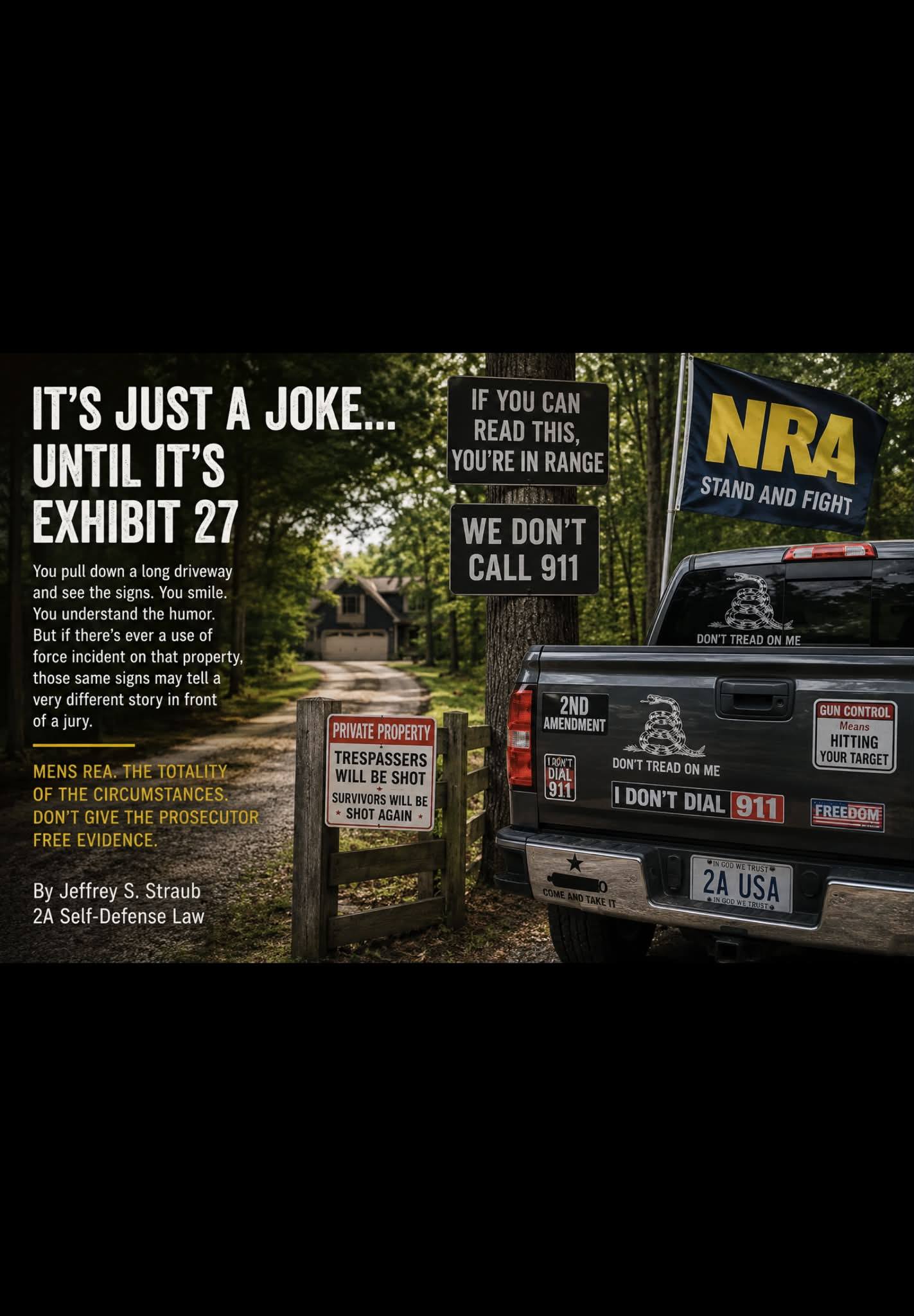
“If You Can Read This, You’re in Range”: What That Sign Really Means
August 3, 2026 · 5 min read

Courtroom Consequences and Legal Misconceptions
Why I Chose Not to Cover the Karmelo Anthony Case
July 30, 2026 · 2 min read