
When the Music Stops: Why Self-Defense Begins Before the Attack
What a Jack-in-the-Box, a Marine Corps officer, a fighter pilot, a self-defense instructor, a self-defense attorney, and a self-defense law educator can teach us about recognizing danger, avoiding violence, and understanding when force is legally justified.
- Originally published:
- October 22, 2026
- Last modified:
- October 22, 2026
When the Music Stops: Why Self-Defense Begins Before the Attack
What a Jack-in-the-Box, a Marine Corps officer, a fighter pilot, a self-defense instructor, a self-defense attorney, and a self-defense law educator can teach us about recognizing danger, avoiding violence, and understanding when force is legally justified.
By Jeffrey S. Straub | 2A Self-Defense Law
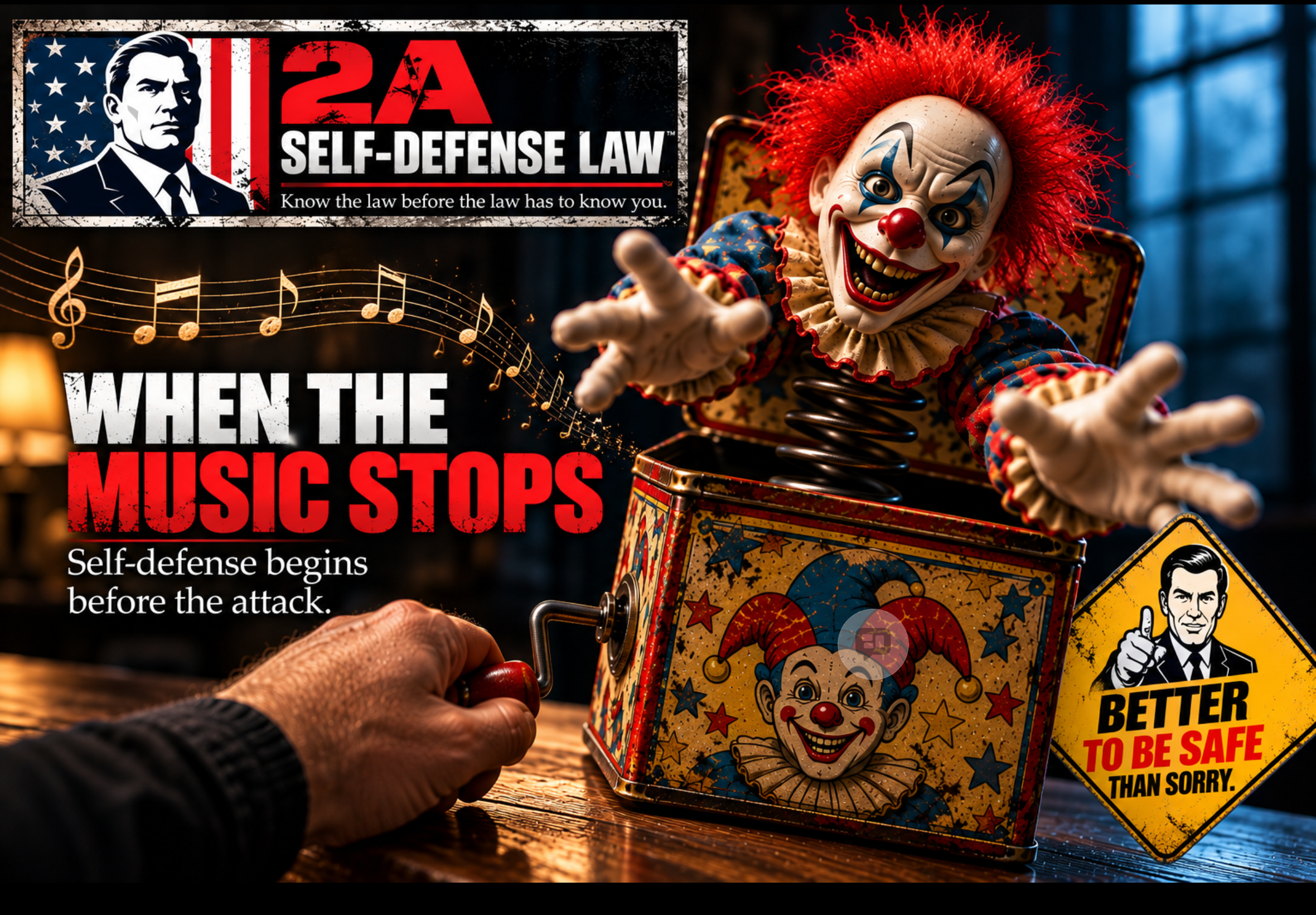
Imagine an old-fashioned Jack-in-the-Box sitting on a table. You turn the crank, and that familiar melody starts playing. You know exactly what’s going to happen. Eventually, the lid will fly open, and some ridiculous-looking clown will launch itself out like it has just been served an eviction notice. You don’t know precisely when, but you know it’s coming. Now imagine refusing to move. It’s your chair, your table, and your Jack-in-the-Box. Nobody has the right to make you leave. So you keep turning the crank because apparently proving you’re tougher than a children’s toy has become a matter of personal honor. And when the clown finally appears, you jump. Congratulations. You knew something was coming, but your body reacted anyway. Now imagine what might happen if you hadn’t noticed the music.
That toy illustrates something I’ve been reconsidering after years of teaching self-defense law. We spend considerable time teaching people when they can legally defend themselves, but how much time do we spend teaching them to recognize and avoid circumstances that might make defending themselves necessary? We spend hours discussing the legal justification for force, yet the most important decision a person makes may occur long before anyone threatens them, raises a fist, or produces a weapon.
I’ve taught self-defense law since 2008, using what I call the Five Pillars of Self-Defense: innocence, imminence, proportionality, avoidance, and reasonableness. I adapted this framework from attorney Andrew Branca’s Five Elements of Self-Defense, which organizes complicated legal principles into something ordinary people can understand and remember without attending law school. I call them pillars because I want students to visualize five columns supporting a roof. That roof represents their claim of lawful self-defense. If a prosecutor successfully establishes that even one legally required pillar is missing, the entire defense can collapse. Satisfying four requirements won’t necessarily save you if the fifth is absent. Not every element applies identically in every jurisdiction, and the prosecution still carries its applicable burden of proof. But the picture gives students something they can retain long after they’ve forgotten the precise language of a statute.
To bring those principles together, I’ve developed what I call the Core Rule: “A person who is without fault may use force, including deadly force, to defend against what they reasonably fear is an imminent, unlawful threat of death or great bodily harm, provided that there is no reasonable alternative to avoid it.” That sentence gives students a memorable starting point for understanding the justification of deadly defensive force. It isn’t a substitute for the applicable statutes or court decisions, and it shouldn’t be mistaken for a universal rule governing every use of force. Ordinary nondeadly force can be justified against threats that fall short of death or great bodily harm, while certain jurisdictions recognize separate justifications, including defense of the dwelling. But as useful as that framework is, it raises another question. What happens before someone reaches the point where they must evaluate those legal requirements?
Recently, while revisiting the work of self-defense instructor Tony Blauer, I found myself considering something that should have received more attention in my own instruction. What should happen before that clown ever comes out of the box? Perhaps we’ve become so focused on teaching people how to survive a violent encounter, and whether their actions will be legally justified afterward, that we haven’t devoted enough attention to helping them recognize the circumstances that lead to violence in the first place.
The Problem With Starting at the Fight
Think about how many martial arts exercises begin. The instructor demonstrates a technique, explains the attack, positions the students, and tells them to begin. The student already knows what’s coming. They’ve identified the threat, selected a response, and prepared themselves to execute it. In other words, the program has already been downloaded into their head. Repetition and technical practice have legitimate value, but real attackers generally don’t announce their intentions, give you three practice attempts, or wait patiently while you remember what you learned last Thursday.
The same criticism applies to legal self-defense education, including my own. Instead of downloading a physical technique, we’re downloading a legal framework. We teach students to evaluate innocence, imminence, proportionality, avoidance, and reasonableness. We explain when ordinary or deadly force may be justified and how retreat requirements differ between jurisdictions. That’s important information, but we’re frequently beginning our discussion after the confrontation has already developed into a threat. We’re starting when the clown pops out, then wondering why the student hasn’t calmly reviewed the applicable statutes, assessed the threat, considered the exits, and performed a legal analysis while experiencing an adrenaline dump and possibly reconsidering their choice of underwear.
Tony Blauer and the Three D’s
Tony Blauer, founder of Blauer Tactical Systems and developer of the SPEAR System, teaches an approach organized around three stages: Detect, Defuse, and Defend. Detect means recognizing danger before it becomes unavoidable. Defuse involves communication, positioning, de-escalation, and decisions intended to prevent a confrontation from becoming physical. Defend addresses the physical response when a credible threat cannot be avoided or defused. His approach recognizes that defensive training frequently concentrates too heavily on that third stage. We teach people how to respond once violence begins, but what about the decisions that might have prevented the confrontation?
Blauer’s work also addresses the startle-flinch response, the natural protective reaction people experience when suddenly confronted with danger. For an entertaining demonstration, watch those social-media videos where a husband hides behind a doorway and jumps out at his unsuspecting wife. She walks into the room, minding her own business, probably wondering why the garbage hasn’t been taken out. Suddenly, her husband jumps out like he’s auditioning for a horror movie. She screams loud enough to alert three neighboring counties, recoils, throws her hands toward her head, and occasionally discovers that bladder control has certain limitations under emergency conditions. Then comes the verbal response. The husband, having demonstrated his advanced understanding of human physiology, receives a colorful assessment of his intelligence, ancestry, and future sleeping arrangements. He may also discover that his wife has an excellent memory and absolutely no intention of letting him forget what he just did.
Everyone watching knows it’s a prank. The husband knows it’s a prank. The camera knows it’s a prank. Unfortunately, nobody remembered to inform her nervous system. That reaction isn’t weakness or cowardice. Protective startle responses are part of normal human physiology and can occur even in trained individuals. The body may instinctively recoil, raise the arms, or move away before the person consciously identifies the stimulus. The difficulty often comes afterward, as the person recognizes what happened, reorients, manages fear, and selects an appropriate response. Stress can affect perception, attention, and decision-making, although those effects vary between people and situations.
Blauer’s approach connects involuntary protection with deliberate defensive action. But his Detect and Defuse stages raise another important question: Why wait until physical defense becomes necessary when recognizing danger earlier might allow us to avoid it? If the objective is personal safety rather than winning a confrontation, then recognizing an opportunity to leave safely should be considered a successful defensive decision, not a failure of courage.
Jeff Cooper: Are You Even Paying Attention?
Marine Corps officer and firearms instructor Jeff Cooper popularized the Color Code of Awareness, progressing from Condition White through Yellow, Orange, and Red. Condition White describes someone largely unaware or mentally unprepared. Yellow represents relaxed awareness without expecting a particular threat. Orange means something specific warrants closer evaluation. Red represents readiness to take appropriate protective action. Condition Yellow isn’t paranoia. You’re not walking through the grocery store expecting an armed robbery behind every display of breakfast cereal. You’re simply paying attention. And reaching Condition Red doesn’t independently authorize the use of force. Legal justification remains a separate question.
I have a daughter who is 20 years old, and one thing that drives me crazy is seeing her walking at night with headphones on, listening to music, and concentrating on her phone. She’s enjoying herself, which is understandable, but she’s also reducing her ability to hear, see, and recognize what’s happening around her. It’s almost like Snow White wandering through the forest, except instead of singing birds and friendly woodland creatures, we have traffic, distracted drivers, strangers, and whatever else might be happening. Unlike the Disney version, there’s no guarantee seven short men with mining equipment will appear to rescue you. That doesn’t make her responsible if someone harms her. Responsibility belongs to the attacker. But limiting your awareness can make recognizing developing problems more difficult.
You don’t have to fear everyone around you. You simply need to remain engaged enough to recognize when something deserves attention. You cannot make an informed decision about a threat you haven’t noticed. And if your entire awareness consists of whatever is happening on a six-inch screen, you’re allowing an electronic device to decide how much of the world you’re going to experience.
John Boyd: The Decision-Making Process
U.S. Air Force Colonel John Boyd developed the OODA Loop: Observe, Orient, Decide, and Act. Observe means gathering information. Orient means interpreting it through experience and circumstances. Decide means selecting a response. Act means carrying it out. The process continues as new information becomes available. This isn’t four sentences someone must consciously recite during an attack. Boyd’s concept describes dynamic decision-making, with feedback and adjustments occurring continuously.
Connect that to Cooper’s Color Code. If you’re disengaged, you may miss relevant information. If you observe something but misunderstand its significance, your interpretation may be faulty. If you recognize danger but allow pride or anger to dictate your response, your decision may be unnecessarily dangerous. Return to our Jack-in-the-Box. The music plays. You observe it, understand that the clown will eventually appear, decide whether to continue turning the crank, and act.
Actual violence isn’t that predictable. Sometimes there’s no warning, and sometimes the warning is ambiguous. Someone who appears threatening may have no intention of harming anyone. Good judgment requires recognizing those limitations rather than treating every unusual behavior as evidence of an impending attack. Nevertheless, meaningful warning signs can preserve choices that disappear once violence begins. And deciding to remain somewhere simply because you have a legal right to be there is still a decision. It just might not be a particularly intelligent one.
The Alleyway: A Decision Before the Threat
Here’s a scenario I’ve used in teaching. You and your girlfriend leave a bar late at night. It’s raining, and your vehicle is parked about a block away. You can follow the well-lit sidewalk around the block, which takes longer, or cut through a dark alley and reach your vehicle sooner. You’re tired, wet, and the shortcut looks appealing. Naturally, this is where human beings perform that extraordinary mental calculation in which three minutes of discomfort outweighs every other consideration. Apparently, walking around the block has become an expedition requiring supplies and a Sherpa.
But what do you know about that alley? Can you see through it? Are there places where someone could remain concealed? Could you change direction if something went wrong? There may be nobody dangerous in the alley. Walking through it isn’t automatically reckless, just as the sidewalk doesn’t guarantee safety. But you’re choosing between routes offering different levels of visibility and opportunities to recognize or avoid trouble.
Cooper’s Condition Yellow encourages awareness. Boyd’s OODA Loop describes evaluating the routes and making a decision. Blauer’s Detect stage encourages avoiding unnecessary exposure to danger. Nobody has attacked or threatened you. You haven’t displayed a weapon, thrown a punch, or invoked a self-defense statute. The Five Pillars haven’t become the legal test of defensive force because you haven’t used force. Yet you may have made one of the most important safety decisions of your evening.
You can take the illuminated sidewalk, or announce that you’re a grown man who isn’t afraid of some dark alley because apparently your masculinity is being evaluated by municipal street lighting. Personally, I think arriving at the vehicle safely is more impressive than winning an argument with a sidewalk.
The Economy of Decision-Making: Retreat Versus Stand Your Ground
Here’s something that gets overlooked in arguments about duty-to-retreat laws and Stand Your Ground. From a practical decision-making standpoint, retreat can be a surprisingly simple question: Can I get myself and the people I’m protecting out of danger safely? In a duty-to-retreat jurisdiction, the legal analysis may require retreat when a reasonable and safe opportunity exists. Minnesota generally follows that approach outside the home in circumstances where its retreat requirement applies. In State v. Blevins (2024), the Minnesota Supreme Court addressed the duty to retreat in a second-degree assault-fear case involving a machete, reinforcing that the requirement isn’t necessarily confined to cases involving the actual infliction of injury.
Now compare that with Pennsylvania’s Stand Your Ground exception. Under 18 Pa.C.S. § 505(b)(2.3), the protection depends on several conditions, including whether you’re lawfully present, whether you’re engaged in criminal activity, whether you illegally possess a firearm, the nature of the threat, and whether the attacker displays or uses a qualifying weapon. It’s not simply a matter of announcing that you have a right to stand there. The legal analysis can become considerably more complicated.
But consider the economy of the decision itself. When evaluating your options during a developing confrontation, do you really want to mentally work through a collection of statutory requirements while someone is threatening you? Or would it make more sense to recognize that you have a safe opportunity to leave and take it? Pennsylvania’s statute uses the specific legal standard of retreating with complete safety in circumstances where its retreat requirement applies. Minnesota’s judicial doctrine asks whether a reasonable opportunity to retreat safely existed. Those are not interchangeable legal tests, even though both reinforce the practical importance of identifying a safe escape.
This is where Tony Blauer’s Detect, Defuse, and Defend approach becomes especially valuable. Detect the developing danger, recognize your options, and choose safety before physical defense becomes necessary. That doesn’t mean retreat is always possible, and it certainly doesn’t mean turning your back on someone presenting an immediate deadly threat. It means that when a safe exit is genuinely available, choosing it may be the simplest and most effective defensive decision you can make.
The irony is that some people spend enormous amounts of energy defending their legal right not to retreat while overlooking that leaving safely might accomplish their real objective without a confrontation, injury, arrest, or courtroom. A statute cannot stop a bullet, slow a knife, or guarantee that your attacker has carefully reviewed the same legal provisions you have. Being found legally justified provides remarkably little comfort if you’re no longer around to hear the verdict. Retreating when safe isn’t automatically cowardice. Sometimes it’s the difference between going home to your family and having your family select a photograph for your funeral.
The Five Pillars and the Legal Consequences of Defensive Force
My Five Pillars framework remains essential because recognizing danger doesn’t automatically authorize defensive force. Innocence concerns whether you were without fault in creating or provoking the confrontation in a manner that legally affects your claim. Imminence concerns whether threatened unlawful harm is sufficiently immediate. Proportionality examines whether the degree of force matches the threat. Avoidance addresses legally relevant retreat requirements. Reasonableness evaluates the person’s beliefs and actions under the circumstances.
The Core Rule brings these principles together, but the actual legal requirements depend on the jurisdiction and the kind of force used. Minnesota Statutes § 609.06 authorizes reasonable force in specified circumstances, including resisting an offense against the person. Section 609.065 separately addresses the intentional taking of life, permitting it when necessary to resist or prevent an offense reasonably believed to expose someone to death or great bodily harm, or to prevent a felony in the actor’s place of abode. Those are distinct statutory justifications, and defense of the dwelling shouldn’t be reduced to the same test used for ordinary self-defense outside the home.
Not every unlawful shove or threatened punch authorizes deadly force. Conversely, the law doesn’t universally require someone to wait until an attacker makes physical contact before defending themselves. A sufficiently immediate threatened attack may justify an appropriate response, depending on the law and circumstances. If someone reasonably recognizes an imminent unlawful attack and acts before the attacker lands a blow, that doesn’t automatically make the defender the unlawful initial aggressor. But suspecting someone might become dangerous later doesn’t authorize a preemptive strike.
Some people believe self-defense law operates like a schoolyard argument where whoever throws the first punch automatically loses. Others believe merely feeling threatened gives them permission to introduce someone else’s face to the pavement. Neither reflects the legal analysis required. Recognizing danger earlier doesn’t authorize force earlier than the law permits. It creates opportunities to make decisions that may prevent force from becoming necessary.
Fear, Surprise, and the Courtroom
One reason I’ve found retreat requirements challenging to teach is the difference between experiencing a violent encounter and reconstructing it afterward. Imagine someone unexpectedly confronting you with a deadly weapon. Your attention may narrow. You may flinch, recoil, freeze momentarily, or struggle to understand what’s happening. Those reactions don’t automatically establish legal justification, but they matter when understanding the circumstances surrounding a decision.
Months later, attorneys and jurors examine surveillance footage, photographs, witness testimony, and the physical layout. A prosecutor may argue the defendant could reasonably and safely retreat. The defense may argue that the supposed opportunity wasn’t apparent or safe under the conditions actually experienced. Those are legitimate questions. The difficulty comes when hindsight makes an alternative seem obvious despite the limited information and time available during the encounter.
It’s easy to watch surveillance footage for the fifteenth time and explain how the defendant should have moved three feet left, turned 40 degrees, and exited through a doorway that becomes wonderfully obvious when nobody is pointing a weapon at you. It’s considerably harder to make those decisions while frightened, surprised, and trying to determine whether you’re about to suffer serious injury or death.
Fear doesn’t excuse every decision. Claiming adrenaline interfered with rational thought doesn’t automatically establish self-defense. The legal requirements remain. But the analysis shouldn’t pretend that someone experiencing a sudden confrontation possessed the calm, complete perspective of someone repeatedly watching the encounter from a courtroom chair. This is why Blauer’s Detect and Defuse stages matter. Recognizing a problem early may allow more time to evaluate alternatives, create distance, communicate, or disengage before options disappear. The best opportunity to make a thoughtful decision may occur before the emergency.
What These Perspectives Teach Us
Cooper, Boyd, Blauer, Branca, and my own approach to teaching self-defense law don’t all address the same question. Cooper’s Color Code addresses awareness and readiness. Boyd’s OODA Loop explains how information, interpretation, decisions, and actions interact. Blauer’s Three D’s organize personal defense around detection, de-escalation, and physical protection. Branca’s Five Elements provide an educational framework for legal justification, while my Five Pillars presentation adapts that framework into a visual teaching method designed to help ordinary people understand and retain those principles.
Together, they offer something broader than simply teaching people what to do when violence begins. Awareness may reveal a developing problem. Sound decision-making may identify safer choices. De-escalation may prevent a disagreement from becoming physical. Understanding the law may help someone recognize when force is justified and when it isn’t. None of this guarantees safety. Ambushes happen. Attacks sometimes occur without warning. Avoidance isn’t always possible, and physical defensive skills remain important.
But I believe self-defense education has a gap when we spend so much time preparing people to respond to violence and comparatively little time helping them recognize opportunities to avoid it. And I include my own teaching in that criticism. I’ve devoted years to studying and explaining the legal consequences of defensive force. That work remains important. But students deserve to understand the entire progression, from awareness and early decisions through de-escalation, physical defense when necessary, and the legal consequences that follow, rather than beginning and ending with the final confrontation.
When the Music Stops
Let’s return to our Jack-in-the-Box. The handle is turning. The music is playing. You know something is coming, although you don’t know precisely when. You can keep sitting there waiting for the lid to open, or stop turning the crank and move away. Now imagine someone telling you that you have every legal right to remain seated. They’re correct. But what does that have to do with whether remaining seated is the safest decision?
Actual violence isn’t a children’s toy. Sometimes the music never plays. Sometimes the lid opens without warning. Sometimes warning signs are too subtle or ambiguous to recognize. But sometimes they’re there, and we ignore them because we’re distracted, impatient, angry, embarrassed, or determined not to appear afraid. That’s where personal safety education should begin.
You don’t need a legal justification to cross the street, take the longer route to your vehicle, decline an argument, or leave a place where trouble may be developing. You don’t need to wait for an imminent threat of death or great bodily harm before making ordinary decisions to protect yourself. And you certainly don’t need to prove your courage by remaining somewhere simply because a statute says you have no duty to retreat.
The Five Pillars remain essential to understanding the legal justification of defensive force. But they should never cause us to overlook the decisions that might prevent the need for force. Self-defense isn’t exclusively about what you’re legally allowed to do to another person. It’s also about what you can reasonably do to keep yourself and the people you care about out of danger. The law may give you the right to stand your ground. It cannot guarantee you’ll survive standing there. And when you hear the music playing, perhaps the smartest decision isn’t preparing to fight the clown. Perhaps it’s recognizing that you never had to sit in front of the box in the first place.
Legal Authorities and Educational References
The Minnesota legal discussion draws on Minnesota Statutes § 609.06, governing authorized uses of reasonable force, and Minnesota Statutes § 609.065, addressing the justifiable taking of life. Relevant Minnesota Supreme Court decisions include State v. Blevins (2024), concerning the duty to retreat in an assault-fear case, and State v. Glowacki, 630 N.W.2d 392 (Minn. 2001), concerning self-defense within the home. The Pennsylvania discussion references 18 Pa.C.S. § 505, including its provisions addressing retreat and Stand Your Ground.
The educational frameworks discussed include Andrew Branca’s Five Elements of Self-Defense, presented through Law of Self Defense; Tony Blauer’s Detect, Defuse, and Defend approach and SPEAR System, presented through Blauer Tactical Systems; Jeff Cooper’s Color Code of Awareness; and John Boyd’s Observe, Orient, Decide, and Act decision-making model. My Five Pillars of Self-Defense presentation is an adaptation of Branca’s educational framework, using the image of five supporting pillars and a roof to explain how the legal requirements of self-defense work together.
This article is intended for educational purposes and general legal discussion. It is not legal advice. Self-defense laws differ by jurisdiction, and the legal justification for force depends on the specific circumstances and applicable law. The safety and training concepts discussed are educational frameworks, not guarantees of personal safety or legal justification.
Citations & sources
Here’s something that gets overlooked in arguments about duty-to-retreat laws and Stand Your Ground. From a practical decision-making standpoint, retreat can be a surprisingly simple question: Can I get myself and the people I’m protecting out of danger safely? In a duty-to-retreat jurisdiction, the legal analysis may require retreat when a reasonable and safe opportunity exists. Minnesota generally follows that approach outside the home in circumstances where its retreat requirement applies. In State v. Blevins (2024), the Minnesota Supreme Court addressed the duty to retreat in a second-degree assault-fear case involving a machete, reinforcing that the requirement isn’t necessarily confined to cases involving the actual infliction of injury. Now compare that with Pennsylvania’s Stand Your Ground exception. Under 18 Pa.C.S. § 505(b)(2.3), the protection depends on several conditions, including whether you’re lawfully present, whether you’re engaged in criminal activity, whether you illegally possess a firearm, the nature of the threat, and whether the attacker displays or uses a qualifying weapon. It’s not simply a matter of announcing that you have a right to stand there. The legal analysis can become considerably more complicated. The Core Rule brings these principles together, but the actual legal requirements depend on the jurisdiction and the kind of force used. Minnesota Statutes § 609.06 authorizes reasonable force in specified circumstances, including resisting an offense against the person. Section 609.065 separately addresses the intentional taking of life, permitting it when necessary to resist or prevent an offense reasonably believed to expose someone to death or great bodily harm, or to prevent a felony in the actor’s place of abode. Those are distinct statutory justifications, and defense of the dwelling shouldn’t be reduced to the same test used for ordinary self-defense outside the home. The Minnesota legal discussion draws on Minnesota Statutes § 609.06, governing authorized uses of reasonable force, and Minnesota Statutes § 609.065, addressing the justifiable taking of life. Relevant Minnesota Supreme Court decisions include State v. Blevins (2024), concerning the duty to retreat in an assault-fear case, and State v. Glowacki, 630 N.W.2d 392 (Minn. 2001), concerning self-defense within the home. The Pennsylvania discussion references 18 Pa.C.S. § 505, including its provisions addressing retreat and Stand Your Ground.