
When the Gun Goes Off: Self-Defense or Accident?
An intentional use of force and an accidental discharge are two different things. The distinction matters.
- Originally published:
- October 25, 2026
- Last modified:
- October 25, 2026
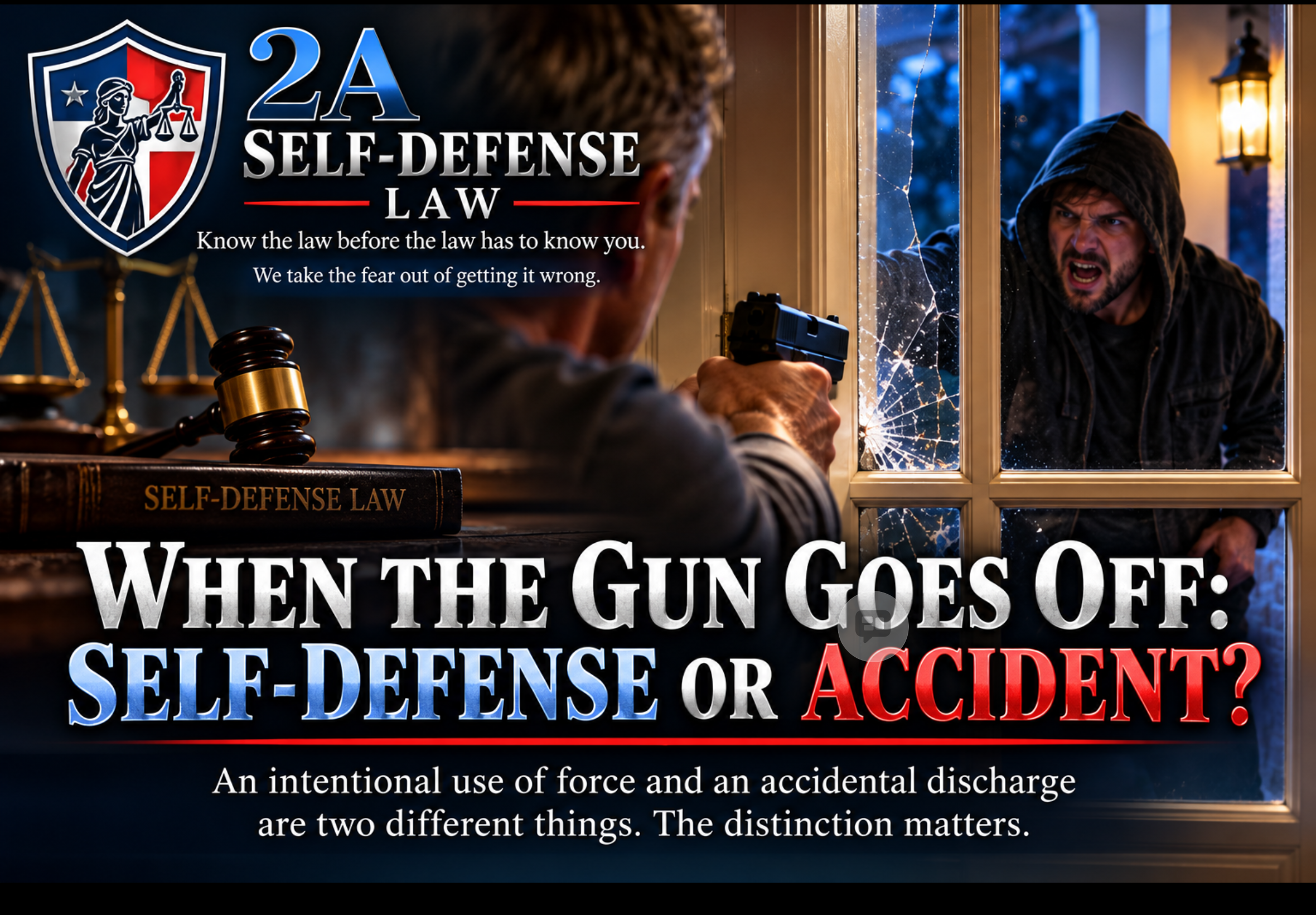
When the Gun Goes Off: Self-Defense or Accident?
An intentional use of force and an accidental discharge are two different things. The distinction matters.
A Fictional Story With a Real Legal Lesson
The following story is fictional. Its purpose is to examine the difference between an intentional use of force in self-defense and an accidental discharge of a firearm.
Before we begin, a word about Castle Doctrine. Over roughly 200 years of American legal development, all fifty states have developed their own laws and court decisions governing the defense of the home. Those laws are not uniform. Some, all, or none of the circumstances in our fictional story may satisfy the Castle Doctrine requirements of a particular state. We have deliberately selected these facts to illustrate one distinction, not to decide whether the homeowner’s actions would be justified under any state’s Castle Doctrine laws. Our subject is simple: an intentional act and an accidental act are not the same thing.
The Night Eric Came Back
It was shortly after 10:00 on a Saturday evening when Daniel and his wife, Rebecca, heard shouting outside their home. Their adult daughter, Lauren, had recently ended a relationship with a man named Eric. Throughout the afternoon, Eric had sent increasingly angry messages demanding that Lauren speak with him. She refused. Now Eric stood on the front porch, pounding on the door and shouting for Lauren to come outside. Daniel could see him through a narrow window beside the entrance. Eric appeared agitated, but Daniel could not see a weapon.
Rebecca called 911 while Daniel told Lauren to stay away from the front windows. Eric continued shouting, demanding that someone open the door. When nobody responded, he began kicking it. The first impact rattled the frame. The second was harder, and Daniel heard wood cracking near the lock. Rebecca told the dispatcher that someone was attempting to break into their home. Daniel retrieved his handgun from a cabinet, believing Eric might force his way inside before police arrived. He wanted to be prepared to protect his family.
Then the kicking stopped. Daniel looked through the window and saw Eric step backward from the porch. For several seconds, it appeared he might be leaving. Rebecca urged Daniel to stay away from the entrance and wait for police. Instead, Daniel moved closer to determine whether the danger had passed. Eric suddenly turned and approached the door again, reaching into his jacket pocket. Daniel could not see what Eric was reaching for, but given the threats and attempted entry, he feared Eric might be retrieving a weapon.
Daniel raised his handgun toward the doorway and shouted for Eric to stop. The door remained closed, and Eric had not crossed the threshold. At that moment, Lauren emerged from the hallway behind her father and called out to him. Startled, Daniel turned toward her. As he redirected his attention toward the front door, his finger inadvertently pressed the trigger. The handgun discharged. The bullet passed through the glass panel beside the entrance and struck Eric, who collapsed on the porch. Daniel immediately told Rebecca to inform the dispatcher that someone had been shot. He placed the handgun on the floor and waited for police.
Eric died from the gunshot wound. Investigators photographed fresh damage to the entrance, including a fractured doorjamb, a partially separated strike plate, and splintered wood surrounding the deadbolt. The damage was consistent with repeated attempts to kick the door open. The 911 recording also captured heavy impacts while Rebecca described Eric’s attempts to force entry. This evidence confirmed that Eric had been attempting to break into the home. Investigators also determined that the object Eric reached for was a cellular phone, not a weapon. Daniel maintained that he had not intended to fire, and for purposes of our hypothetical, the physical evidence supports his account of an accidental trigger pull.
Intentional Conduct Versus an Accidental Discharge
Here is where we need to be precise about what happened. Daniel intentionally retrieved his handgun and intentionally raised it toward Eric because he believed his family was threatened. When Lauren startled him, Daniel inadvertently pressed the trigger, causing the firearm to discharge. The presentation of the handgun was intentional. The discharge was accidental. Whether Daniel’s actions were legally justified depends on the applicable jurisdiction and is not a question this hypothetical attempts to answer.
That distinction is the entire reason for our hypothetical. If Daniel had deliberately fired because he believed Eric was about to break through the door and attack his family, we would be examining an intentional use of deadly force and whether that force was justified. But that is not what our story describes. Daniel never made the decision to fire.
People sometimes describe any shooting that occurs during a confrontation involving a perceived threat as a self-defense shooting. But the circumstances surrounding a shooting and the reason the firearm discharged are not necessarily the same thing. An accident may occur during a confrontation in which someone believes defensive force might become necessary. That does not make the accidental discharge an intentional use of defensive force.
The distinction also works in the opposite direction. A person who deliberately fires at an attacker to stop a threat cannot call the discharge accidental simply because the attacker dies and death was not the person’s desired outcome. The trigger pull was intentional. Whether it was justified is a separate question.
In short, self-defense concerns the legal justification for using force, while accident concerns whether an act or consequence was intended. The two concepts can arise in the same encounter, but they should not be confused.
A Real Case Study: State v. Edwards
The Minnesota Supreme Court confronted this distinction in State v. Edwards, 343 N.W.2d 269 (Minn. 1984). The case involved Robert Edwards and his brother-in-law, Gerald Howard, who was shot and killed in the entrance area of a south Minneapolis bar in November 1981.
Before the shooting, Edwards had been discussing allegations that Howard mistreated Edwards’s sister. Witnesses described threatening remarks, and after Howard left the bar, Edwards followed him into the entrance area. A confrontation occurred, and Edwards shot Howard at close range.
Edwards claimed that Howard appeared to be reaching for a gun. According to Edwards, he drew his own firearm, pointed it at Howard, and ordered him to stop. He maintained that he did not intend to fire. Instead, he claimed that a woman grabbed him from behind and that the gun discharged accidentally during the struggle. Other witnesses disputed important portions of his account.
The jury convicted Edwards of second-degree intentional murder, and the Minnesota Supreme Court affirmed that conviction. The court did not establish that Edwards’s version of the shooting was true. Nevertheless, the court addressed an important legal distinction raised by his testimony.
Edwards claimed that he pointed his firearm in self-defense but that the discharge was accidental. The Supreme Court explained that the jury instruction concerning self-defense causing death was not appropriate for that particular claim. The trial court had instead used an instruction addressing self-defense where death was not the intended result. The Supreme Court found that distinction appropriate.
That distinction is important. Edwards was not claiming that he deliberately fired a justified defensive shot. He was claiming that he intentionally pointed the gun because he perceived a threat and that it subsequently discharged without his intention. The court recognized that those are different factual and legal propositions.
The Supreme Court also concluded that the jury should have been allowed to consider second-degree culpably negligent manslaughter as a lesser offense, although it determined that the failure to give that instruction did not prejudice Edwards and affirmed his conviction. That portion of the decision concerns possible criminal liability for the handling of the firearm, which is separate from our central lesson about intentional and accidental conduct.
The case illustrates why precision matters. A person may claim that pointing a firearm was justified by self-defense while maintaining that its discharge was accidental. Those claims are not necessarily inconsistent because they concern different acts. But the accidental discharge should not be described as though the person intentionally fired in self-defense.
The complete decision is available here: State v. Edwards, 343 N.W.2d 269 (Minn. 1984).
What Daniel and Edwards Teach Us
Daniel’s fictional encounter and the real Edwards case share one important feature. Both involve a person who intentionally presented a firearm because of a perceived threat, followed by a discharge the person maintained was accidental.
There is also a critical difference. In our fictional scenario, we have established that Daniel’s trigger pull was accidental. In Edwards, the defendant’s claim was disputed, and the jury convicted him of intentional murder. We should not confuse an allegation of accident with a proven accident.
But once we identify which act was intentional and which was accidental, the distinction becomes clear. If someone deliberately pulls the trigger to stop a threat, that is an intentional use of force. Whether it is justified depends on the applicable law and circumstances. If the trigger is pulled unintentionally, the discharge is accidental. It is not an intentional defensive shot merely because the person was confronting a perceived threat when it happened.
This does not mean the surrounding circumstances become irrelevant. They may matter to other legal questions, including whether the person’s earlier actions were justified and what criminal liability, if any, may follow. It simply means we must not treat an accidental discharge as though it were a deliberate decision to shoot.
The Lesson
Self-defense and accident describe different things. Self-defense is a legal justification for the use of force. Accident describes an unintended event. A person can intentionally draw or point a firearm because of a perceived threat and then accidentally discharge it. Whether the initial conduct was justified depends on the applicable law, but the accidental discharge does not become an intentional defensive shot merely because it happened during a threatening encounter.
That is the distinction we wanted readers to recognize in Daniel’s story. His decision to present the handgun was intentional. His decision to fire did not exist because he never made one. The trigger pull was accidental. Those facts should not be combined into a single description that obscures what actually happened.
Whether Daniel’s actions were justified under a particular state’s Castle Doctrine laws is a separate question, as is whether the accidental discharge could create criminal liability. Neither question changes the distinction between an intentional trigger pull and an accidental one.
An intentional defensive shot and an accidental discharge are not the same act. Understanding which one occurred is essential before the law can properly evaluate what happened.
⸻
Legal case study: State v. Edwards, 343 N.W.2d 269 (Minn. 1984)
Educational disclaimer: This article is intended for general legal education and is not legal advice. The Daniel and Eric scenario is fictional. State v. Edwards is an actual Minnesota Supreme Court decision. Castle Doctrine laws, self-defense rules, and criminal liability standards vary by jurisdiction. The outcome of any real case depends on its particular facts and applicable law.
Citations & sources
A Real Case Study: State v. Edwards The Minnesota Supreme Court confronted this distinction in State v. Edwards, 343 N.W.2d 269 (Minn. 1984). The case involved Robert Edwards and his brother-in-law, Gerald Howard, who was shot and killed in the entrance area of a south Minneapolis bar in November 1981. The complete decision is available here: State v. Edwards, 343 N.W.2d 269 (Minn. 1984). Legal case study: State v. Edwards, 343 N.W.2d 269 (Minn. 1984) Educational disclaimer: This article is intended for general legal education and is not legal advice. The Daniel and Eric scenario is fictional. State v. Edwards is an actual Minnesota Supreme Court decision. Castle Doctrine laws, self-defense rules, and criminal liability standards vary by jurisdiction. The outcome of any real case depends on its particular facts and applicable law.