
When Even the Professionals Get Self-Defense Law Wrong: Lawyers, Cops, and Firearms Instructors Aren’t Immune
- Originally published:
- October 18, 2026
- Last modified:
- October 18, 2026
There is something particularly dangerous about being confidently wrong when the subject is self-defense law. We’ve developed this peculiar habit of assuming that because someone has a law degree, wears a police uniform, or possesses a firearms instructor certification, they must understand the legal standards governing the use of force. Credentials deserve consideration, but they aren’t substitutes for understanding the law. Unfortunately, the consequences of bad information rarely fall on the person who provided it. They fall on the person who relied upon it when making a decision that cannot be taken back.
I’ve been teaching self-defense law since 2008, and one of the greatest obstacles I’ve encountered isn’t ignorance. It’s the illusion of knowledge. Someone heard something from a police officer, attended a concealed-carry class, or watched an attorney explain the law on YouTube. Suddenly, a simplified explanation becomes an unquestionable legal principle. Apparently, having letters after your name or a badge on your chest makes Minnesota Supreme Court decisions easier to understand without actually reading them.
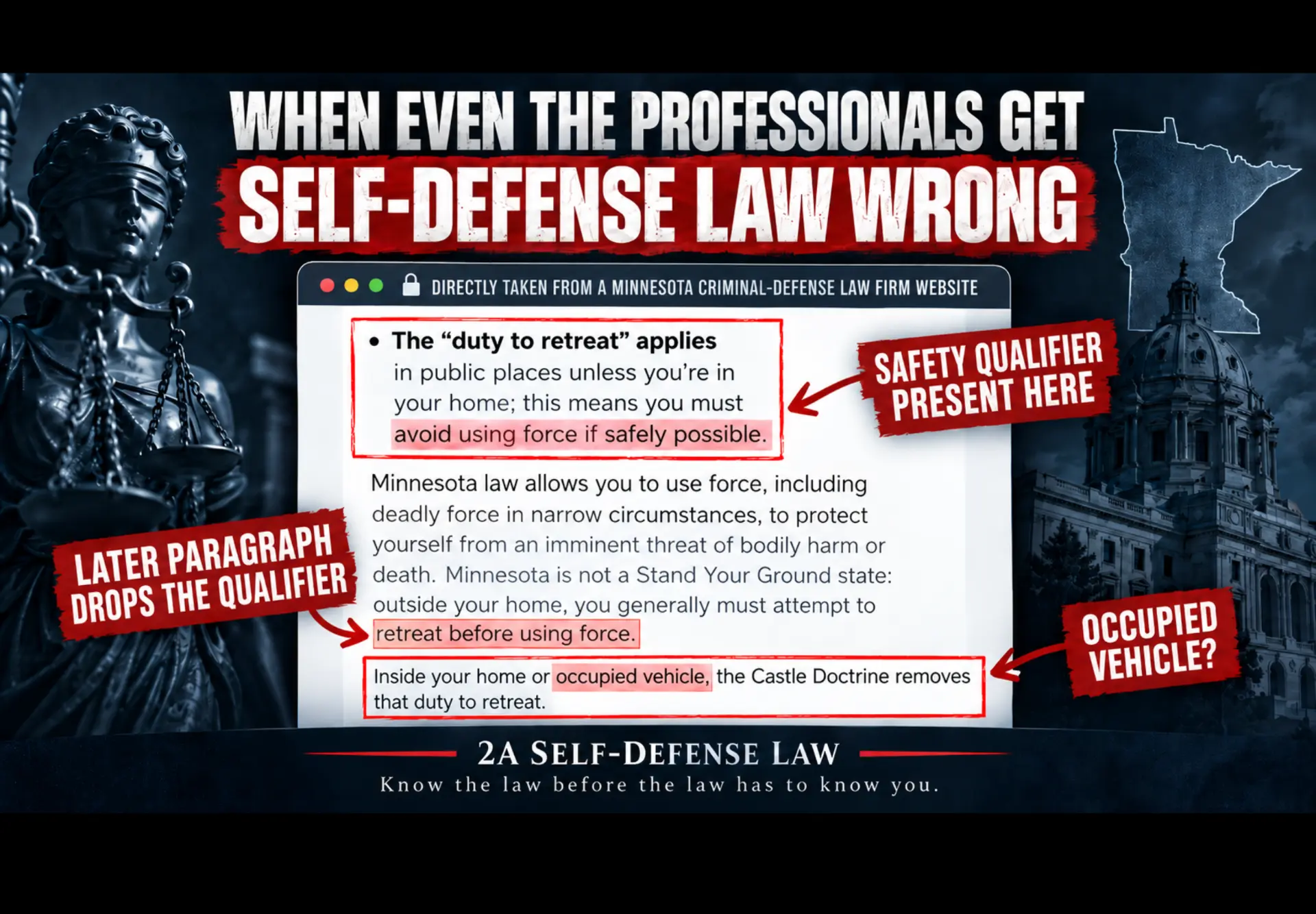
Recently, I came across an article published on the website of a Minnesota criminal-defense law firm explaining Minnesota’s duty to retreat and Castle Doctrine. Much of the information is useful, but two things caught my attention: an inconsistent explanation of the duty to retreat and a claim that the Castle Doctrine automatically extends to occupied vehicles. Neither is something I’d expect to find in educational material published by criminal-defense attorneys.
What makes the retreat explanation particularly frustrating is that the firm gets the safety qualification right in its own bullet-point summary. It correctly tells readers that retreat is required when it can be accomplished safely. But a few paragraphs later, that qualification disappears, and the explanation becomes a general statement that people must attempt to retreat before using force. Technically, the statements can be reconciled, but why should readers have to reconcile a law firm’s explanation with itself? Whether retreat can be accomplished safely isn’t an insignificant detail. It’s central to understanding the obligation, and consistency shouldn’t be an unreasonable expectation when publishing legal guidance.
Minnesota generally requires someone defending themselves outside the home to retreat when reasonably possible. But that doesn’t mean exposing yourself to greater danger simply to demonstrate that you tried escaping. Imagine someone advancing toward you with a knife while an exit sits thirty feet behind you. Does the existence of that exit automatically establish a reasonable opportunity to retreat? Certainly not. Distance, movement, the aggressor’s conduct, and the danger involved in escaping all matter. The law doesn’t require someone to ignore an imminent threat simply because a prosecutor might later identify a theoretical escape route on a photograph.
In State v. Devens (2014), the Minnesota Supreme Court examined retreat outside the protected area of the home. In State v. Blevins (2024), the court applied the duty to retreat when reasonably possible to a particular felony assault-fear offense involving a dangerous weapon. These decisions demonstrate why simply teaching someone they may draw a firearm whenever they feel threatened is inadequate. Even threatening force may create criminal liability when the circumstances don’t justify it. Fear alone doesn’t establish legal justification.
The law firm’s occupied-vehicle statement presents a more significant problem. Minnesota recognizes a Castle Doctrine exception to the duty to retreat within the home. Decisions including State v. Carothers (1999) and State v. Glowacki (2001) explain that protection, but they don’t establish a categorical exception for every occupied automobile. Someone inside a vehicle might have no reasonable opportunity to retreat safely, particularly when an aggressor blocks an exit. That is a fact-specific safety analysis, not an automatic exemption because someone happens to be sitting behind a steering wheel. Four tires and a seat belt don’t magically transform an automobile into a dwelling.
State v. Valdez (2024) demonstrates another distinction. The Minnesota Supreme Court held that someone defending another person doesn’t personally have a duty to retreat. However, the defender must subjectively believe the person being protected has no reasonable possibility of safe retreat, and that belief must be objectively reasonable. The details matter because defending yourself and defending someone else don’t necessarily involve identical retreat requirements.
But if you think lawyers occasionally misstate self-defense law only when writing educational articles, Alaska provides an extraordinary example of what happens when the misunderstanding reaches an actual courtroom.
In Rossiter v. State (2017), a prosecutor repeatedly argued that a defendant’s claim of self-defense could succeed only if the person he killed deserved to die. Think about that for a moment. The prosecutor effectively replaced the legal requirements of self-defense with a moral judgment about whether the deceased deserved his fate. The defense attorney objected to portions of the prosecutor’s presentation but failed to object to the closing argument, even after the judge invited an objection. The trial judge failed to intervene. The Alaska Court of Appeals reversed the second-degree murder conviction because the prosecutor had so seriously mischaracterized self-defense law that the error undermined the fairness of the trial.
And Alaska wasn’t finished providing examples. In Savo v. State (2016), a prosecutor sought to prevent a defendant from presenting self-defense, despite evidence supporting the claim. The trial judge then prohibited the defense from discussing self-defense during jury selection and opening statements. The appellate court reversed the convictions and actually characterized the prosecutor’s motion as frivolous. Apparently, even placing a prosecutor, defense attorney, and judge in the same courtroom doesn’t guarantee that the applicable legal principles will be properly understood or applied.
Now let’s discuss police officers, because their professional responsibilities differ substantially from civilian self-defense. Police operate under departmental policies, constitutional standards, and statutes governing official duties. Consider my Five Pillars framework: Innocence, Imminence, Proportionality, Avoidance, and Reasonableness. For officers, lawful authority and departmental policy affect the innocence analysis because officers may initiate encounters, detain suspects, and use authorized force without automatically becoming unlawful aggressors. Imminence and proportionality have recognizable parallels to civilian self-defense, although the governing legal standards aren’t identical.
Avoidance presents an especially important distinction. A private citizen generally has no obligation to pursue or apprehend a criminal. Police officers, however, have public-safety responsibilities that may require confronting dangerous individuals. Departmental policies govern engagement, de-escalation, disengagement, and force. These policies undergo extensive review, training, and revision, often informed by judicial decisions. Under Graham v. Connor (1989), police force during a seizure is evaluated under the Fourth Amendment’s objective-reasonableness standard. Minnesota Statutes section 609.066 separately governs peace officers’ use of deadly force. But compliance with departmental policy doesn’t automatically establish that every action was lawful or reasonable.
This is why asking an officer to explain civilian self-defense law can produce an answer influenced by police training and responsibilities. The officer may accurately describe what police are authorized to do while overlooking the different rules applicable to private citizens. Firearms instructors present a similar problem. Someone can be exceptionally qualified to teach marksmanship and defensive tactics while possessing only a superficial understanding of appellate law. And as our Minnesota example illustrates, attorneys aren’t immune to incomplete explanations either.
I’m not suggesting the attorneys at the Minnesota law firm intentionally misrepresented Minnesota law or that they’re incompetent. My criticism concerns the published statements themselves. A correct safety qualification in one paragraph doesn’t excuse careless wording elsewhere, particularly when accompanied by an unsupported expansion of the Castle Doctrine to occupied vehicles. If Rossiter and Savo demonstrate anything, it’s that professional qualifications don’t make a person’s understanding of self-defense law immune from error, even when the consequences involve a criminal conviction.
This is precisely why I teach the Five Pillars as an educational framework rather than a collection of slogans. Innocence, Imminence, Proportionality, Avoidance, and Reasonableness help people understand the questions that arise when defensive force is used. They aren’t substitutes for statutes or controlling judicial decisions. Their value comes from understanding how the principles interact and how their application changes with the circumstances.
What you think you know will prevent you from learning what you should know. That applies to civilians, police officers, firearms instructors, attorneys, judges, and certainly anyone teaching self-defense law, myself included. The objective shouldn’t be to defend our credentials or protect our favorite explanations from criticism. It should be to understand the law accurately enough that someone relying on our instruction doesn’t discover its exceptions for the first time while sitting beside a criminal-defense attorney.
Know the law before the law has to know you.