Six Ways to Turn a Self-Defense Shooting Into a Prosecutor’s Favorite Case
The law may justify your actions, but the evidence still has to tell the same story.
- Originally published:
- October 23, 2026
- Last modified:
- October 23, 2026
Six Ways to Turn a Self-Defense Shooting Into a Prosecutor’s Favorite Case
The law may justify your actions, but the evidence still has to tell the same story.
By Jeffrey S. Straub
The investigation doesn’t necessarily begin when the trigger is pulled. It may begin with an argument twenty minutes earlier, an angry social media post from the previous week, or the brilliant decision to follow someone who had already walked away. And it certainly doesn’t end when the shooting stops. Everything you do afterward may become part of the evidence used to determine whether you acted in lawful self-defense or committed a crime.
Yet there remains a remarkably persistent belief in the firearms community that a justified shooting will be immediately recognized as such. Apparently, some people imagine the police arriving, reviewing their concealed carry permit, accepting their explanation, and congratulating them on successfully exercising their constitutional rights. Perhaps they’ll even offer to clean the firearm before returning it. Unfortunately, the criminal justice system has never been particularly impressed by what someone believes the law allows.
Attorney Mitch Vilos, coauthor with Evan Vilos of Self-Defense Laws of All 50 States: With Plain-Talk Summaries, identified recurring circumstances he called “Thumbs-Down Factors.” Based on their examination of defensive-force cases, these were circumstances they believed increased the likelihood of arrest, prosecution, or conviction. Their work raises an important distinction: having a legally defensible justification for deadly force is not necessarily the same as having evidence that will persuade investigators, prosecutors, or a jury.
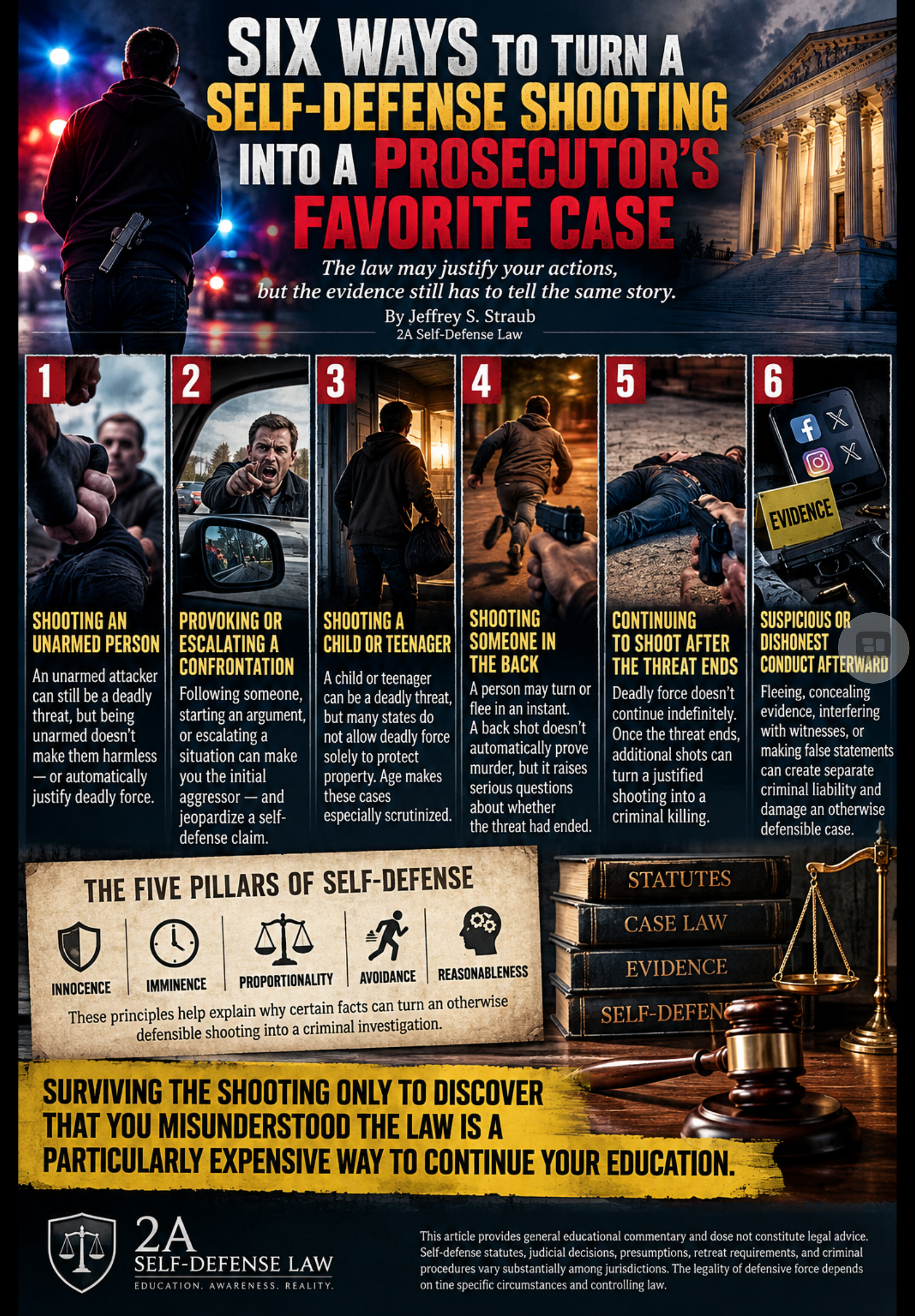
Drawing from Vilos’s broader observations, I’ve selected six particularly instructive warning signs: shooting an unarmed person, provoking or escalating a confrontation, shooting a child or teenager, shooting someone in the back, continuing to shoot after the threat ends, and engaging in suspicious or dishonest conduct afterward. These are not statistically ranked, and the order does not represent their relative seriousness. They are illustrative rather than exhaustive, and none automatically establishes criminal liability.
At 2A Self-Defense Law, we examine defensive force through five fundamental considerations: Innocence, Imminence, Proportionality, Avoidance, and Reasonableness. Although their precise legal application varies by jurisdiction, these principles help explain why certain facts can turn an otherwise defensible shooting into a criminal investigation. And unlike the legal advice occasionally dispensed by the loudest person at the gun counter, these principles require something more than confidence and a willingness to repeat yourself.
Consider the first warning sign: shooting someone who was unarmed. There is a common misconception that an unarmed attacker cannot present a deadly threat. Apparently, fists, feet, concrete sidewalks, and overwhelming physical strength have all been declared harmless because they don’t come with serial numbers. In reality, an unarmed attacker can inflict death or serious bodily injury, particularly when significant disparities in strength, numbers, or physical ability exist.
But the opposite misconception is equally dangerous. Being smaller, older, or outnumbered does not automatically justify deadly force. Investigators will examine what the attacker was actually doing, whether the defender reasonably believed serious harm was imminent, and whether the degree of force used was reasonable. These are related but distinct questions. A reasonable belief that someone might become violent does not necessarily justify shooting that person. Likewise, a genuine threat does not authorize every possible response. The law is annoyingly particular about circumstances, which is unfortunate for people who prefer legal rules that fit comfortably on a bumper sticker.
The second warning sign involves provoking or escalating the confrontation. Imagine someone cuts you off in traffic. You follow him, exchange insults, pull into a parking lot, and approach his vehicle. Eventually, the confrontation becomes physical, and you draw your handgun. You may believe the other driver ultimately threatened you, but investigators will want to know why you followed him in the first place. Apparently, the opportunity to demonstrate that you were right about a traffic violation was worth introducing a firearm into the discussion.
This is where innocence and avoidance become important. Self-defense laws generally place limitations on people who initiate or provoke unlawful confrontations. In many jurisdictions, an initial aggressor may regain the right of self-defense by genuinely withdrawing and clearly communicating that withdrawal, although the precise requirements and exceptions vary. Merely deciding that you’ve had enough of the argument may not satisfy the applicable legal standard, particularly when your earlier behavior helped create the danger.
Retreat requirements also differ substantially. Some jurisdictions impose a duty to retreat when it can be accomplished safely before using deadly force. Others generally remove that duty for people lawfully present who meet specified conditions. But having no legal duty to retreat does not transform every avoidable confrontation into a wise decision. There is a remarkable difference between standing your ground against an unlawful attack and actively searching for an opportunity to prove that you don’t have to retreat. Unfortunately, that distinction sometimes becomes clear only after the defense attorney explains his hourly rate.
The third warning sign, shooting a child or teenager, introduces an emotionally charged circumstance that can complicate even a legitimate defensive claim. A sixteen-year-old can commit armed robbery, participate in a violent home invasion, or present an imminent threat of death or serious bodily injury. Age does not automatically make an attacker harmless, nor does it generally prevent someone from using otherwise justified defensive force. But consider a homeowner who discovers a fourteen-year-old stealing electronics and shoots the teenager. Investigators determine that the intruder was unarmed and apparently had not threatened anyone physically. The homeowner insists that burglary is a felony and therefore deadly force was justified. Apparently, finding the word felony in a criminal statute is now sufficient to dispense with the remaining legal analysis.
In most American jurisdictions, deadly force is generally not justified solely to protect ordinary personal property. However, defense-of-habitation laws and other statutory exceptions vary. Some states recognize presumptions involving unlawful and forcible entry, while others permit deadly force under more limited circumstances. Texas, for example, expressly authorizes deadly force to protect property in certain narrowly defined situations under Penal Code § 9.42, subject to additional statutory requirements. Unfortunately, self-defense law doesn’t come with a nationwide subscription plan. What Texas permits under particular circumstances may get you prosecuted somewhere else, and waving around a statute from another state isn’t likely to impress the judge.
The critical distinction is between protecting human life, defending a dwelling under an applicable legal provision, and merely preventing property loss. Those situations may receive very different legal treatment. A teenager’s age does not determine justification, but the death of a child can bring intense scrutiny to the defender’s assessment of danger and the necessity of the response. Public emotion should never replace legal analysis, but neither should a defender assume that labeling someone a burglar answers every question about the shooting. The law does not automatically convert every criminal act into a capital offense, and homeowners do not acquire judicial authority simply because the crime occurred on their property.
The fourth warning sign is shooting someone in the back. Popular entertainment has convinced generations of viewers that every legitimate attacker faces the defender directly until the final dramatic moment. Actual violence is far less cooperative. People turn, stumble, twist, and change direction in fractions of a second. A person who was facing a defender when the decision to fire was made may have turned before the bullet struck. Consequently, a gunshot wound to the back does not automatically prove that a shooting was unjustified.
Nevertheless, it may raise questions about whether the attacker was fleeing and whether the threat had ended. Consider an armed robber who turns and runs toward an exit. If a store employee shoots him from behind, investigators will examine whether the robber still presented an imminent threat to anyone. If the robber was turning toward another employee with a weapon, the analysis may be different. Certain states also have statutory provisions addressing deadly force in connection with specified forcible felonies, fleeing offenders, or protection of property. Those provisions are not interchangeable, and ordinary citizens should not assume they possess the same authority as law enforcement officers.
Apparently, some people believe that a bullet entering someone’s back automatically establishes murder, while others believe that calling the deceased a criminal automatically establishes self-defense. Both groups would benefit enormously from opening a law book before opening their mouths. The forensic evidence, the defender’s reasonable perceptions, and the applicable law must all be examined together. A wound location is evidence, not a verdict, regardless of how confidently someone on social media announces otherwise.
The fifth warning sign is perhaps the clearest example of how an initially justified shooting can become an unjustified killing. The legal authority to use deadly force does not continue indefinitely simply because someone presented a threat moments earlier. Apparently, this comes as a surprise to people who confuse stopping an attacker with making absolutely certain the attacker receives the punishment they believe he deserves.
One of the most disturbing examples involved Oklahoma pharmacist Jerome Ersland. In 2009, two teenagers entered the pharmacy where he worked during an attempted robbery. Ersland shot sixteen-year-old Antwun Parker, who fell to the floor. Ersland subsequently retrieved another handgun and fired additional shots into Parker. Surveillance footage became central to the prosecution, and Ersland was convicted of first-degree murder and sentenced to life imprisonment. His conviction was affirmed on direct appeal, and his subsequent federal habeas challenge was unsuccessful.
The case illustrates the difference between responding to an ongoing deadly threat and continuing to use deadly force after that threat has ended. It also exposes another dangerous misconception: the belief that the law establishes some magical number of permissible shots. There is no universal rule that two shots are justified while five constitute murder. Multiple shots may be reasonable during an ongoing deadly encounter, while a single shot fired after the danger has clearly ended may be unlawful. The relevant questions concern the continuing threat, the defender’s reasonable perception of that threat, and whether additional force remained necessary.
A wounded attacker may still be dangerous, but an incapacitated attacker who no longer presents a threat cannot lawfully be subjected to additional deadly force merely because the defender is frightened, angry, or believes the attacker deserves punishment. The objective is to stop the unlawful threat, not to ensure the attacker never has the opportunity to explain himself. Self-defense is about stopping a threat. It is not a sentencing hearing conducted with ammunition.
The sixth warning sign concerns the defender’s conduct after the shooting. Vilos identifies fleeing, concealing evidence, interfering with witnesses, and making false statements as circumstances that can seriously damage a self-defense claim. These actions may create separate criminal liability while undermining the credibility of the defender’s explanation. If someone genuinely believes the shooting was justified, deliberately rearranging the crime scene to make it look more justified is a remarkably effective way to persuade investigators that something is wrong.
But credibility problems can begin long before investigators arrive. A 911 recording may preserve the defender’s initial account. Surveillance footage may establish the sequence of events. Witnesses may describe earlier threats or arguments. Social media posts, text messages, and previous statements may become relevant if they tend to establish motive, intent, or the circumstances surrounding the confrontation. A person who publicly boasts about wanting an opportunity to shoot someone may discover that those words sound considerably less entertaining when read aloud in a courtroom. What received applause from an online audience may receive a rather different reaction from a jury.
There is also an important distinction between deliberate deception and imperfect memory. A person who has experienced a violent encounter may be injured, disoriented, or unable to recall events in perfect chronological order. Inconsistencies do not automatically establish dishonesty. But intentionally inventing facts, coordinating false accounts, or altering evidence can turn an otherwise defensible incident into a substantially more difficult case.
After a shooting, the immediate priorities should be safety, obtaining necessary emergency medical assistance, and notifying authorities when it is safe to do so. A defender should follow lawful police commands, avoid unnecessary handling or alteration of evidence, and identify urgent safety concerns. Exercising the right to remain silent and requesting legal counsel are not admissions of guilt. There is an important difference between cooperating with emergency responders and attempting to reconstruct every detail of a traumatic encounter during an extended, unrepresented interview. Contrary to what some people apparently believe, the right to remain silent does not expire simply because someone feels compelled to demonstrate how knowledgeable he is about self-defense law.
None of this guarantees that a person who acted lawfully will avoid arrest or prosecution. Nor does the presence of one of Vilos’s warning signs establish that a crime occurred. A prosecutor must still evaluate the evidence under the applicable law, and the government bears the burden required by that jurisdiction’s criminal procedures. The fact that an incident looks suspicious does not establish guilt, just as the defender’s insistence that he was justified does not establish innocence.
What these six circumstances demonstrate is that self-defense cannot be understood by examining the trigger pull in isolation. The defender’s conduct before the confrontation may affect innocence and avoidance. The circumstances during the encounter determine whether the perceived danger and responsive force were reasonable. The defender’s actions afterward may influence the evidence available to establish what actually occurred. Each stage matters, even when the defender would prefer investigators to focus exclusively on the few seconds that support his version of events.
The greatest mistake is assuming that surviving a violent encounter automatically means every decision made during that encounter was legally justified. The law does not exist to reward courage, punish cowardice, or validate someone’s belief that the other person deserved what happened. It exists to determine whether the use of force was justified under the governing legal standards. Unfortunately, those standards are not determined by how passionately someone argues about them on the internet.
Understanding those standards before an encounter is considerably more useful than discovering them during a consultation with a criminal defense attorney. Your decisions before, during, and after a confrontation matter, and the evidence will ultimately speak for itself, whether you like what it has to say or not. Because surviving the shooting only to discover that you misunderstood the law is a particularly expensive way to continue your education.
⸻
Source acknowledgment: This article draws its organizing concept from attorney Mitch Vilos’s “Thumbs-Down Factors,” discussed in Self-Defense Laws of All 50 States: With Plain-Talk Summaries, coauthored with Evan Vilos, and in Vilos’s article What to Avoid to Reduce Chances of Arrest, Prosecution and Conviction. The selection, analysis, Five Pillars framework, and commentary are original to this article.
Educational disclaimer: This article provides general educational commentary and does not constitute legal advice. Self-defense statutes, judicial decisions, presumptions, retreat requirements, and criminal procedures vary substantially among jurisdictions. The legality of defensive force depends on the specific circumstances and controlling law.
Citations & sources
In most American jurisdictions, deadly force is generally not justified solely to protect ordinary personal property. However, defense-of-habitation laws and other statutory exceptions vary. Some states recognize presumptions involving unlawful and forcible entry, while others permit deadly force under more limited circumstances. Texas, for example, expressly authorizes deadly force to protect property in certain narrowly defined situations under Penal Code § 9.42, subject to additional statutory requirements. Unfortunately, self-defense law doesn’t come with a nationwide subscription plan. What Texas permits under particular circumstances may get you prosecuted somewhere else, and waving around a statute from another state isn’t likely to impress the judge.