Shut Up, Counselor. Minnesota Law Has Something to Say.
When an attorney's confidence meets a Minnesota statute he apparently overlooked.
- Originally published:
- October 31, 2026
- Last modified:
- October 31, 2026
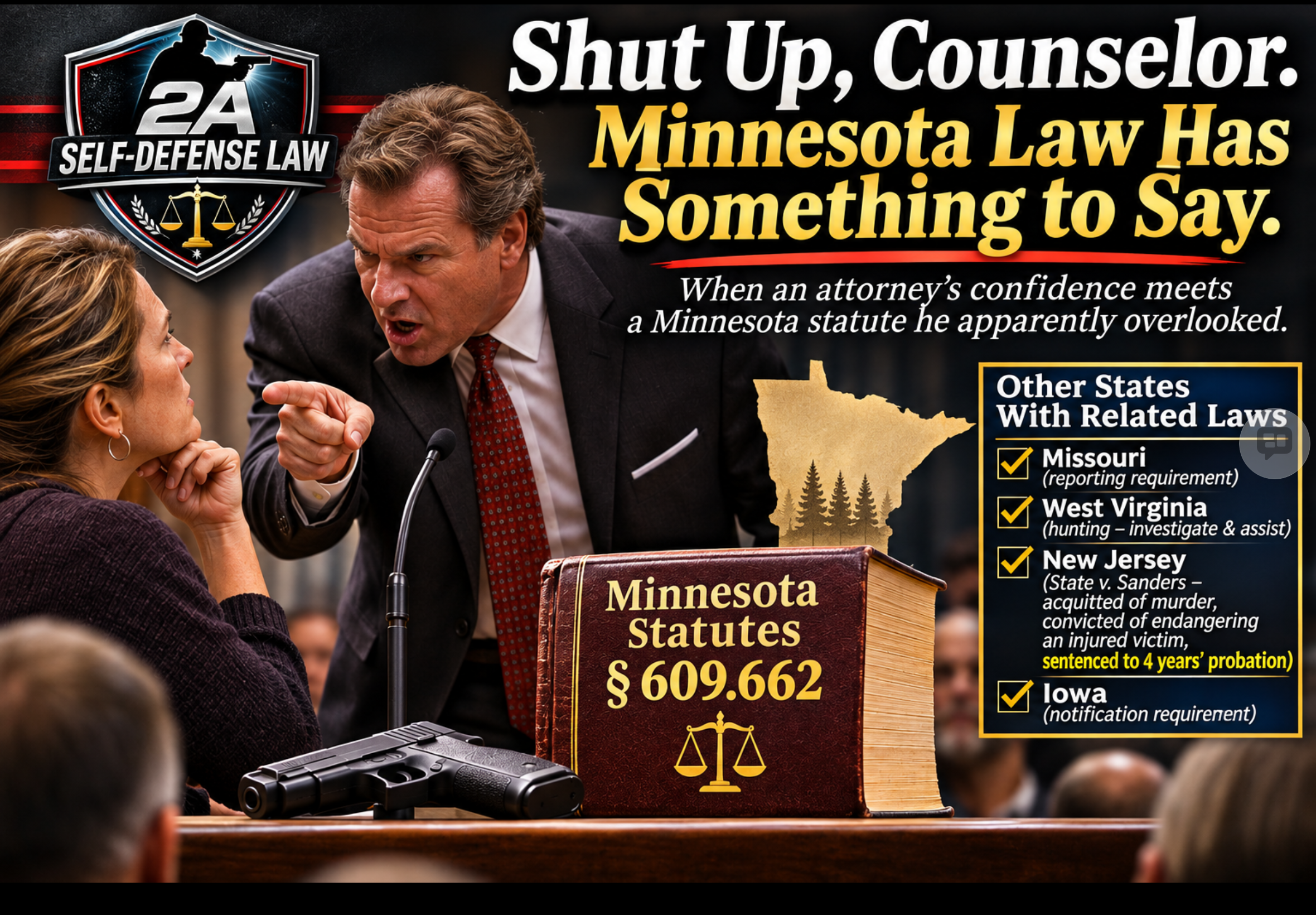
Several years ago, sometime between 2015 and 2020, I attended a firearms legal-protection seminar at Bill's Gun Shop in Robbinsdale, Minnesota. The featured speaker was an attorney I remember as E. Alan Anderson, representing a national firearms legal-protection company. He was a relatively short fellow, perhaps five-foot-five, with a rather Napoleonic command of the room. Confidence certainly wasn't in short supply. Unfortunately, confidence and a thorough understanding of Minnesota law aren't necessarily traveling companions.
The discussion eventually turned to what someone should do immediately after a defensive shooting. Anderson repeatedly advised against calling 911. His reasoning was familiar enough: emergency calls are recorded, prosecutors can obtain those recordings, and frightened people sometimes say things that complicate their legal defense. Those concerns are legitimate. What caught my attention was how emphatically he discouraged making the call without addressing Minnesota's statutory obligations.
A woman in the audience repeatedly asked whether she was legally required to call 911 following a defensive shooting. As I remember it, Anderson leaned toward her, getting right into her face, and slapped the table while emphatically repeating that she was not. Calling 911, he insisted, was a courtesy, not a legal requirement. She seemed increasingly bewildered, apparently sensing something was missing but unable to identify it. Meanwhile, the attorney's confidence seemed to grow with every repetition. Eventually, I raised my hand and brought up Minnesota Statute § 609.662, the state's duty-to-render-aid law.
From what I observed, Anderson didn't seem to know about Minnesota's statutory duty. Perhaps he had studied it previously and simply overlooked it that evening. I'll give him that benefit of the doubt. But nothing in his presentation suggested he recognized the distinction between being legally required to dial 911 and being legally required to investigate injuries and provide assistance. He was technically correct about the telephone number, but his answer left out an important part of the law.
That's the problem with presenting incomplete legal advice as though it's the final word. An attorney standing before a roomful of armed citizens to explain their responsibilities after shooting someone ought to know when a state statute complicates an otherwise simple answer.
Minnesota's Duty to Render Aid
Under Minnesota Statute § 609.662, a person who discharges a firearm and knows or has reason to know that the discharge caused bodily harm to another person must immediately investigate the extent of the injuries and render immediate reasonable assistance. The statute defines reasonable assistance as aid appropriate to the circumstances, including obtaining or attempting to obtain help from law enforcement or medical personnel.
Those are two distinct statutory obligations. The law doesn't prescribe a particular telephone number, require hands-on medical treatment in every situation, or demand a detailed explanation of the shooting to police. Calling 911 may be a practical way to obtain professional assistance, but whether the person has fulfilled both obligations depends on the circumstances.
And let's not pretend this is 1885. If someone has been shot, most people aren't going to saddle a horse, ride into town, and search for the sheriff. They're going to reach for the cellphone in their pocket and dial 911. Not because they're thinking about Minnesota Statute § 609.662 or trying to satisfy some legal obligation they've probably never heard of. They're calling because they want the cavalry on its way. They want police officers arriving to secure the scene, prevent another confrontation, and make sure the danger is over. And if someone is injured, they want medical help coming too. As it happens, that same call may help fulfill Minnesota's statutory duty to render reasonable assistance. But the immediate motivation is getting help and making the situation safe, not performing a legal exercise.
The statute also applies to qualifying witnesses who saw the firearm discharge and knew or had reason to know it caused bodily harm. A witness who was a companion of the shooter faces greater potential punishment than an ordinary witness. For the shooter, a violation involving death or great bodily harm carries a maximum penalty of two years' imprisonment, a $4,000 fine, or both. Lesser injuries carry lower penalties.
Most importantly for defensive gun owners, § 609.662 contains no express exception for a legally justified shooting. Its language focuses on the discharge, the resulting bodily harm, and the person's knowledge of that harm. That suggests the duty may arise after a justified defensive shooting, although I have not identified a controlling Minnesota appellate decision directly resolving that particular application.
You Don't Have to Become the Victim Twice
There's an obvious problem with requiring someone to investigate injuries immediately after a defensive shooting: the person who was just shot may still present a threat. Minnesota lawmakers anticipated that possibility. Subdivision 4 of § 609.662 provides an affirmative defense when the defendant proves, by a preponderance of the evidence, that the failure to investigate or assist occurred because the defendant reasonably perceived that those actions couldn't be performed without a significant risk of bodily harm to themselves or others.
That doesn't mean someone must approach an armed aggressor, surrender a position of safety, or expose themselves to another attack. But it also doesn't mean every obligation automatically disappears because the injured person was previously dangerous. Someone might reasonably be unable to approach an attacker while still being able to summon emergency assistance from a safe location. Whether the statutory defense applies depends on the circumstances and the evidence.
The law doesn't require you to become a second victim, but it doesn't provide a blanket exemption from reasonable assistance whenever self-defense was involved.
A Separate Criminal Question
Some time ago, I asked a respected attorney to conduct preliminary research into Minnesota prosecutions involving § 609.662. In the cases reviewed, the duty-to-render-aid allegation appeared as an additional charge accompanying other criminal accusations. We didn't identify a standalone prosecution in that limited examination.
That observation doesn't establish that standalone prosecutions have never occurred. Many criminal cases never produce published appellate decisions, and the statute expressly permits prosecution and punishment for other offenses arising from the same conduct.
Consider a homeowner who lawfully shoots an intruder, recognizes that the person is injured, and then does nothing to investigate the injuries or obtain assistance despite being able to act safely. The justification for the original shooting wouldn't necessarily resolve the separate question of compliance with § 609.662. The lawfulness of the force and the person's conduct afterward are distinct legal issues.
The Fifth Amendment Isn't a Get-Out-of-Everything Card
I understand why criminal defense attorneys warn clients about recorded emergency calls. People who have just experienced a violent confrontation may be frightened, confused, injured, or overwhelmed by adrenaline. A recording can preserve inaccurate statements, speculation, or details prosecutors later interpret unfavorably.
The Fifth Amendment protects against compelled testimonial self-incrimination. It doesn't automatically erase independent legal obligations arising after an incident. Rendering physical assistance, obtaining emergency help, and submitting to a detailed investigative interview are different kinds of conduct with different legal implications.
There may also be constitutional questions about how particular reporting or assistance requirements interact with potentially incriminating statements. Those questions deserve careful analysis rather than sweeping assurances that one constitutional protection settles everything.
Firearms instructor Massad Ayoob has long advocated a limited initial-disclosure approach rather than providing an exhaustive account immediately after a defensive shooting. Other defense-oriented commentators favor much greater silence until counsel is present. These are tactical approaches, not substitutes for understanding applicable law.
Someone can seek emergency medical assistance without volunteering an elaborate explanation of why shots were fired. Whether additional disclosures are required in a particular jurisdiction is a separate question. The distinction between complying with a legal obligation and unnecessarily discussing an incident deserves more attention than it sometimes receives.
Minnesota Isn't Alone, but Its Law Is Distinctive
Minnesota isn't the only state imposing affirmative obligations following certain shootings or uses of deadly force. Our research identified several states with comparable, although not identical, requirements. Missouri § 577.068 requires reporting certain shootings causing injury or death. West Virginia § 20-2-57a imposes investigation-and-assistance duties following certain hunting-related injuries. Iowa § 704.2B requires notification of law enforcement following certain uses of deadly force. New Jersey takes a different approach through its law against endangering an injured victim, § 2C:12-1.2.
New Jersey provides an especially revealing example. In State v. Sanders (2021), Julian Sanders became involved in a confrontation with Kendall Anthony outside a store in Newark. Anthony threatened to beat Sanders up and eventually threw a punch. Sanders dodged the punch and stabbed Anthony once in the chest. Anthony staggered, continued moving, and eventually collapsed. Sanders watched the aftermath but left without summoning medical assistance. Anthony died at the hospital the following morning.
Sanders was charged with murder, two weapons offenses, and third-degree endangering an injured victim. The jury acquitted him of murder and both weapons charges, apparently accepting his claim of self-defense. But it convicted him of endangering the injured victim. Sanders was sentenced to four years of probation, and the New Jersey appellate court affirmed the conviction.
Think about that distinction. Sanders was acquitted of the homicide charge arising from the fatal stabbing, yet he was convicted of a separate crime arising from leaving the injured man behind. The jury's apparent acceptance of self-defense didn't automatically excuse what happened after the confrontation ended.
The appellate court emphasized that Anthony was physically helpless and no longer presented a threat when Sanders left. The court rejected the argument that the original use of justified force necessarily eliminated liability under the endangering statute. Importantly, it did not establish an absolute requirement that someone remain beside a dangerous attacker. The opinion recognized that self-defense, necessity, and other legal justifications might apply under different circumstances, particularly when the threat continues. Judge Sabatino's concurrence underscored that concern.
Sanders is especially instructive because it demonstrates something our hypothetical Minnesota homeowner cannot: an actual defendant acquitted of homicide and weapons charges while being convicted for his conduct afterward. It isn't a Minnesota case, and New Jersey's statute has different elements, but the underlying lesson is relevant. A justified use of force doesn't necessarily end every legal responsibility arising from the encounter.
For gun owners in these jurisdictions, blanket advice to say absolutely nothing and do nothing until an attorney arrives may overlook important legal requirements. Depending on the state and circumstances, someone may have to report an incident, investigate injuries, obtain assistance, or take other reasonable action. Exercising constitutional rights and complying with statutory duties aren't necessarily incompatible, but neither should we assume one automatically eliminates the other.
Minnesota's law is distinctive because it expressly combines investigation and assistance obligations following qualifying firearm discharges, including duties for certain witnesses. Whether that precise combination is unique among all 50 states hasn't been conclusively established.
Minnesota also has a broader emergency-assistance provision, § 604A.01, requiring reasonable assistance in certain emergencies involving grave physical harm when assistance can be provided without danger or peril. That separate statute carries a petty-misdemeanor penalty and includes Good Samaritan civil-immunity provisions. It shouldn't be confused with § 609.662.
When the Expert Comes to Town
This brings me back to that seminar in Robbinsdale. Anderson's concerns about recorded 911 calls weren't inherently wrong. His statement that Minnesota law doesn't specifically require dialing 911 was technically correct. But his presentation, as I remember it, failed to explain a Minnesota statute imposing affirmative duties on the very people he was supposedly educating.
The woman in the audience wasn't asking for a constitutional-law lecture. She wanted to understand what the law required after a shooting. Instead, she encountered an attorney leaning toward her, slapping the table, and confidently repeating an answer that omitted an important qualification. To me, the performance demonstrated more arrogance than careful legal instruction.
Perhaps Anderson knew about § 609.662 and simply overlooked it. But when the subject is what armed citizens must do after shooting another human being, that omission matters. National firearms legal-protection companies may provide valuable services, but national marketing and impressive credentials are no substitute for understanding the laws of the jurisdiction where a client actually lives.
I don't expect every visiting attorney to memorize every provision of Minnesota criminal law. I do expect someone teaching Minnesotans about their responsibilities after a shooting to recognize when state-specific law complicates the advice. A little less table-slapping and a little more familiarity with the Minnesota Revisor of Statutes would have served that audience considerably better.
The Illusion of Knowledge
There's an old observation that the greatest obstacle to knowledge isn't ignorance, but the illusion of knowledge. Ignorance can be corrected. Someone who recognizes what they don't know can ask questions, examine statutes, read appellate decisions, and reconsider assumptions. The more dangerous person is the one who believes the questions have already been answered. That's what troubled me about the seminar. It wasn't simply that an attorney apparently overlooked a Minnesota statute. It was the extraordinary confidence with which he delivered an incomplete explanation, leaving people with the impression that there was nothing more they needed to know.
And that principle applies to this website as well. At 2A Self-Defense Law, our purpose is education, not pretending that any single article can explain every legal issue surrounding a defensive encounter. We examine specific statutes, court decisions, and principles to help readers better understand particular aspects of the law. But an article focused on one issue may not address other statutes, exceptions, constitutional questions, or factual circumstances that could materially change the legal analysis. Something explained accurately within a limited discussion may require additional qualifications when considered in the full context of the law. Readers should understand both what an article establishes and what it leaves unanswered.
Our Five Pillars of Self-Defense, innocence, imminence, proportionality, avoidance, and reasonableness, help explain whether a use of force was justified. But the legal examination doesn't necessarily stop when the immediate threat ends. Conduct afterward may raise separate questions. A justified shooting doesn't automatically excuse every subsequent omission, just as a failure to render assistance doesn't retroactively establish that the shooting itself was unlawful.
My criticism of that seminar isn't that an attorney advised caution when speaking to authorities. It's that the advice was delivered, as I remember it, with extraordinary confidence and without the statutory context necessary to make it complete. When people's decisions can affect their freedom, their safety, and another person's survival, incomplete legal instruction is no small oversight. A law degree may earn someone the microphone, but it doesn't make the Minnesota Revisor of Statutes disappear.
Know the law before the law has to know you.
Jeffrey S. Straub is an independent, self-taught legal researcher and founder of 2A Self-Defense Law. He is not an attorney. This article is educational commentary, not individualized legal advice.
Citations & sources
A woman in the audience repeatedly asked whether she was legally required to call 911 following a defensive shooting. As I remember it, Anderson leaned toward her, getting right into her face, and slapped the table while emphatically repeating that she was not. Calling 911, he insisted, was a courtesy, not a legal requirement. She seemed increasingly bewildered, apparently sensing something was missing but unable to identify it. Meanwhile, the attorney's confidence seemed to grow with every repetition. Eventually, I raised my hand and brought up Minnesota Statute § 609.662, the state's duty-to-render-aid law. Under Minnesota Statute § 609.662, a person who discharges a firearm and knows or has reason to know that the discharge caused bodily harm to another person must immediately investigate the extent of the injuries and render immediate reasonable assistance. The statute defines reasonable assistance as aid appropriate to the circumstances, including obtaining or attempting to obtain help from law enforcement or medical personnel. And let's not pretend this is 1885. If someone has been shot, most people aren't going to saddle a horse, ride into town, and search for the sheriff. They're going to reach for the cellphone in their pocket and dial 911. Not because they're thinking about Minnesota Statute § 609.662 or trying to satisfy some legal obligation they've probably never heard of. They're calling because they want the cavalry on its way. They want police officers arriving to secure the scene, prevent another confrontation, and make sure the danger is over. And if someone is injured, they want medical help coming too. As it happens, that same call may help fulfill Minnesota's statutory duty to render reasonable assistance. But the immediate motivation is getting help and making the situation safe, not performing a legal exercise. Most importantly for defensive gun owners, § 609.662 contains no express exception for a legally justified shooting. Its language focuses on the discharge, the resulting bodily harm, and the person's knowledge of that harm. That suggests the duty may arise after a justified defensive shooting, although I have not identified a controlling Minnesota appellate decision directly resolving that particular application. There's an obvious problem with requiring someone to investigate injuries immediately after a defensive shooting: the person who was just shot may still present a threat. Minnesota lawmakers anticipated that possibility. Subdivision 4 of § 609.662 provides an affirmative defense when the defendant proves, by a preponderance of the evidence, that the failure to investigate or assist occurred because the defendant reasonably perceived that those actions couldn't be performed without a significant risk of bodily harm to themselves or others. Some time ago, I asked a respected attorney to conduct preliminary research into Minnesota prosecutions involving § 609.662. In the cases reviewed, the duty-to-render-aid allegation appeared as an additional charge accompanying other criminal accusations. We didn't identify a standalone prosecution in that limited examination. Consider a homeowner who lawfully shoots an intruder, recognizes that the person is injured, and then does nothing to investigate the injuries or obtain assistance despite being able to act safely. The justification for the original shooting wouldn't necessarily resolve the separate question of compliance with § 609.662. The lawfulness of the force and the person's conduct afterward are distinct legal issues. Minnesota isn't the only state imposing affirmative obligations following certain shootings or uses of deadly force. Our research identified several states with comparable, although not identical, requirements. Missouri § 577.068 requires reporting certain shootings causing injury or death. West Virginia § 20-2-57a imposes investigation-and-assistance duties following certain hunting-related injuries. Iowa § 704.2B requires notification of law enforcement following certain uses of deadly force. New Jersey takes a different approach through its law against endangering an injured victim, § 2C:12-1.2. New Jersey provides an especially revealing example. In State v. Sanders (2021), Julian Sanders became involved in a confrontation with Kendall Anthony outside a store in Newark. Anthony threatened to beat Sanders up and eventually threw a punch. Sanders dodged the punch and stabbed Anthony once in the chest. Anthony staggered, continued moving, and eventually collapsed. Sanders watched the aftermath but left without summoning medical assistance. Anthony died at the hospital the following morning. Minnesota also has a broader emergency-assistance provision, § 604A.01, requiring reasonable assistance in certain emergencies involving grave physical harm when assistance can be provided without danger or peril. That separate statute carries a petty-misdemeanor penalty and includes Good Samaritan civil-immunity provisions. It shouldn't be confused with § 609.662. Perhaps Anderson knew about § 609.662 and simply overlooked it. But when the subject is what armed citizens must do after shooting another human being, that omission matters. National firearms legal-protection companies may provide valuable services, but national marketing and impressive credentials are no substitute for understanding the laws of the jurisdiction where a client actually lives. https://www.revisor.mn.gov/statutes/2026/cite/609.662 https://revisor.mo.gov/main/OneSection.aspx?section=577.068 https://code.wvlegislature.gov/20-2-57a/ https://www.legis.iowa.gov/docs/code/2024/704.2B.pdf https://law.justia.com/codes/new-jersey/title-2c/section-2c-12-1-2/ https://law.justia.com/cases/new-jersey/appellate-division-published/2021/a1965-18.html https://www.revisor.mn.gov/statutes/cite/604A.01