
Reading the Statute Is Not the Same as Understanding the Law
Why Minnesota firearms instructors need to understand statutes, appellate decisions, and jury instructions
- Originally published:
- October 21, 2026
- Last modified:
- October 21, 2026
Reading the Statute Is Not the Same as Understanding the Law
Why Minnesota firearms instructors need to understand statutes, appellate decisions, and jury instructions
By Jeffrey S. Straub
If you’re taking a Minnesota permit-to-carry class and your firearms instructor teaches self-defense law by doing little more than reading or quoting Minnesota statutes, you may want to seriously reconsider who you’re trusting to teach you the law. That instructor is giving you only part of the puzzle, and leaving out some of its most important pieces. Minnesota self-defense law cannot be properly understood by reading statutory language alone. You also need to understand how Minnesota appellate courts have interpreted those statutes and how the resulting legal principles are explained to jurors through jury instructions. Without that foundation, what you’re receiving may be little more than a recitation of statutory language dressed up as legal education, and those are two very different things.
Now, that same instructor might be outstanding at teaching firearms safety, marksmanship, defensive tactics, or the mechanics of carrying a handgun. He might have impressive credentials, a packed classroom, and hundreds of glowing reviews. Good for him. None of those things establishes that he understands Minnesota self-defense law. Being an excellent firearms instructor does not automatically make someone a competent instructor of legal principles, and students need to recognize the difference. If your instructor cannot explain how appellate decisions affect the meaning and application of the statutes he’s quoting, you should seriously consider finding someone who specializes in teaching self-defense law. Popularity is not a substitute for competence, and confidence is not evidence of correctness.
The problem becomes even more serious when instructors confidently present incomplete legal explanations as settled law. A student who knows that he doesn’t understand something can ask questions, seek additional instruction, or recognize the limits of his knowledge. A student who has been taught something incorrectly, however, may leave the classroom convinced that he understands exactly when he can legally use deadly force. That false confidence is potentially far more dangerous than ignorance because it can influence decisions made under extraordinary stress, when there is no opportunity to consult a statute, research a court decision, or ask the instructor what he really meant.
Minnesota law generally requires applicants for a permit to carry to complete qualifying firearms training, subject to statutory exceptions. Under Minnesota Statute § 624.714, subdivision 2a(b)(3), that training must include instruction in the fundamental legal aspects of pistol possession, carry, and use, including self-defense and restrictions on the use of deadly force. Notice what the statute does not expressly require. It does not specifically mandate instruction in Minnesota Supreme Court decisions, appellate interpretations, or criminal jury instructions. That leaves considerable room for an instructor to satisfy the statutory training requirements while providing students with an incomplete understanding of the law they may someday have to rely upon.
I have seen the consequences of that distinction firsthand. Years ago, I spent approximately three months reviewing several Minnesota permit-to-carry classes, paying particular attention to how instructors explained the legal requirements for using force. What I encountered was troubling. Some instructors taught that Minnesota’s Castle Doctrine extended to occupied vehicles without explaining the important distinctions established by appellate decisions. Others described the duty to retreat without adequately explaining that retreat must be reasonably possible and safe. Still others presented broad statements about defending the home that sounded reassuring but failed to account for the actual legal standards. These were my observations of the particular classes I reviewed, not a statistical study of Minnesota instructors. Nevertheless, the errors involved fundamental principles that could determine whether someone’s use of force was legally justified.
To understand why this happens, we need to examine three components that should form the foundation of competent self-defense law instruction: statutes, appellate court decisions, and jury instructions. These are not three equal sources of legal authority. Statutes establish legislative law. Binding appellate decisions interpret and apply that law, sometimes also establishing or clarifying common-law principles. Jury instructions are subordinate tools used to communicate the applicable legal rules to jurors. Understanding their different roles and how they work together is essential. Treating statutory language as the complete explanation, or treating pattern jury instructions as independently controlling law, can produce serious misunderstandings.
Let’s begin with statutes. Minnesota Statute § 609.06 addresses circumstances in which reasonable force may be authorized, while § 609.065 addresses the intentional taking of life. Section 609.065 recognizes two distinct statutory justifications: resisting or preventing an offense that the actor reasonably believes exposes the actor or another person to death or great bodily harm, and preventing the commission of a felony in the actor’s place of abode. Those are separate grounds for justification, and the distinction matters enormously. Yet an instructor who simply reads the statute and announces that deadly force is justified whenever someone commits a felony inside a home has skipped the difficult questions concerning necessity, reasonableness, and how Minnesota courts have interpreted the provision.
This is where appellate case law becomes indispensable. The Minnesota Legislature writes statutes, but statutes cannot anticipate every factual situation in which they will be applied. Courts must interpret statutory language, resolve disputes about its meaning, and determine how established legal principles apply to particular circumstances. Decisions from the Minnesota Supreme Court establish controlling interpretations, and precedential decisions from the Minnesota Court of Appeals also bind lower courts within the applicable judicial hierarchy. Consequently, when an appellate court authoritatively interprets a self-defense statute, that interpretation becomes part of the governing legal framework. An instructor cannot simply ignore it because the statute itself seems easier to explain.
One of the clearest examples is State v. Pendleton, 567 N.W.2d 265 (Minn. 1997). In that case, the Minnesota Supreme Court addressed the distinction between ordinary self-defense and defense of dwelling. The trial court had instructed the jury in a manner that improperly required the defendant to fear death or great bodily harm to justify deadly force used to prevent a felony in his abode. The Supreme Court recognized that the defense-of-dwelling provision establishes a separate statutory justification and that fear of death or great bodily harm is not an independent element of that justification. The court reversed the conviction and remanded the case for a new trial because the jury had not been properly instructed on the separate defense-of-dwelling justification.
Here is what makes Pendleton particularly important to this discussion. The erroneous language was not something the trial judge simply invented. It appeared in Minnesota’s standard criminal jury instruction, CRIMJIG 7.05. The defense requested a modification, but the trial court declined. The Minnesota Supreme Court ultimately concluded that the standard instruction itself improperly included the fear-of-death-or-great-bodily-harm element in the defense-of-dwelling analysis. Think about that for a moment. A standardized instruction intended to help judges explain the law was wrong, and that error affected an actual criminal trial. If a courtroom can get the instructions wrong, perhaps a firearms instructor with a slideshow and a weekend class should exercise a little humility before declaring that the law is perfectly straightforward.
The decision also illustrates why recognizing a separate defense-of-dwelling justification does not mean that every felony inside a home automatically authorizes deadly force. The reasonableness of the actor’s assessment of danger and the decision to use deadly force remain essential considerations. Removing an improperly imposed fear-of-death requirement does not eliminate the need for a legally justified response. That distinction is precisely the kind of information students may never hear when an instructor limits the discussion to reading the statute.
The same problem arises when instructors discuss Minnesota’s duty to retreat. Under Minnesota’s established self-defense framework, the state does not provide a general stand-your-ground rule outside the home. When retreat is reasonably possible and can be accomplished safely, the duty to retreat can apply. That last word matters. The law does not require someone to undertake an unsafe escape simply to demonstrate a willingness to avoid confrontation. Yet an instructor who teaches only that Minnesota requires retreat, without explaining the qualifications and applicable case law, can leave students with an equally misleading understanding.
Now consider State v. Carothers, 594 N.W.2d 897 (Minn. 1999), and State v. Glowacki, 630 N.W.2d 392 (Minn. 2001). These Minnesota Supreme Court decisions address the absence of a duty to retreat in the home, although they arise in different legal contexts. Carothers concerns defense of dwelling, while Glowacki addresses self-defense within the home, including circumstances involving co-residents. The decisions help explain how the retreat requirement operates and why the home occupies a distinct position in Minnesota self-defense law. They do not, however, establish an unrestricted right to use deadly force whenever someone feels threatened inside a residence. The use of force must still satisfy the applicable legal requirements, including reasonableness.
And what exactly counts as a home? That question becomes considerably more complicated when instructors begin talking about vehicles. In State v. Baird, 654 N.W.2d 105 (Minn. 2002), the defendant lived in a motorhome at a campground. But the central holding of Baird concerned whether the rule announced in Glowacki applied retroactively. The Supreme Court concluded that it did, and the erroneous retreat instruction required a new trial. The case should not be presented as a sweeping holding that motorhomes, much less all occupied vehicles, automatically qualify as homes. Its actual holding is important enough without inventing another one.
In State v. Edwards, 717 N.W.2d 405 (Minn. 2006), the Minnesota Supreme Court considered a confrontation involving a running van on a public street. The principal dispute concerned an aggressor-forfeiture jury instruction, CRIMJIG 7.07. The court also discussed the defendant’s opportunity to retreat as part of its harmless-error analysis. The decision is relevant to understanding how retreat considerations arise in vehicle-related confrontations, but it should not be misrepresented as establishing a categorical rule that vehicles can never qualify as dwellings. That is not the holding the court was asked to deliver.
Then consider State v. Devens, 852 N.W.2d 255 (Minn. 2014). The Minnesota Supreme Court declined to extend the no-retreat protection associated with the home to a shared apartment hallway. The court emphasized the importance of exclusive possession and control in determining the boundaries of the home for this purpose. Again, this is a distinction that may never become apparent to someone who relies solely on the general statutory language. Being inside a residential building is not necessarily the same as being inside one’s own home.
Notice what has happened. We began with statutory provisions that appear relatively short and understandable. Once we examine the appellate decisions, however, we discover distinctions involving defense of dwelling, ordinary self-defense, reasonable necessity, safe retreat, residential motorhomes, vehicles on public streets, shared hallways, and the boundaries of the home itself. Some cases establish controlling rules directly, while others discuss relevant circumstances without deciding every broader question an instructor might wish they had answered. Knowing the difference between a court’s actual holding and an observation made during its analysis is itself part of understanding case law.
That brings us to the third component: jury instructions. Most people who carry firearms will never serve as criminal defendants in a self-defense case, and hopefully they never will. But if a shooting results in criminal charges and the case goes to trial, the applicable law must be explained to the jury. Jurors are not expected to independently research every statute and appellate decision relevant to the case. Instead, the trial judge provides instructions explaining the legal principles jurors must apply when evaluating the evidence. Those instructions can address the elements of an offense, the requirements of a justification defense, the prosecution’s burden of proof, and the circumstances under which force may be legally justified.
Minnesota has pattern criminal jury instructions designed to assist judges and attorneys in accurately communicating legal principles. But pattern instructions are not themselves statutes, and they do not override controlling appellate decisions. They are tools for explaining the law, not independent sources of legislative or judicial authority. A trial judge must ensure that the instructions actually given correctly state the law applicable to the evidence. As Pendleton demonstrates, an incorrect instruction can have consequences serious enough to require reversal of a criminal conviction.
The discussion in Edwards provides another reason to be cautious. The case raised concerns about whether the standard aggressor instruction, CRIMJIG 7.07, accurately communicated the governing law. A separate opinion agreed that the instruction might misstate the law and required attention. This reinforces an important distinction: pattern instructions can be extremely useful for understanding how legal principles are presented to jurors, but their accuracy must be measured against controlling legal authority. A printed instruction does not become correct merely because it appears in a respected reference manual.
Understanding jury instructions is particularly valuable for firearms instructors because it forces them to consider how legal principles must be explained with enough precision for ordinary people to apply them. It is one thing to tell a classroom that force must be reasonable. It is another to explain what circumstances a jury may consider when determining reasonableness, how the defendant’s perceptions relate to the evidence, and how the prosecution’s burden operates once self-defense has properly been raised. These are not minor details. They help distinguish a meaningful legal education from a collection of familiar phrases.
There is another important distinction that instructors should understand. The legislature does not write every principle of Minnesota self-defense law into a single comprehensive statute. Some requirements have developed through judicial decisions and longstanding common-law principles. Consequently, a person who searches the statutes for a particular phrase and cannot find it should not automatically conclude that the legal requirement does not exist. The absence of a particular sentence from the statutory text does not establish the absence of a controlling legal principle. This is one reason relying exclusively on statutes can produce such confident but incorrect conclusions.
None of this means that every permit-to-carry instructor must become an attorney or conduct a semester-long course on Minnesota criminal law. It does mean that instructors who undertake to teach self-defense law should understand the material well enough to distinguish between statutory language, binding judicial interpretations, and the instructions used to communicate the law to jurors. When a legal issue is unsettled or complicated, a competent instructor should acknowledge that complexity rather than manufacture certainty. And when an instructor discovers that something he has taught for years is wrong, correcting the information should be a professional responsibility, not an embarrassment to be avoided.
The same standard should apply to attorneys and legal commentators who publish explanations of self-defense law. Professional credentials do not make every legal statement accurate, and experience does not eliminate the possibility of misunderstanding a controlling decision. A lawyer may be highly competent in one area of criminal practice without having devoted substantial attention to the nuances of self-defense and defense-of-dwelling law. Likewise, a firearms instructor may be exceptionally skilled in teaching shooting techniques while possessing only a superficial understanding of the legal consequences of using those skills. Recognizing the limits of one’s expertise is not weakness. Pretending those limits do not exist is where the real danger begins.
I have always believed that the greatest obstacle to discovery is not ignorance but the illusion of knowledge. Ignorance can be corrected when someone recognizes that there is something left to learn. The illusion of knowledge is considerably more stubborn because the person suffering from it may have no reason to question what he already believes. That is particularly troubling in self-defense education, where misinformation can affect decisions involving criminal prosecution, imprisonment, financial devastation, and the irreversible consequences of taking another human life.
If you’re considering a Minnesota permit-to-carry class, ask the instructor whether the legal portion of the course includes relevant Minnesota appellate decisions. Ask whether he can explain how the Supreme Court has interpreted the statutes he intends to teach. Ask whether he understands the relationship between those decisions and the jury instructions that may ultimately be used in a criminal trial. You do not need to demand a law school lecture, but you should expect something more substantial than a collection of statute numbers and confident declarations. If the instructor cannot explain why those other sources matter, you may have learned something important about the limitations of the class before you spend your money.
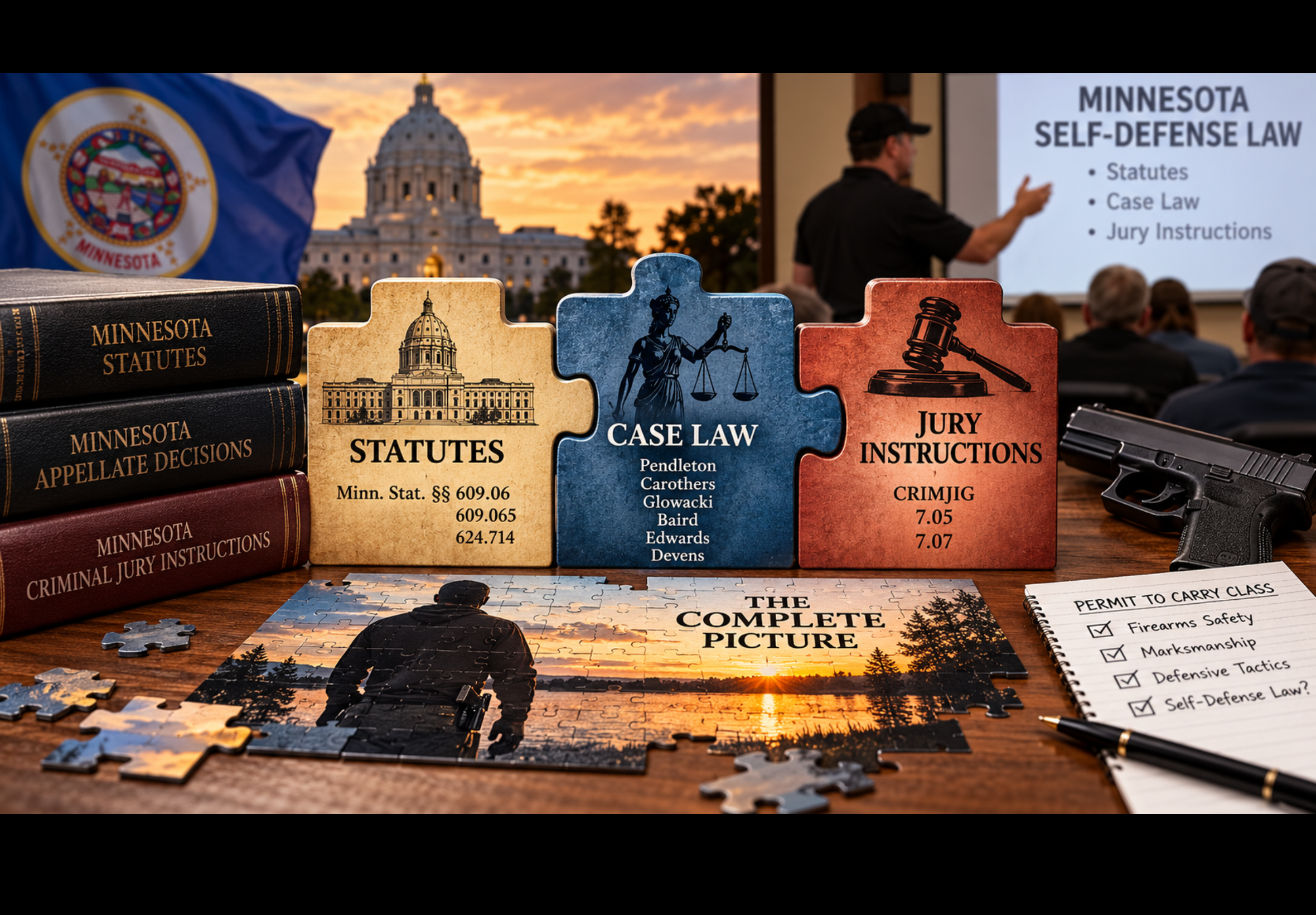
Minnesota self-defense law is not a three-piece puzzle in which each piece carries equal legal authority. The statute establishes the legislative foundation, appellate decisions provide authoritative interpretations and governing legal principles, and jury instructions communicate the applicable law to jurors. Understanding how those three components work together gives us a far more accurate picture than any one component can provide by itself. Leaving out appellate decisions and jury instructions does not make the subject easier to understand. It makes the explanation incomplete, and sometimes dangerously wrong.
The purpose of studying self-defense law is not to memorize enough statutory language to sound knowledgeable at a dinner party or impress a classroom. It is to understand the legal boundaries that govern decisions made under circumstances most people hope they will never experience. An instructor who teaches only the statute may be giving students enough information to recognize the words of the law without giving them enough understanding to recognize its limits. That is not the level of education I would want someone relying upon when the consequences could last the rest of his life.
What you think you know will prevent you from learning what you should know. And when it comes to Minnesota self-defense law, the difference between those two things may be the difference between believing your actions were justified and discovering, in front of twelve jurors, that the law says otherwise.
Citations & sources
Minn. Stat. § 609.06 | https://www.revisor.mn.gov/statutes/cite/609.06 Minn. Stat. § 609.065 | https://www.revisor.mn.gov/statutes/cite/609.065 Minn. Stat. § 624.714, subd. 2a(b)(3) | https://www.revisor.mn.gov/statutes/cite/624.714 State v. Pendleton, 567 N.W.2d 265 (Minn. 1997) State v. Carothers, 594 N.W.2d 897 (Minn. 1999) State v. Glowacki, 630 N.W.2d 392 (Minn. 2001) State v. Baird, 654 N.W.2d 105 (Minn. 2002) State v. Edwards, 717 N.W.2d 405 (Minn. 2006) State v. Devens, 852 N.W.2d 255 (Minn. 2014)