
The AOJ Triad: Three Questions That Can Keep You Out of Trouble
Ability, Opportunity, and Jeopardy: A Practical Framework for Understanding Imminence, Proportionality, and Reasonableness
- Originally published:
- November 14, 2026
- Last modified:
- November 14, 2026
One of the biggest problems with self-defense education is that people are often taught to recognize dangerous situations without spending nearly enough time understanding what makes a threat imminent. There's a considerable difference between recognizing that someone could hurt you and recognizing that someone is about to hurt you. Unfortunately, too many people have convinced themselves that identifying a potential danger is the same thing as establishing a legal justification to use force. It isn't, and that's where a relatively simple three-part framework becomes enormously useful.
Massad Ayoob, one of the most respected educators in defensive use of force, has long taught a concept known as the AOJ Triad. AOJ stands for Ability, Opportunity, and Jeopardy. It's a practical framework for evaluating whether someone presents an immediate threat of death or serious bodily injury. Some law enforcement training uses AOI, substituting Intent for Jeopardy. The terminology differs, but both examine the ability to inflict harm, the opportunity to do so, and observable behavior indicating a threatened attack.
Before going further, there's an important distinction. AOJ is not a universal statutory standard, an independent legal test courts require defendants to pass, or a substitute for controlling self-defense law. It's an educational framework that helps explain Imminence, Proportionality, and, to a lesser extent, Reasonableness. AOJ doesn't automatically justify using force, but it offers a practical way to examine a developing threat. Anyone selling it as a magical three-question test for whether you can legally shoot somebody is selling considerably more certainty than the law provides.
The first component, Ability, asks whether another person possesses the means to cause serious injury or death. That might involve a firearm, knife, baseball bat, or another potentially deadly instrument. Ability can also exist without a weapon, particularly when there's a significant disparity in physical strength or multiple attackers. But possessing the ability to hurt someone doesn't establish that an attack is imminent. Most physically capable adults could injure another person, and fortunately, walking past someone larger than ourselves hasn't yet become a deadly-force emergency.
The second component, Opportunity, asks whether someone is positioned to use that ability against you under the immediate circumstances. A person carrying a baseball bat fifty yards away may be capable of inflicting serious injuries without having the present opportunity to strike you. Distance, barriers, movement, and the surrounding environment all matter. Opportunity isn't simply about measuring feet. It's about understanding what another person can realistically do within the time and space available.
This brings us briefly to the Tueller Drill, developed by Salt Lake City police instructor Dennis Tueller in the early 1980s. His exercises demonstrated that a person could cover approximately 21 feet in about 1.5 seconds, roughly the time trained officers in those exercises needed to draw and fire a handgun. The purpose was to demonstrate how quickly someone armed with a knife or similar contact weapon could close the distance before a defender could react. Unfortunately, some people transformed this exercise into the supposed "21-foot rule," as though deadly force suddenly becomes legally justified at a particular distance. It doesn't. Twenty-one feet isn't a statutory boundary, and the law doesn't change because someone takes another step.
There's another important consideration. The original exercise involved trained police officers, not every person who might confront a violent attacker. Their performance doesn't necessarily represent yours, mine, or that of a seventy-year-old citizen carrying a firearm for protection. Age, physical limitations, reaction time, training, and equipment can influence how quickly someone recognizes and responds to a threat. Someone requiring additional time to respond may reasonably assess Opportunity differently from a person with considerably faster reactions.
That's why understanding your own capabilities matters. A qualified firearms instructor working with you in a controlled range environment may help you evaluate your reaction time and performance. The purpose isn't to establish a personalized legal distance at which deadly force automatically becomes justified. It's to develop a realistic understanding of your abilities and limitations. Knowing your own performance may be considerably more valuable than repeating statistics from an exercise involving somebody else.
There's also a courtroom consideration worth understanding. If you're ever involved in a use of force event, and your knowledge of the Tueller Drill influenced how you perceived the danger, your attorney may need to establish that you possessed that knowledge before the event. Learning about the drill six months afterward doesn't establish that it influenced your decision. You cannot reasonably claim specialized knowledge informed your actions if you didn't possess that knowledge at the time.
Massad Ayoob has emphasized documenting firearms and self-defense education. One method he has recommended involves preparing written training notes, signing and dating them, and mailing them to yourself in a sealed envelope. The postal service provides an independently dated postmark, and you retain the envelope unopened. If those records later become relevant, your attorney may be able to use them to help establish that the materials existed before the use of force event.
You can also document your education by signing and dating relevant passages in books, retaining purchase receipts, keeping training certificates, or preserving dated class notes. A letter to yourself explaining your understanding of the Tueller Drill is another option. None of these methods guarantees that the evidence will be admitted in court, and a postmark doesn't conclusively establish when every word was written. Nevertheless, reliable records created beforehand may help demonstrate what you knew before a use of force event.
The important distinction is that courts decide admissibility under the applicable rules of evidence. A sealed envelope isn't some magical courtroom pass, and an attorney may be able to establish prior knowledge through other evidence. But documentation is generally preferable to expecting a jury to accept an unsupported claim that you understood a specialized training concept years earlier.
The third component, Jeopardy, examines whether someone's observable conduct indicates they're about to use their ability against you. This is closely related to what some law enforcement training calls apparent Intent. Nobody can read minds, so we examine words, movements, behavior, and surrounding circumstances. Someone can possess both Ability and Opportunity without displaying any indication they're about to attack. That's precisely why Jeopardy matters.
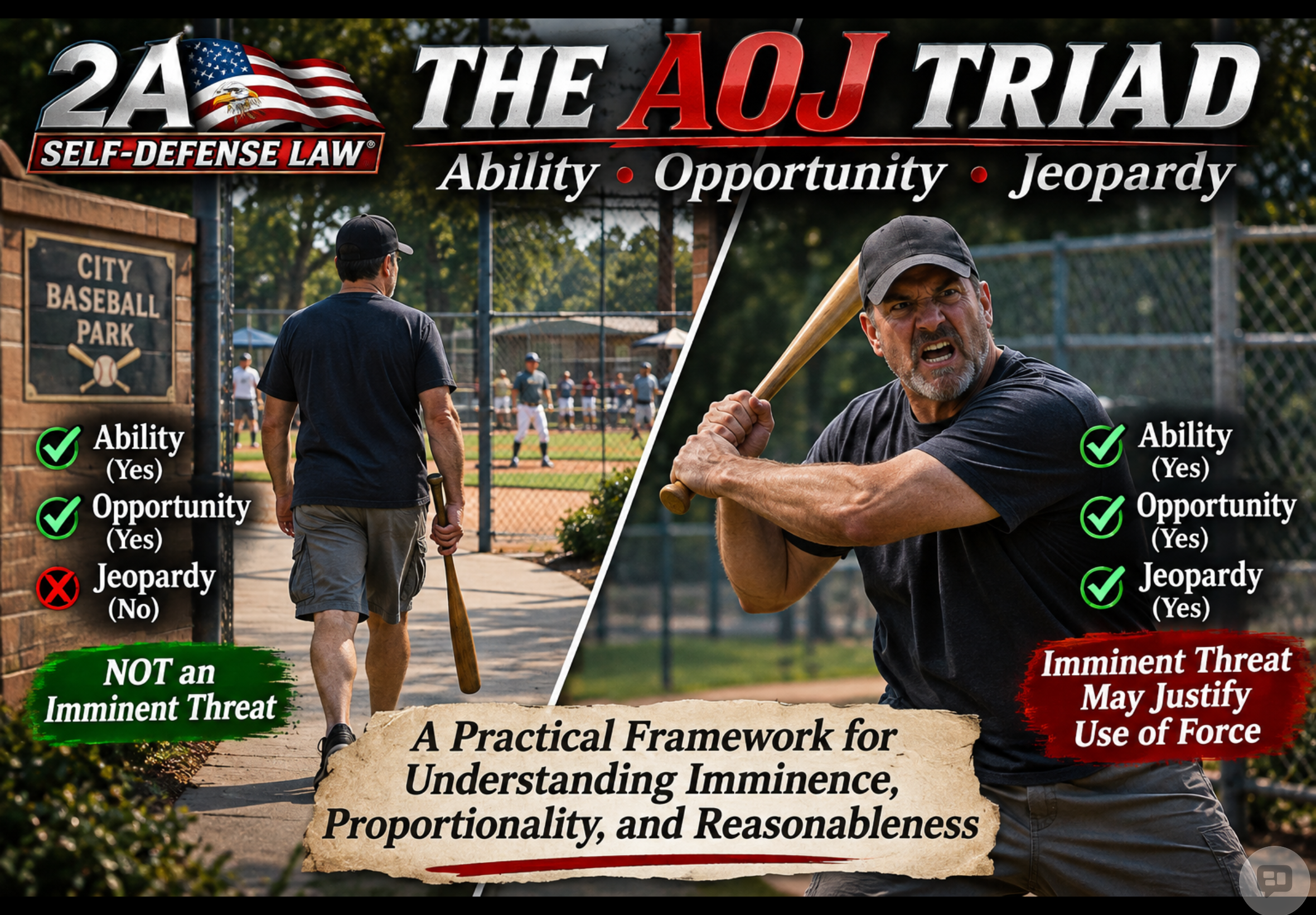
Imagine you're walking through a baseball park on a pleasant Saturday afternoon. People are practicing on one of the diamonds, children are playing nearby, and a man carrying a baseball bat is walking toward you. He's capable of swinging that bat hard enough to cause catastrophic injuries, so there's your Ability. As he approaches, he's close enough to strike you, giving him Opportunity. But he's simply walking toward the batting cages, minding his own business, without displaying any threatening behavior.
Before imagining ourselves in a life-or-death confrontation, perhaps we should acknowledge something painfully obvious. We're standing in a baseball park, and someone is carrying a baseball bat. I realize this may come as a stunning revelation, but people occasionally bring baseball bats to places where baseball is played. It's a peculiar custom that has somehow survived generations. Unless we're planning to classify every Little League parent as a potential deadly threat, perhaps we should examine what the man is doing rather than what he's carrying.
He has Ability and Opportunity, but where's the Jeopardy? There isn't any apparent jeopardy directed toward you. He hasn't threatened you, raised the bat, or behaved as though he's preparing to attack. If merely possessing something capable of causing deadly injuries established an imminent threat, we'd need tactical warnings at Home Depot every time somebody walked out carrying a hammer.
But let's change one detail. Instead of a baseball bat, the man is carrying a tire iron through the baseball park. Now that's a little more interesting. Unless there's some obscure version of baseball I haven't encountered, tire irons generally aren't standard equipment. You might reasonably wonder why he's carrying one between the concession stand and batting cages, although perhaps he just finished changing a flat tire in the parking lot.
A tire iron can cause catastrophic injuries, so Ability exists. If he's close enough, Opportunity exists as well. But what about Jeopardy? Has he threatened you, raised the tire iron, or made an aggressive movement? If not, you've established that someone is carrying an unusual object. Congratulations, you've identified something that doesn't belong in the starting lineup. That doesn't automatically make its owner an imminent deadly threat.
Something being unusual isn't the same thing as something being threatening, and something being threatening isn't automatically the same thing as presenting an imminent deadly threat. Context and conduct matter. A baseball bat at a baseball park is ordinary, while a tire iron is unusual. Neither object, standing alone, establishes that its owner intends to cause serious harm.
Now let's return to our gentleman with the baseball bat. He's approaching you, visibly angry, shouting insults and accusing you of something. His language suggests he missed a promising career as a drill sergeant, and his attitude leaves something to be desired. But he's holding the bat at his side, hasn't threatened to strike you, and hasn't made an aggressive movement. His behavior deserves attention, but being an obnoxious jack hole isn't, by itself, a deadly-force offense.
Now he shouts that he's going to smash your skull, grips the bat with both hands, and advances directly toward you. Suddenly, the analysis changes. He has Ability because the bat can inflict deadly injuries, Opportunity because he's close enough to carry out the attack, and Jeopardy because his words and actions indicate an imminent threat. We're no longer evaluating someone carrying baseball equipment. We're evaluating someone whose conduct suggests he's preparing to use it to cause serious harm.
Notice that you haven't actually been struck. Imminence doesn't necessarily require waiting until the baseball bat is already swinging toward your head. AOJ helps distinguish an impending attack from speculation about something that might happen in the future. Waiting until the bat makes contact with your skull before acknowledging the possibility of serious injury would be a rather unfortunate misunderstanding of the concept.
Suppose the man is thirty yards away, threatening to kill you while waving the bat. He possesses Ability, and his conduct suggests hostile intent, but does he presently have Opportunity? Is he standing still, approaching slowly, or running toward you? Is there a barrier between you? Remember the Tueller Drill and what it demonstrated about reaction time. Thirty yards can become twenty, then ten, remarkably quickly. The question isn't whether someone crossed a predetermined legal boundary, but whether the circumstances provide an immediate opportunity to carry out the threatened attack.
Now he begins running toward you with the bat raised, continuing his threats. His Ability hasn't changed, but his Opportunity is rapidly developing, and his actions provide stronger evidence of Jeopardy. The three components are converging. Apparently, the distinction between someone standing around yelling and someone charging toward you with a raised baseball bat is worth understanding before you're trying to explain it afterward.
Let's change the circumstances once more. The man stops, lowers the bat, apologizes, and walks away. Whatever imminent danger may have existed appears to be ending. He still has Ability and may remain close enough to have Opportunity, but his behavior no longer indicates an impending attack. AOJ helps explain why threats must be evaluated as circumstances change. You don't get to preserve a previous threat in your imagination simply because it would be more convenient to your legal argument.
Suppose instead that he backs away while shouting that he'll find you tomorrow. His statements may constitute criminal threats, but an announced future attack isn't necessarily an imminent attack. Ability and apparent hostile intent don't automatically establish the present Opportunity and Jeopardy associated with an immediate danger. What someone might do tomorrow isn't necessarily what they're about to do today.
Although AOJ primarily helps explain Imminence, it also provides insight into Proportionality. Possessing a baseball bat doesn't automatically establish a deadly threat, but swinging it toward someone's head can present an entirely different danger. The seriousness of the threatened harm matters when evaluating the degree of defensive force, rather than assuming every threatening encounter justifies the same response.
AOJ also contributes to understanding Reasonableness by encouraging people to identify observable circumstances rather than rely solely on subjective fear. What did the person do? How close were they? What were they holding? Did they threaten you, advance, prepare to strike, or retreat? Those observations help explain why someone might reasonably perceive an imminent threat. The law generally expects something more substantial than "I didn't like the way he looked at me."
None of this means AOJ independently determines whether using force is lawful. A situation might appear to satisfy Ability, Opportunity, and Jeopardy while presenting additional legal questions. The framework helps organize the threat assessment without replacing the legal standards courts actually apply. Three conveniently remembered words aren't a substitute for understanding the law.
There's another reason AOJ deserves a place in self-defense education. It can provide a useful framework for discussing a use of force event with your attorney afterward. Your attorney needs to understand what you observed, what you believed was happening, and why you made the decisions you did. AOJ provides a logical way to organize those observations and explain your reasoning from a first-person perspective.
For example, you might explain that you recognized Ability because the man held a baseball bat capable of causing serious injury, perceived Opportunity because he was close enough to strike without an obstacle between you, and perceived Jeopardy because he threatened to kill you, raised the bat, and advanced. That explanation provides your attorney with an organized account of what you perceived and why, rather than simply saying you feared for your life.
Your prior knowledge of the Tueller Drill may also become relevant. If you understood before the use of force event how quickly an attacker could close the distance, and that knowledge influenced your assessment of Opportunity, your attorney may want to establish when and how you learned it. Training records, dated notes, and other documentation may help establish that history.
There's an important qualification. AOJ should never be used to manufacture a justification afterward, fill gaps in memory, or convert uncertainty into convenient certainty. It's a framework for organizing truthful recollections, not creating a rehearsed explanation. Your attorney must evaluate those recollections under the applicable law.
Speaking with your attorney is different from providing a detailed statement to investigators immediately following a use of force event. Stress, injury, and confusion can affect memory and perception, and obtaining legal counsel before providing a detailed account is generally prudent. AOJ can help organize an attorney-client discussion, but it isn't legal advice or a prepared script for investigators.
What I particularly appreciate about AOJ is that it encourages people to move beyond "I was afraid for my life" and explain the observations underlying that fear. What specifically happened, what changed, and what did you reasonably believe was about to occur? These are the kinds of details that help an attorney understand how you assessed Imminence, Proportionality, and Reasonableness.
The baseball park example illustrates why the same person holding the same bat can move from presenting no apparent threat to presenting a potentially imminent deadly threat within seconds. The bat didn't change, but the circumstances did. Understanding that distinction is the real value of AOJ.
AOJ isn't a courtroom test or a magical legal formula. It's a practical teaching tool for recognizing and explaining an imminent threat, and that's considerably more useful than memorizing another slogan that falls apart the moment real life becomes complicated.
Know the law before the law has to know you.